


Welcome to this comprehensive tutorial on TOGAF 10 Phase B: Business Architecture. Whether you are an Enterprise Architect, a business analyst, or a student of systems thinking, understanding how to structure an organization to achieve its strategic goals is fundamental. This article will walk you through the core concepts of Business Architecture, the critical role of Business Capabilities, and how to apply this knowledge using industry-standard tooling.
Defining the Scope of Business Architecture
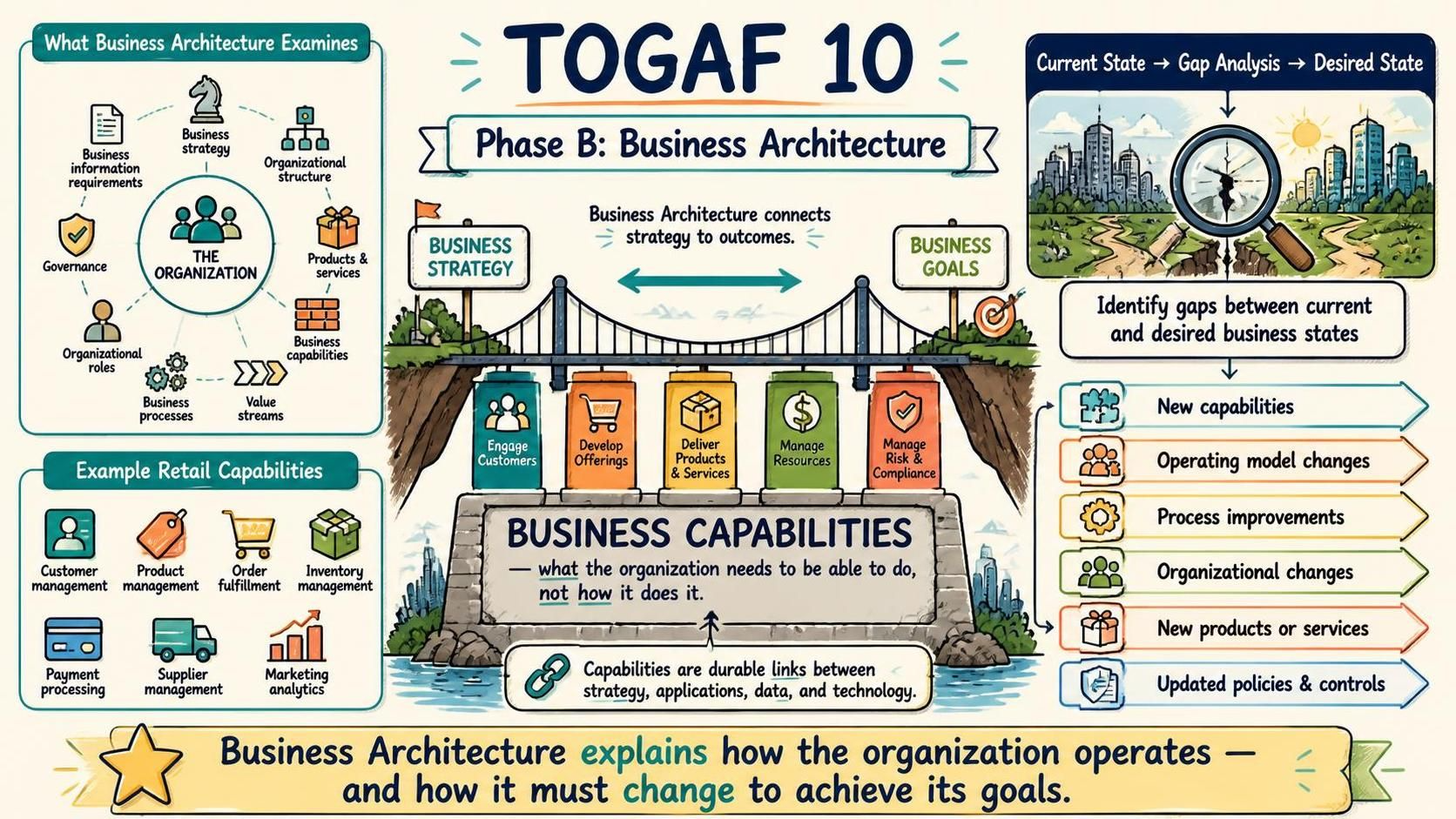
Phase B is not merely about drawing org charts; it is about defining how the organization operates and determining the necessary changes to achieve its goals. The image provided serves as an excellent visual guide to the scope of this phase. To understand the full picture, we must examine the key pillars that Business Architecture touches:
- Business Strategy: The driving force behind all architectural decisions.
- Organizational Structure: How the company is divided and managed.
- Products & Services: The tangible outputs of the business.
- Business Capabilities: The core “what” of the organization.
- Value Streams: The end-to-end activities that deliver value to customers.
- Business Processes: The specific steps taken to execute tasks.
- Organizational Roles: Who is responsible for what.
- Governance & Performance Measures: The controls and metrics for success.
- Business Information Requirements: The data needed to run the business.
The Core Concept: Business Capabilities
Among all the elements listed above, the Business Capability is arguably the most useful and enduring concept in Business Architecture. To truly grasp this, we must distinguish between what an organization does and how it does it.
What is a Business Capability?
A capability describes what an organization needs to be able to do, independent of the specific process or technology used to execute it. It is a stable abstraction. While organizational structures change frequently and business processes are often re-engineered, capabilities tend to remain stable over time.
Example: The Retail Domain
Consider a retail organization. Regardless of whether they sell online or in-store, they need specific capabilities to function. Based on standard architectural frameworks, these capabilities include:
- Customer Management: The ability to manage customer data and relationships.
- Product Management: The ability to define and maintain product catalogs.
- Order Fulfillment: The ability to process and ship customer orders.
- Inventory Management: The ability to track stock levels.
- Payment Processing: The ability to handle financial transactions.
- Supplier Management: The ability to manage vendor relationships.
- Marketing Analytics: The ability to analyze market trends and customer behavior.
Why Capabilities Matter
Capabilities provide a stable way to connect Strategy with Applications, Data, and Technology. Because they are more durable than specific processes, they act as a bridge between the high-level business strategy (the “What”) and the technical implementation (the “How”).
Gap Analysis: From Current State to Desired State
The primary output of Phase B is the identification of gaps between the Current State and the Desired State.
The process typically follows this flow:
- Assess Current State: Analyze the existing capabilities and processes.
- Define Desired State: Look at the Business Strategy and Goals to see where the organization wants to go.
- Perform Gap Analysis: Identify what is missing or what needs improvement.
These gaps lead to specific architectural work, such as:
- Defining New Capabilities.
- Implementing Changes to Operating Models.
- Driving Process Improvements.
- Designing Organizational Changes.
- Launching New Products or Services.
- Updating Policies and Controls.
Recommended Tooling for Business Architecture
To successfully execute Phase B, you need robust modeling tools that support the TOGAF Architecture Development Method (ADM). You need software that allows you to visualize the bridge between strategy and execution.
Visual Paradigm TOGAF ADM Tool is the recommended tooling for this phase. It provides a comprehensive suite for:
- Capability Mapping: Visually map capabilities to business strategies and initiatives.
- Gap Analysis Visualization: Create clear diagrams showing the delta between current and future states.
- Value Stream Modeling: Detail the end-to-end flow of activities.
- Collaboration: Allow stakeholders to review and annotate architecture models in real-time.
Using a tool like Visual Paradigm ensures that your Business Architecture is not just a static document, but a dynamic model that drives decision-making across the enterprise.
Conclusion
Business Architecture is the foundation upon which successful enterprise transformation is built. By focusing on Capabilities rather than just processes, and by utilizing powerful tools like Visual Paradigm, you can ensure a clear path from strategy to execution. Remember, the goal is to explain how the organization operates and how it must change to achieve its goals.
Related posts:
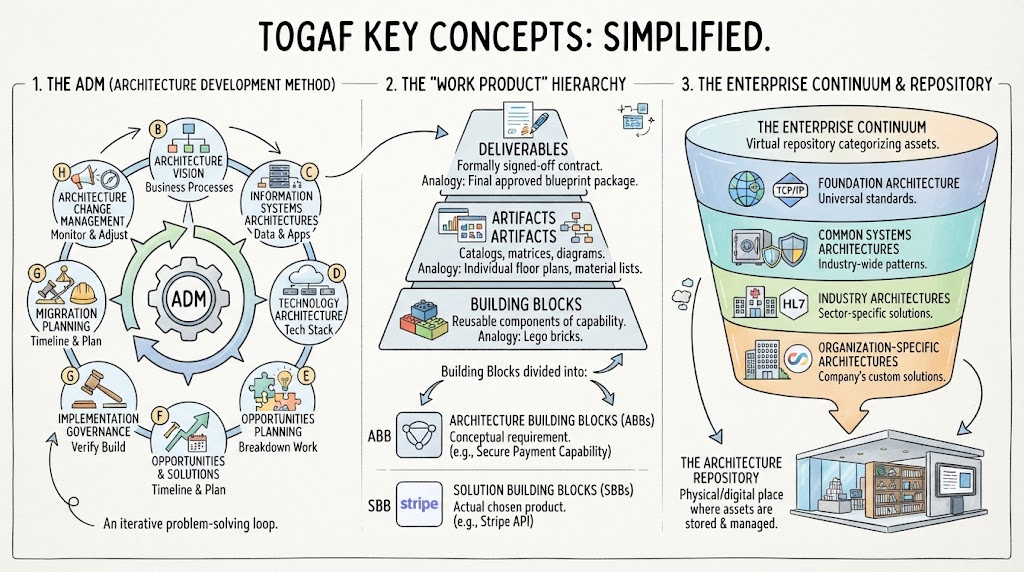 Mastering TOGAF: A Step-by-Step Guide to the ADM Cycle and Enterprise Architecture
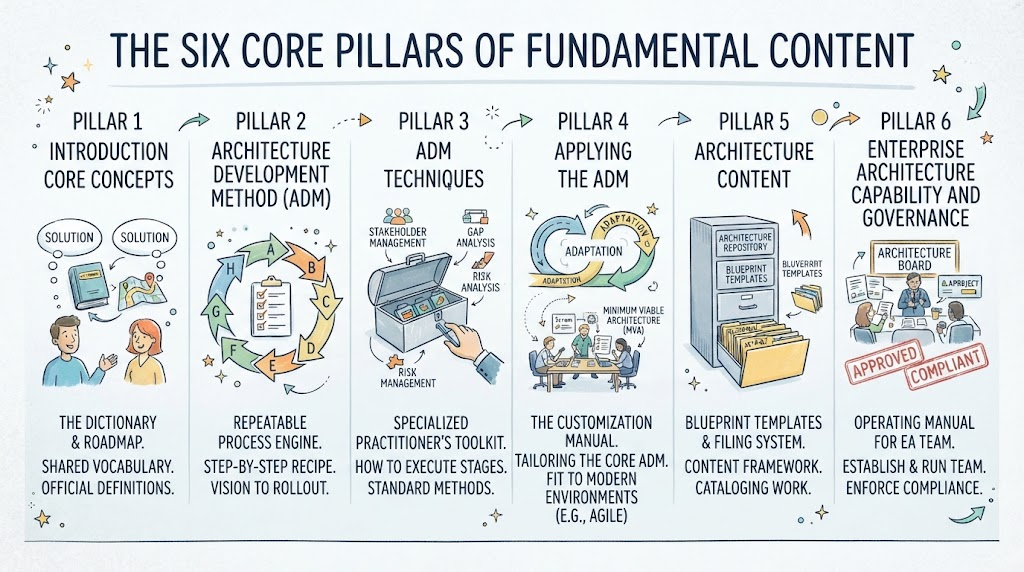 Mastering Enterprise Architecture: A Step-by-Step Guide to the Six Core Pillars of TOGAF
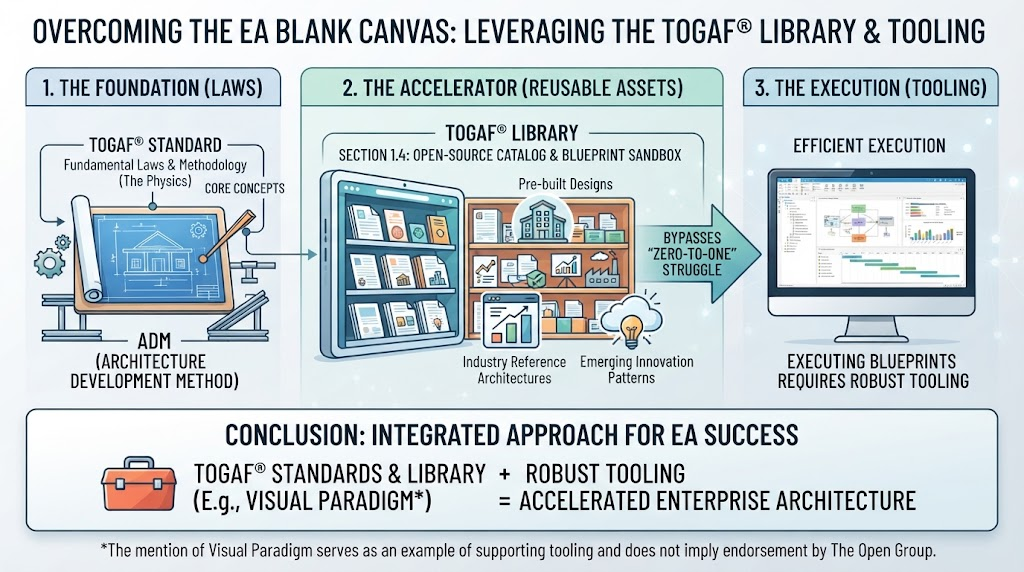 Overcoming the EA Blank Canvas: Leveraging the TOGAF Library & Tooling
 Mastering Phase E: Opportunities & Solutions in Enterprise Architecture