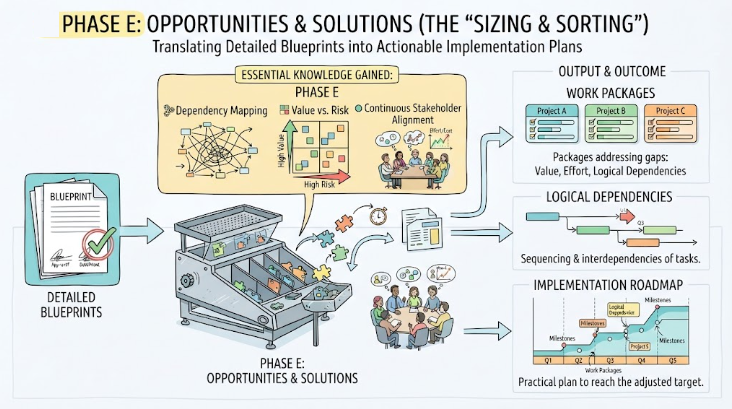
Welcome to the Phase E: Opportunities & Solutions tutorial. In the world of Enterprise Architecture (EA), this phase is often considered the bridge between “what we want” and “how we get there.” It is the pivotal moment where abstract blueprints are translated into concrete, actionable implementation plans. This tutorial will guide you through the mechanics of the TOGAF Architecture Development Method (ADM) Cycle, specifically focusing on the “Sizing & Sorting” process.
The Core Mission: From Blueprints to Implementation
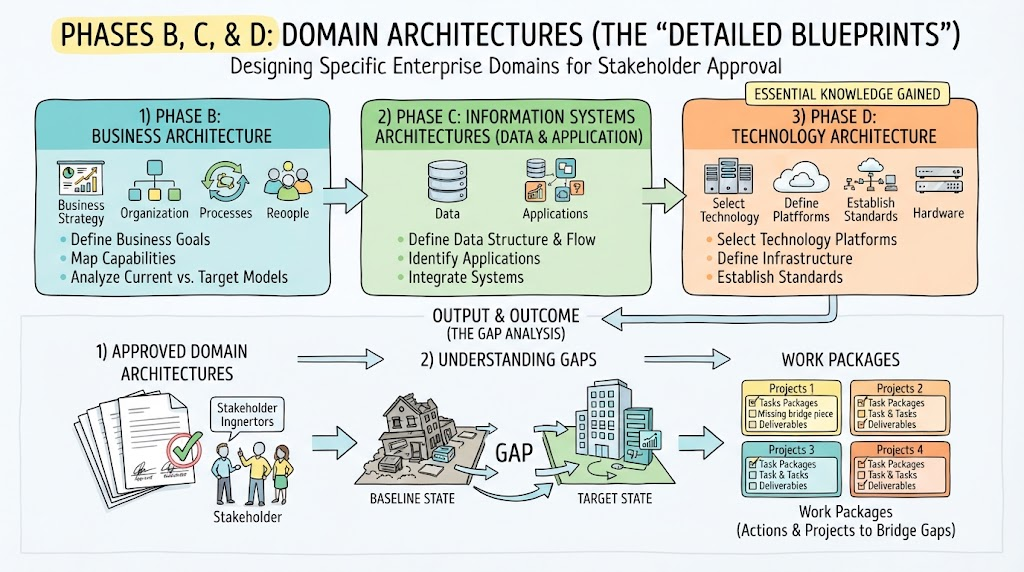
Phase E is the first phase directly concerned with implementation. In the preceding phases (A through D), you have spent your time defining the architecture vision, business architecture, information systems architecture, and technology architecture. You now possess “Detailed Blueprints.”
However, blueprints are theoretical. Phase E is the reality check. It asks the critical question: What is the best practical way to construct the solution given our constraints? This involves “Sizing” the work and “Sorting” the priorities to create a viable roadmap.
Essential Knowledge Gained
As you navigate Phase E, you are expected to derive three specific insights that are crucial for decision-making:
1. Dependency Mapping
Understanding the technical and business dependencies between work packages is vital. You must determine if Task B can happen without Task A. Visualizing these relationships helps prevent bottlenecks where a project is stalled because a prerequisite has not been delivered.
2. Value vs. Risk Analysis
Not all solutions are created equal. This phase requires you to evaluate every proposed change based on a matrix of Value, Effort, and Risk. By plotting these factors, you can identify “quick wins” (high value, low effort) versus “boiling frogs” (high risk, high effort) and make informed choices on where to allocate resources.
3. Continuous Stakeholder Alignment
This is not a linear process but a feedback loop. As you introduce real-world constraints—such as budget limits, technical debt, or timeline risks—you must observe how stakeholder priorities adjust. The goal is to reach a consensus on an Adjusted Target.
The Output: Work Packages & Logical Dependencies
The tangible result of Phase E is a set of Work Packages. These are not just random tasks; they are logical groupings of activities designed to address specific identified gaps in your architecture. A robust work package definition includes:
- Expected Value: The business benefit derived from completion.
- Effort Required: The resources (time, money, people) needed.
- Logical Dependencies: The sequencing of tasks required to reach the target.
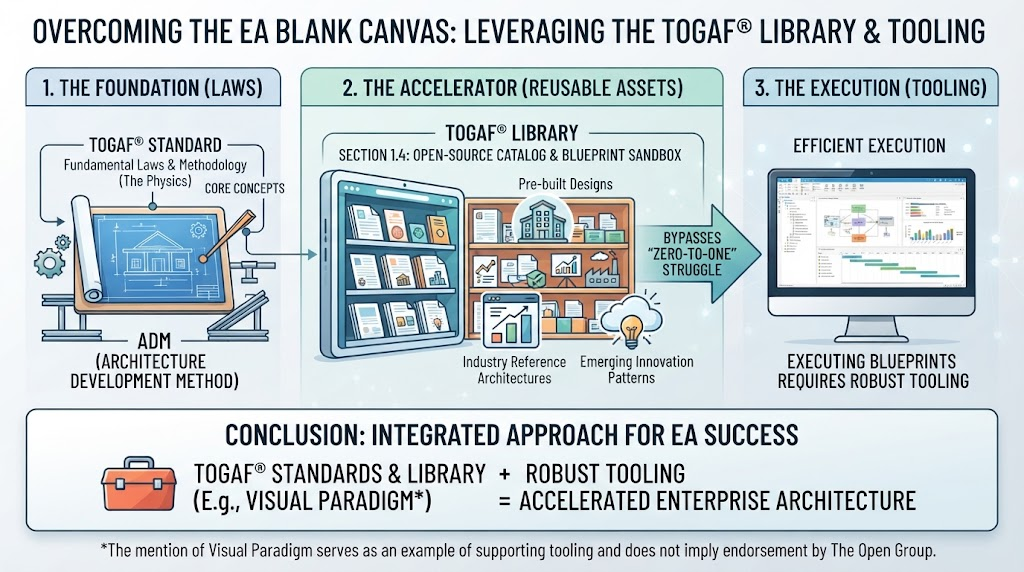
Recommended Tooling: Visual Paradigm + TOGAF ADM + ArchiMate
To effectively execute Phase E, you need tools that can handle complex mapping and visualization. The combination of Visual Paradigm (VP), the TOGAF ADM framework, and ArchiMate modeling language provides a powerful ecosystem for this process.
How These Tools Assist the EA Process
1. Visual Paradigm for TOGAF ADM Management
Visual Paradigm allows architects to manage the entire ADM lifecycle. For Phase E specifically, VP’s “Project Management” features enable you to break down the Architecture Definition Document into specific work packages. You can assign effort estimates and track dependencies directly within the tool, ensuring that the “Sizing” aspect of the phase is accurate.
2. ArchiMate for Visualizing Dependencies
To solve the “Dependency Mapping” challenge, ArchiMate is the industry standard. In Visual Paradigm, you can model your Business, Application, and Technology layers using ArchiMate. By drawing relationship lines (such as realization, aggregation, or dependency) between elements, you create a visual map of the logical dependencies. This directly supports the requirement to understand how work packages interact.
3. The Value vs. Risk Matrix
Visual Paradigm offers reporting and diagramming capabilities that allow you to export your work packages into a matrix view. You can tag specific work packages with metadata regarding their risk profile and effort level. This data can then be visualized in a dashboard, helping stakeholders see the trade-offs clearly.
Conclusion
Phase E is the engine room of the TOGAF ADM cycle. It transforms the “Ideal State” defined in earlier phases into a “Realistic Plan.” By leveraging the power of dependency mapping and utilizing advanced tooling like Visual Paradigm with ArchiMate, architects can ensure that the resulting implementation roadmap is not just a dream, but a practical, achievable reality.