


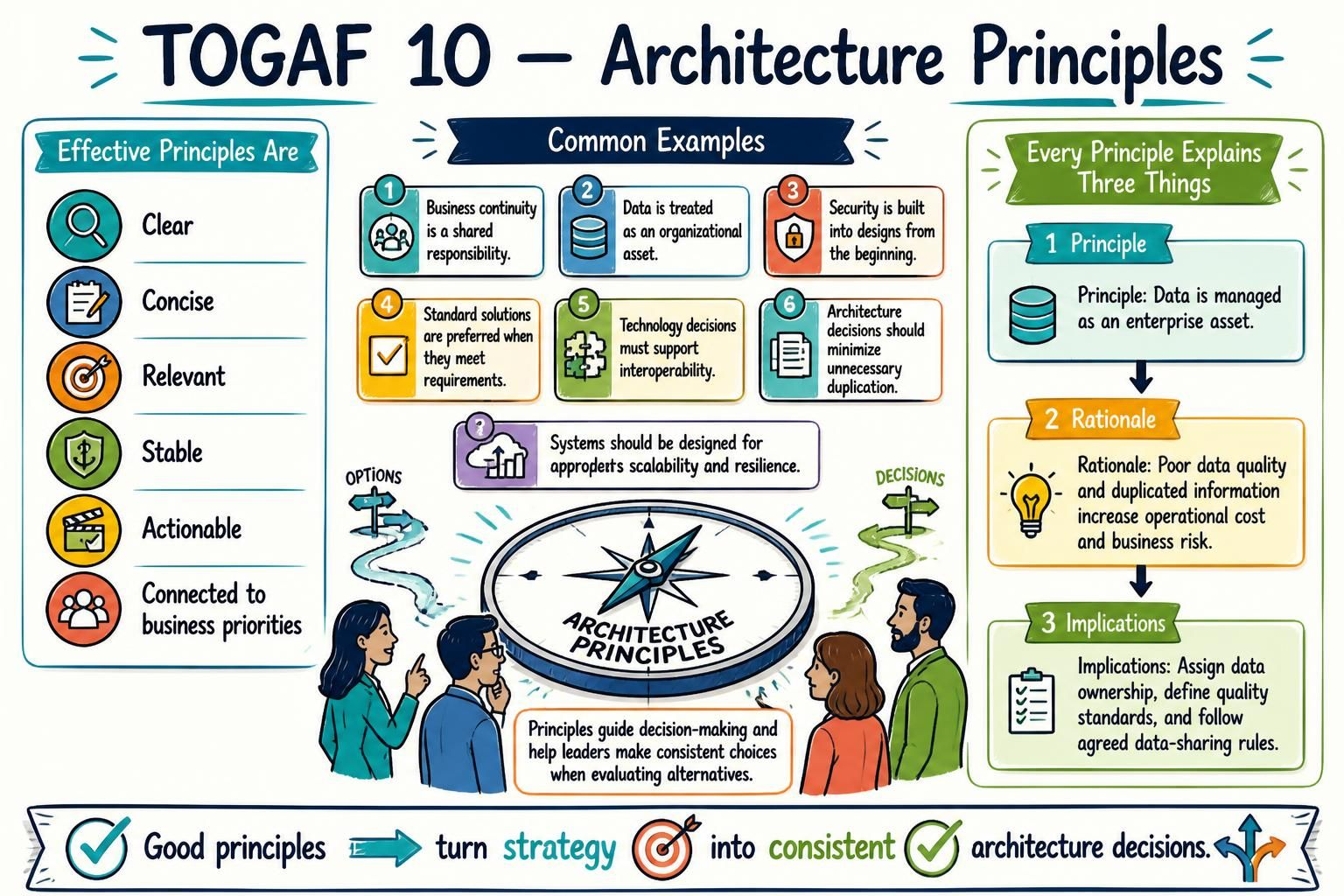
In the complex landscape of Enterprise Architecture, how do we ensure that decisions made today align with business strategy tomorrow? The answer lies in the foundation of TOGAF 10: Architecture Principles. This tutorial will walk you through the definition, characteristics, and practical application of principles, transforming abstract strategy into actionable design choices.
What Are Architecture Principles?
Architecture principles act as the compass for an organization’s technical journey. They are fundamental guidelines that guide decision-making. Without them, architects and leaders are left making isolated choices that may contradict one another. Effective principles help stakeholders make consistent choices when evaluating alternatives.
Think of principles as the bridge between high-level strategy and technical execution. They ensure that the “Why” (strategy) informs the “How” (architecture).
The Anatomy of a Strong Principle
Not every statement is a valid architecture principle. To be effective, a principle must possess specific qualities. As illustrated in the TOGAF framework, there are six key attributes of effective principles:
- Clear: The statement must be easily understood by all stakeholders, avoiding technical jargon where possible.
- Concise: It should be brief and to the point, usually a single sentence.
- Relevant: It must address the specific needs and context of the enterprise.
- Stable: It should remain valid over a reasonable period, not changing with every new technology trend.
- Actionable: It must provide a basis for actual decision-making and enforcement.
- Connected to business priorities: It must directly support the goals of the organization.
Common Examples in Practice
To understand how these principles look in the real world, let’s examine common examples used in enterprise architecture:
- Business continuity is a shared responsibility. This principle ensures that risk management is not siloed but distributed across the organization.
- Data is treated as an organizational asset. This elevates data from a byproduct of IT to a strategic resource that must be managed.
- Security is built into designs from the beginning. Often called “Security by Design,” this prevents vulnerabilities from being patched in later.
- Standard solutions are preferred when they meet requirements. This promotes standardization and reduces complexity.
- Technology decisions must support interoperability. This ensures systems can communicate effectively.
- Architecture decisions should minimize unnecessary duplication. This drives efficiency and cost reduction.
- Systems should be designed for appropriate scalability and resilience. This ensures the system can grow and withstand failure.
The Three-Part Structure: Principle, Rationale, and Implications
A well-documented principle is not just a slogan; it is a structured statement comprising three distinct parts. Every principle must explain:
- The Principle: The statement itself.
- The Rationale: The “Why” behind the principle. This explains the business drivers or risks being mitigated.
- The Implications: The “So What?” or the specific requirements and constraints that result from the principle.
Case Study: Data Management
Let’s break down a specific example to see how these three parts interact:
1. The Principle
Data is managed as an enterprise asset.
2. The Rationale
Poor data quality and duplicated information increase operational cost and business risk. (This explains why we need the rule).
3. The Implications
Data ownership must be assigned, quality standards must be defined, and systems must follow agreed data-sharing rules. (This tells the architects what they must actually do to comply).
Visualizing and Managing Principles
While the concepts above are theoretical, applying them requires structured tools. To effectively document, manage, and visualize these principles within the TOGAF ADM (Architecture Development Method), organizations rely on robust modeling software.
For this tutorial, we recommend using Visual Paradigm TOGAF ADM Tool. This software is specifically designed to handle the complexities of the TOGAF standard. It allows architects to:
- Create formal Principle Registers to track the status of each principle (e.g., Draft, Approved, Implemented).
- Link principles directly to specific architecture artifacts and requirements.
- Visualize the relationships between strategy and architecture.
- Generate comprehensive reports for stakeholder review.
Conclusion
Good principles turn strategy into consistent architecture decisions. By defining clear, actionable, and well-justified principles, you create a stable environment where technology investments are optimized for business value. Whether you are mapping out a new system or auditing an existing one, remember that your principles are the rules that guide your design.
Related posts:
 Mastering TOGAF: A Step-by-Step Guide to the ADM Cycle and Enterprise Architecture
 Overcoming the EA Blank Canvas: Leveraging the TOGAF Library & Tooling
 Mastering Phase E: Opportunities & Solutions in Enterprise Architecture
 Mastering TOGAF Phase B: Business Architecture and the Power of Business Capabilities