


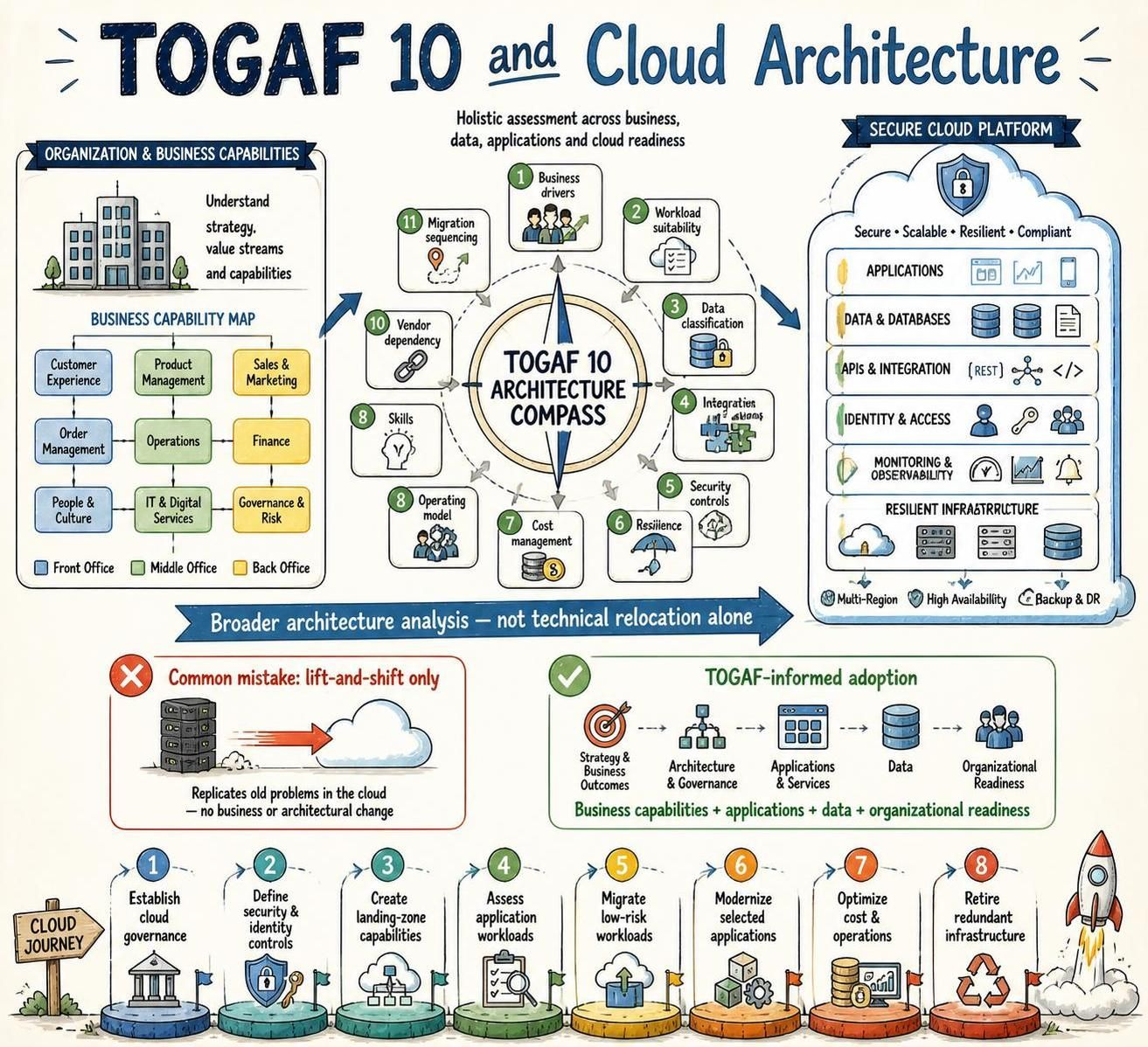
Moving to the cloud is often mistaken for a simple technical relocation—a process of lifting and shifting servers from on-premise data centers to a public cloud provider. However, true digital transformation requires a far deeper strategic approach. TOGAF 10 (The Open Group Architecture Framework) provides the compass necessary to navigate this complexity, ensuring that cloud adoption aligns with business strategy, security requirements, and operational readiness.
This tutorial explores the “TOGAF 10 Architecture Compass,” a conceptual model that guides organizations through a holistic assessment of their cloud journey. We will break down the critical dimensions of this framework, the “Secure Cloud Platform” target state, and the step-by-step roadmap for successful adoption.
The Core Philosophy: Beyond Technical Relocation
The most common pitfall in cloud adoption is treating it as a purely technical exercise. As highlighted in the framework, a “lift-and-shift” strategy often replicates old problems in the cloud environment without addressing the underlying business or architectural flaws.
TOGAF 10 encourages a broader architecture analysis that integrates:
- Business Capabilities: Understanding the value streams and the organization’s strategic goals.
- Application Dependencies: Mapping how services interact.
- Data Requirements: Ensuring classification and governance are met.
- Organizational Readiness: Assessing skills and culture.
By utilizing a holistic assessment, architects can ensure the cloud supports business drivers rather than just hosting IT infrastructure.
Decoding the TOGAF 10 Architecture Compass
The central element of this framework is the “Compass,” which directs attention to 11 critical factors that must be evaluated before and during migration. These factors cover the spectrum from business drivers to technical constraints.
1. Strategic & Business Drivers
Business Drivers (1): Why are we moving? Are we looking for cost savings, speed to market, or innovation? The architecture must be driven by these outcomes.
2. Technical Suitability
Workload Suitability (2): Not every application is cloud-native. A cloud architecture initiative must determine which workloads are suitable for the cloud and which require refactoring.
Data Classification (3): Understanding the sensitivity of data is paramount. Data must be classified to ensure the correct storage tiers and security protocols are applied.
Integration Requirements (4): How will the new cloud applications talk to legacy systems? APIs and integration patterns must be defined early.
3. Operational & Security Controls
Security Controls (5): Security cannot be an afterthought. It must be embedded into the architecture design to ensure compliance and safety.
Resilience (6): The cloud must offer higher availability than on-premise setups. Designing for multi-region and disaster recovery is essential.
Cost Management (7): Cloud costs can spiral if not managed. Architecture decisions must include FinOps principles and cost-optimization strategies.
4. Organizational & Environmental Factors
Operating Model (8): How will the IT team operate? A shift to DevOps or SRE (Site Reliability Engineering) models is often required.
Skills (9): Do the staff have the necessary skills to manage cloud infrastructure?
Vendor Dependency (10): Architects must assess the risk of lock-in and ensure portability.
Migration Sequencing (11): The order of operations is critical. A phased approach ensures stability.
Designing the Target State: The Secure Cloud Platform
The ultimate goal of this architecture is a Secure Cloud Platform that is Scalable, Resilient, and Compliant. The framework breaks this target state down into specific architectural layers:
- Applications: The business-facing software and user interfaces.
- Data & Databases: Structured and unstructured data storage, ensuring proper classification.
- APIs & Integration: The middleware layer connecting services (REST, SOAP, etc.).
- Identity & Access: Managing who can access what, using robust identity providers.
- Monitoring & Observability: Ensuring visibility into system health and performance.
- Resilient Infrastructure: The foundational layer ensuring High Availability, Multi-Region support, and Backup & DR.
The Cloud Journey: A Step-by-Step Roadmap
Based on the TOGAF framework, a successful cloud roadmap follows a logical progression. It is not a “big bang” migration but a series of strategic milestones.
- Establish Cloud Governance: Define the rules of engagement, policies, and guardrails.
- Define Security & Identity Controls: Set up the foundational security posture and access management.
- Create Landing-Zone Capabilities: Build the secure, networked environment where workloads will run.
- Assess Application Workloads: Analyze the portfolio to decide what to refactor, rehost, or retire.
- Migrate Low-Risk Workloads: Start with non-critical applications to build confidence and experience.
- Modernize Selected Applications: Refactor critical applications to leverage cloud-native features.
- Optimize Cost & Operations: Continuously tune resources to ensure efficiency and value.
- Retire Redundant Infrastructure: Decommission legacy on-premise systems to realize cost savings.
Recommended Tooling: Visual Paradigm TOGAF ADM Tool
To effectively model and visualize these complex architectural concepts, architects require robust tooling. While TOGAF is a methodology, the visual representation is key to stakeholder communication.
Visual Paradigm’s TOGAF ADM Tool is a highly recommended solution for this process. It provides a comprehensive environment to manage the Architecture Development Method (ADM) cycles. With Visual Paradigm, teams can:
- Model the “Compass”: Create detailed diagrams that map the 11 critical factors and their interdependencies.
- Visualize the Roadmap: Use Gantt charts and process flow diagrams to plan the cloud journey phases.
- Manage Requirements: Link business drivers directly to technical requirements and security controls.
- Collaborate: Enable real-time collaboration between business stakeholders and technical architects.
By integrating Visual Paradigm into your workflow, you transform the theoretical concepts of TOGAF 10 into actionable, visual blueprints that drive successful cloud transformation.
Conclusion
Cloud architecture is not just about technology; it is about business alignment. By following the TOGAF 10 Architecture Compass, organizations can avoid common pitfalls like “lift-and-shift” failures and instead build a secure, scalable, and cost-effective cloud environment that truly drives business value.
Related posts:
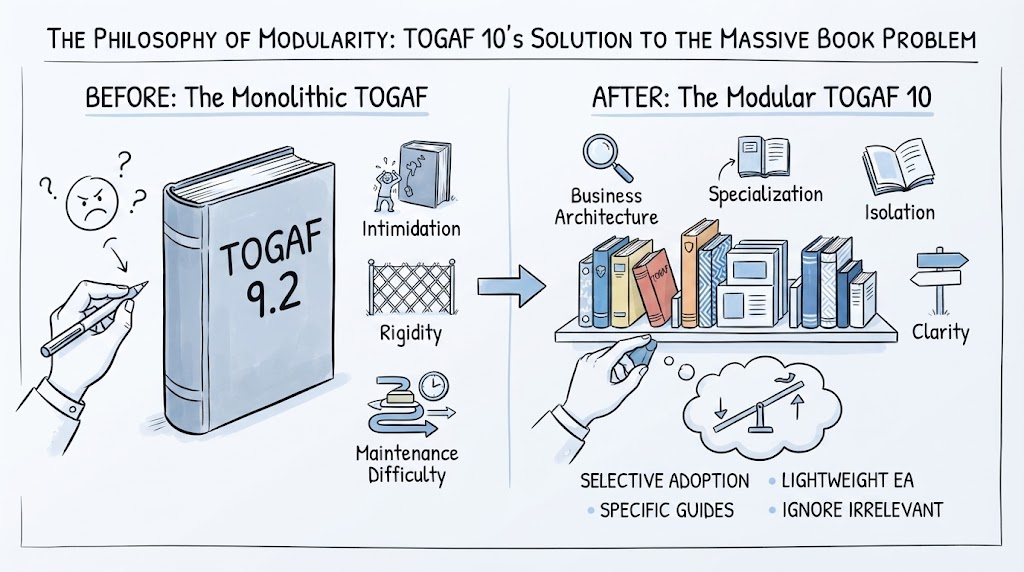 Mastering Modularity: How TOGAF 10 Solves the “Massive Book Problem” with Strategic Flexibility
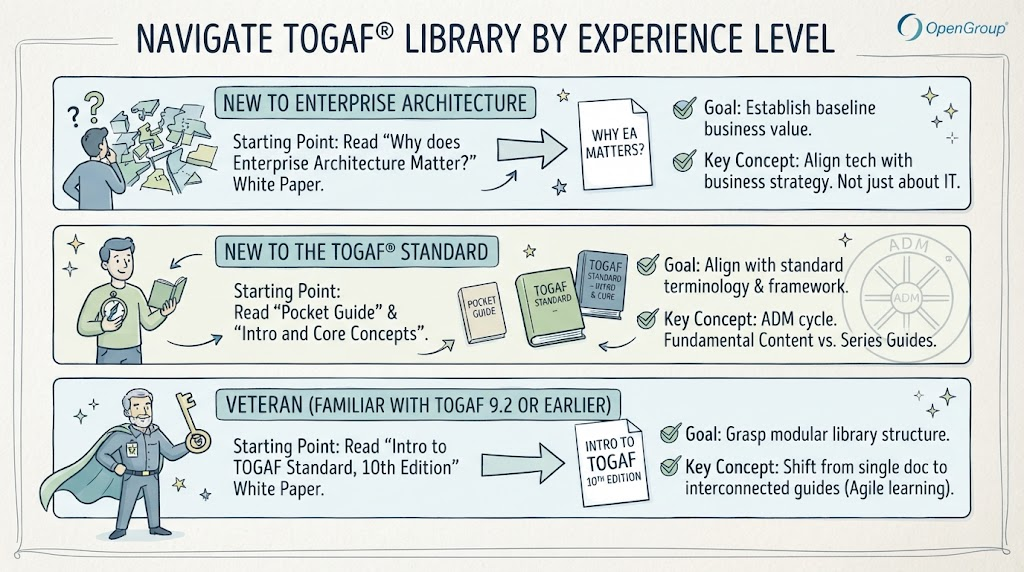 Navigating the TOGAF® Library: A Tiered Approach to Enterprise Architecture Mastery
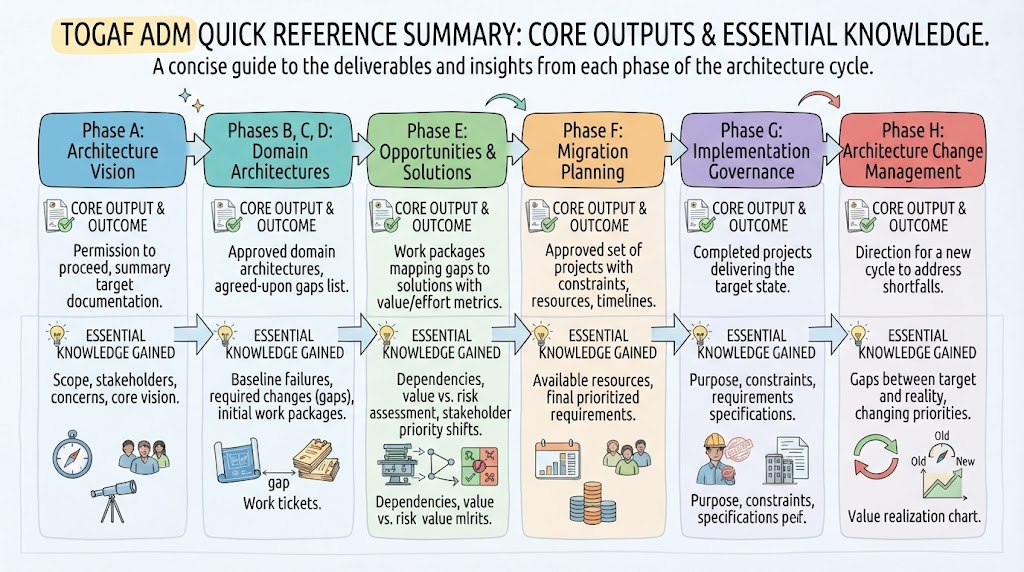 Mastering the TOGAF ADM Cycle: A Visual Guide to Architecture Outputs and Outcomes
 Accelerating Enterprise Architecture: Why Visual Paradigm is the Ideal Companion for TOGAF 10