


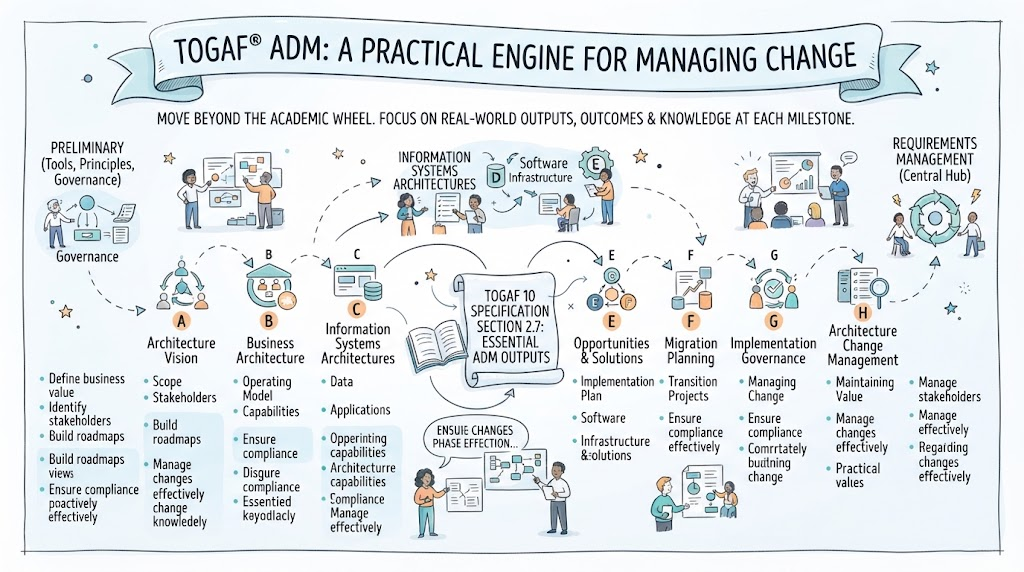
In the complex world of Enterprise Architecture (EA), the TOGAF Architecture Development Method (ADM) serves as the compass. It provides a structured, iterative approach to building enterprise architectures that align with business needs. However, navigating the eight phases of the ADM can be daunting. This tutorial breaks down the lifecycle into manageable steps, focusing on the tangible Core Outputs (what you deliver) and the Essential Knowledge (what you must understand) for each stage.
The TOGAF Lifecycle: From Vision to Value
The ADM is not a linear checklist but a cycle. As you progress through the phases, you refine your understanding of the business and the technology required to support it. Let’s walk through the cycle step-by-step.
Phase A: Architecture Vision
The journey begins with the big picture. Before any detailed design work starts, the architect must secure a mandate to proceed. Phase A is about defining the scope, identifying the key stakeholders, and understanding their concerns. The primary goal is to produce a high-level summary of the target state.
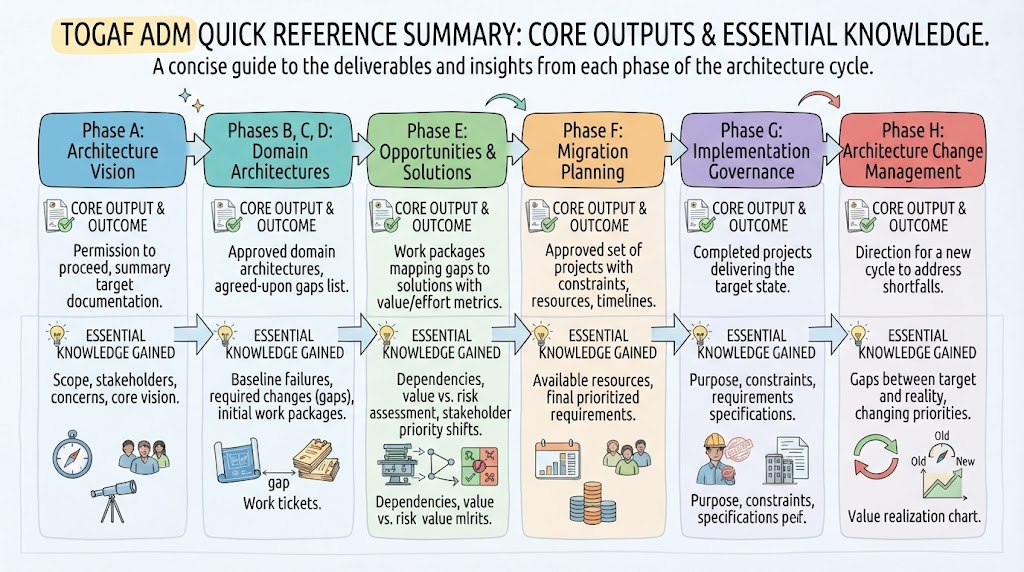
- Core Output & Outcome: You deliver the Architecture Vision. This is essentially a permission slip to continue and sufficient documentation to prove the feasibility of the project’s summary target.
- Essential Knowledge Gained: You must understand the scope of the problem, who the stakeholders are, their specific concerns, and the core vision that will guide the project.
Phases B, C, and D: Domain Architectures
Once the vision is approved, we dive into the details. These phases focus on the specific domains of the enterprise:
- Phase B (Business Architecture): Defining the business strategy, governance, organization, and key business processes.
- Phase C (Information Systems Architectures): Split into Data Architecture (information assets) and Application Architecture (applications).
- Phase D (Technology Architecture): Defining the hardware, software, and network infrastructure.
The culmination of these three phases is the creation of Approved Domain Architectures. You must identify the gaps between the current state (Baseline) and the future state (Target).
- Core Output & Outcome: An agreed-upon list of gaps and approved domain architectures.
- Essential Knowledge Gained: You must understand baseline failures, exactly what needs to change (the Gaps), and the initial work packages required to fix them.
Phase E: Opportunities & Solutions
Now that we know what needs to change, we must decide how to do it. Phase E is about strategy and solution selection. It involves mapping the identified gaps to specific solutions.
- Core Output & Outcome: A set of Work Packages. These packages map gaps to solutions, complete with metrics for value and effort.
- Essential Knowledge Gained: You must understand the dependencies between work packages, perform value vs. risk assessments, and adjust stakeholder priorities based on these findings.
Phase F: Migration Planning
This phase transforms the strategic work packages into an actionable plan. It involves planning the implementation of the architecture, ensuring that resources are available and constraints are defined.
- Core Output & Outcome: An approved set of projects with clear constraints, resources, and timelines.
- Essential Knowledge Gained: You must understand the availability of resources and the final, prioritized stakeholder requirements that drive the schedule.
Phase G: Implementation Governance
With the plan in place, the build begins. Phase G is about governance. It ensures that the actual construction of the system aligns with the architecture. If the project deviates from the target, this phase identifies the variances.
- Core Output & Outcome: Completed projects that successfully deliver the target state.
- Essential Knowledge Gained: You must understand the purpose, constraints, and requirements specifications that are guiding the build team on the ground.
Phase H: Architecture Change Management
The cycle does not end with the delivery. Phase H looks at the realized value. It compares the target design against the actual value realized. If the reality does not match the target, or if stakeholder priorities have shifted, the cycle restarts.
- Core Output & Outcome: Direction to proceed with a new cycle of architecture to address shortfalls.
- Essential Knowledge Gained: You must understand the gaps between the target design and actual value realization, as well as any changes in stakeholder priorities.
Recommended Tooling: Visual Paradigm + TOGAF ADM + ArchiMate
To effectively manage this complex cycle, architects require robust tooling that supports the visual nature of Enterprise Architecture. The combination of Visual Paradigm, the TOGAF ADM methodology, and ArchiMate modeling language offers a powerful ecosystem for EA.
1. Visual Paradigm for TOGAF ADM
Visual Paradigm provides a comprehensive platform that automates the documentation process inherent in the ADM. Instead of manually creating Word documents or Excel sheets for each phase, the tool enforces the structure of the ADM.
- Automated Reporting: As you build the architecture in the tool, Visual Paradigm automatically generates the required reports for Phase A (Vision) or Phase F (Migration Planning), ensuring consistency.
- Work Package Management: The tool allows architects to create and manage Work Packages (Phase E) directly linked to the architecture elements, making it easy to track progress and dependencies.
2. ArchiMate for Semantic Clarity
ArchiMate is the standard modeling language for enterprise architecture. It provides a common vocabulary to describe, analyze, and visualize the relationships between business, application, and technology layers.
- Gap Analysis Visualization: In Phases B, C, and D, ArchiMate diagrams make it easy to visually represent the “Baseline” and “Target” states, clearly highlighting the gaps that need to be filled.
- Impact Analysis: By using ArchiMate’s relationship types, architects can trace how a change in a business process (Phase B) impacts the underlying application or technology stack (Phase C/D), ensuring that the “Essential Knowledge” regarding dependencies is accurate.
3. The Synergy: Visual Paradigm + TOGAF + ArchiMate
When integrated, these three elements create a seamless workflow:
- Define: Use the TOGAF ADM guide within Visual Paradigm to structure your project.
- Model: Use ArchiMate diagrams to visualize the architecture, capturing the “Core Outputs” like work packages and domain architectures.
- Analyze: Use the tool’s analysis features to calculate gaps and value metrics (Phase E).
- Report: Generate the final documentation and migration plans (Phase F/H) directly from the model.
By leveraging this stack, architects move beyond static documentation to dynamic, living models that drive the enterprise architecture process from the initial Vision to the final Value Realization.
Related posts:
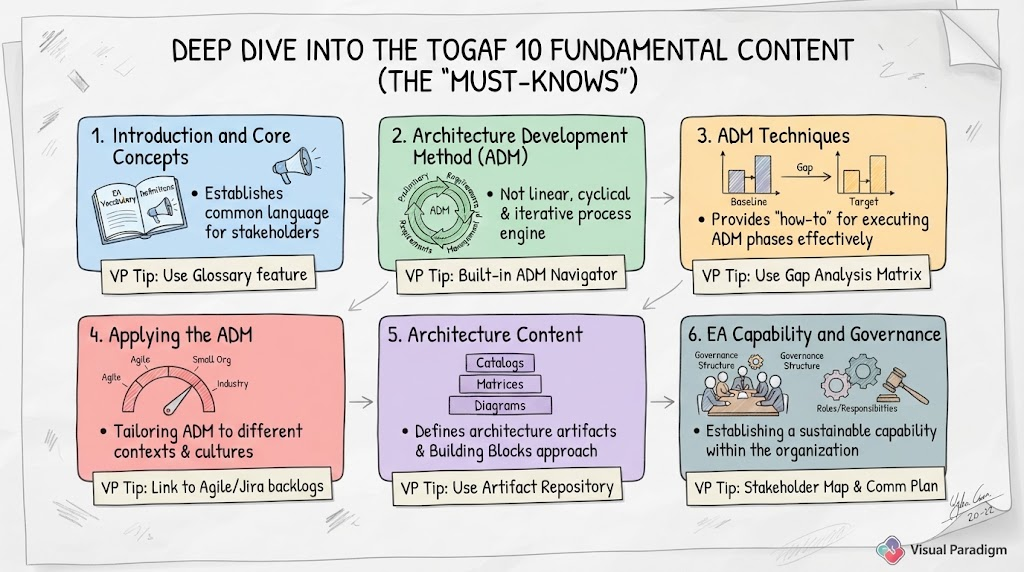 Mastering TOGAF 10: A Step-by-Step Guide to the Six Fundamental Content Pillars
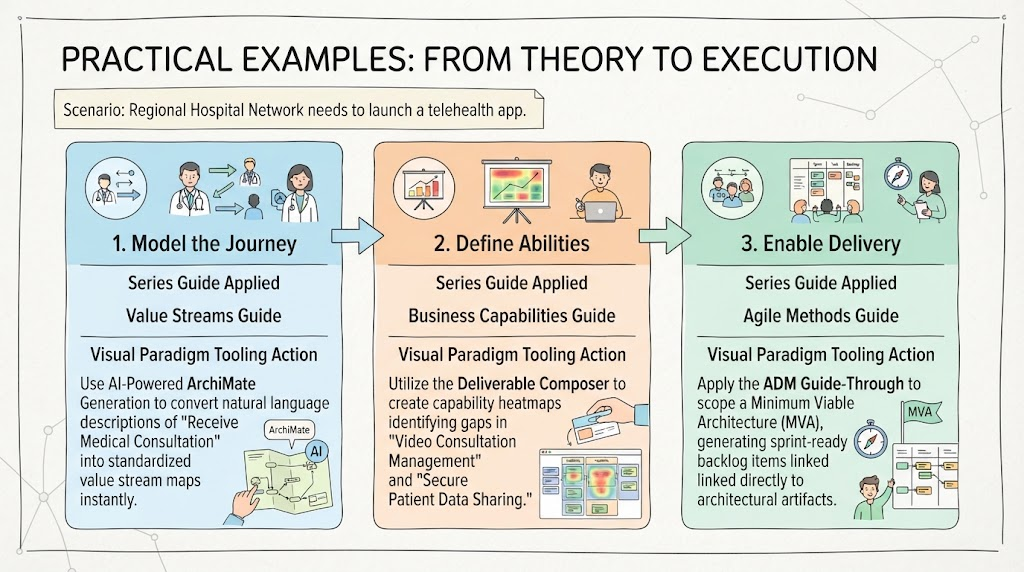 From Theory to Execution: A Practical Guide to Enterprise Architecture with Visual Paradigm
 Mastering the TOGAF Preliminary Phase with Visual Paradigm and ArchiMate
 Mastering the TOGAF ADM: A Practical Engine for Managing Change