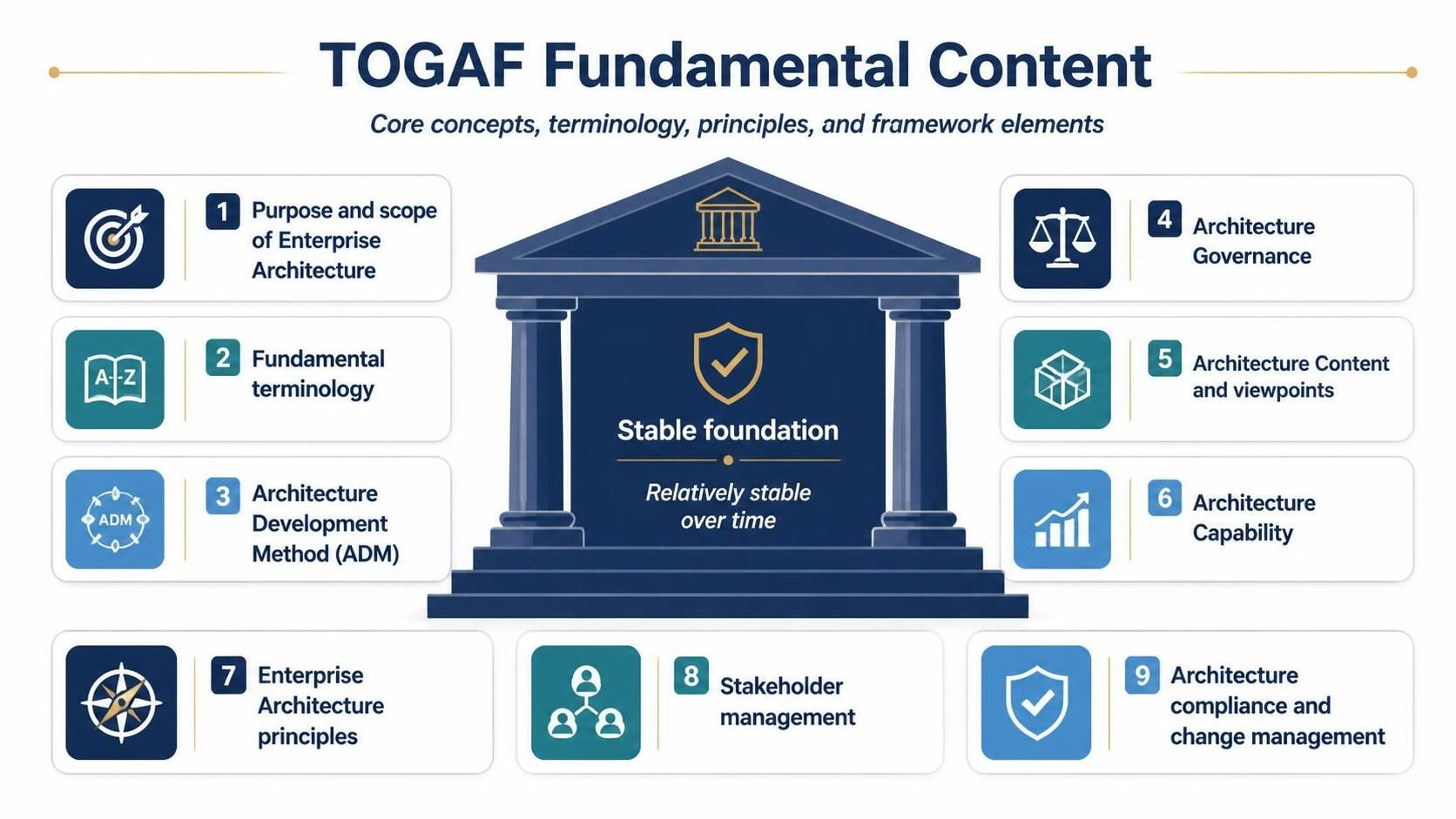
Enterprise Architecture (EA) can often feel like navigating a complex labyrinth of acronyms and abstract concepts. However, the TOGAF (The Open Group Architecture Framework) standard offers a structured approach to demystify these complexities. At the very heart of this framework lies the Fundamental Content, which acts as the stable foundation upon which all other architectural work is built.
In this tutorial, we will walk through the core pillars of the TOGAF Fundamental Content, breaking down what each element means, why it matters, and how they interconnect to support robust enterprise transformation.
Understanding the “Stable Foundation”
Imagine an Enterprise Architecture framework as a grand building. While the specific details of the building—the rooms, the furniture, and the specific technologies used—might change over time to meet new business needs, the foundation must remain solid and relatively unchanging. This is the core philosophy of TOGAF Fundamental Content.
As illustrated in the diagram, this content represents the “stable” elements. It includes the core concepts, terminology, and principles that do not fluctuate with every new project. By mastering these nine key elements, architects ensure that their work is grounded in a consistent, proven methodology.
Deep Dive: The 9 Pillars of Fundamental Content
Let’s explore each of the nine components identified in the framework, moving logically from the high-level purpose to the specific execution details.
1. Purpose and Scope of Enterprise Architecture
Before diving into the “how,” one must understand the “why.” This section defines the role of EA within an organization. It clarifies that EA is not just about drawing diagrams; it is about aligning business strategy with IT capabilities. It sets the boundaries (scope) of the architecture practice, ensuring stakeholders understand what problems the architecture function is intended to solve.
2. Fundamental Terminology
Communication is the lifeblood of architecture. If architects, developers, and business leaders are using different words to describe the same concept, projects will fail. The Fundamental Content establishes a standardized lexicon. By agreeing on terms like “Stakeholder,” “Capability,” or “Architecture View,” teams ensure that their collaboration is precise and unambiguous.
3. The Architecture Development Method (ADM)
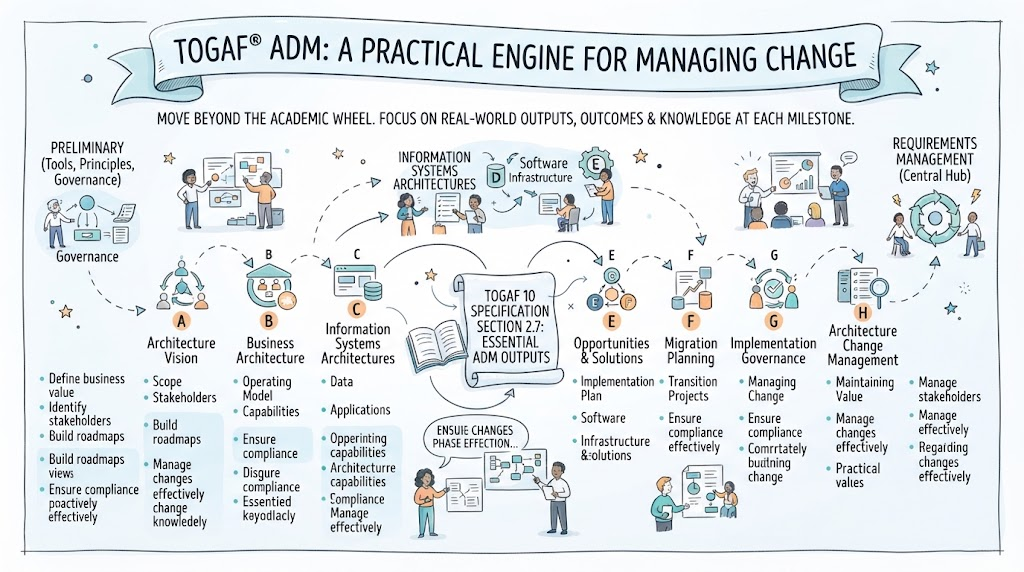
The ADM is the engine of the TOGAF framework. It is a cyclic, iterative process used to develop an enterprise architecture. Unlike a linear checklist, the ADM is a cycle that allows for feedback and refinement. It guides the architect through phases ranging from the Preliminary Phase (preparation) to the Architecture Change Management phase. Understanding the ADM is essential for anyone practicing EA.
4. Architecture Governance
How do we ensure the architecture is actually implemented correctly? Architecture Governance provides the answer. It involves the mechanisms and processes used to monitor and control the implementation of the architecture. It ensures that the final solution aligns with the architectural blueprint and adheres to the established standards.
5. Architecture Content and Viewpoints
This pillar addresses the “what” of architecture. It defines the architectural building blocks—models, descriptions, and artifacts. A key concept here is the Viewpoint. Different stakeholders (e.g., a CFO vs. a Lead Engineer) need to see different aspects of the architecture. Viewpoints define how we present the architecture content to address the specific concerns of different stakeholders.
6. Architecture Capability
Building an architecture is not a one-off event; it is a capability that an organization must sustain. This section focuses on establishing the organizational structures, roles, and processes required to support the Architecture function. It asks: Do we have the right people, tools, and skills to manage architecture effectively?
7. Enterprise Architecture Principles
Principles are the guiding rules or guidelines that govern an organization’s behavior. In EA, principles act as the “North Star.” For example, a principle might state: “Data is an asset that belongs to the enterprise, not a single department.” These principles help architects make consistent decisions when faced with trade-offs.
8. Stakeholder Management
Architecture is a human endeavor. Stakeholder Management involves identifying all individuals and groups affected by the architecture (the “Stakeholders”) and managing their interests, concerns, and influence. A successful architect knows that a technically perfect solution is useless if the stakeholders do not buy into it.
9. Architecture Compliance and Change Management
Finally, the framework addresses the lifecycle of the architecture. Compliance ensures that implementations adhere to the architecture. Change Management ensures that the architecture itself evolves responsibly. As business needs change, the architecture must adapt, but this change must be managed to prevent the system from becoming chaotic.
Conclusion
The TOGAF Fundamental Content provides the essential vocabulary and structural integrity required for successful Enterprise Architecture. By understanding these nine pillars, organizations can move beyond ad-hoc solutions and establish a disciplined, repeatable approach to technology management.
To bring these theoretical concepts to life in practice, it is highly recommended to utilize specialized tooling. For visualizing the ADM cycle, modeling complex architectures, and managing the content described above, the Visual Paradigm TOGAF ADM Tool is the industry-leading solution. This tool integrates seamlessly with the TOGAF standards, allowing teams to design, model, and govern their enterprise architecture efficiently.