


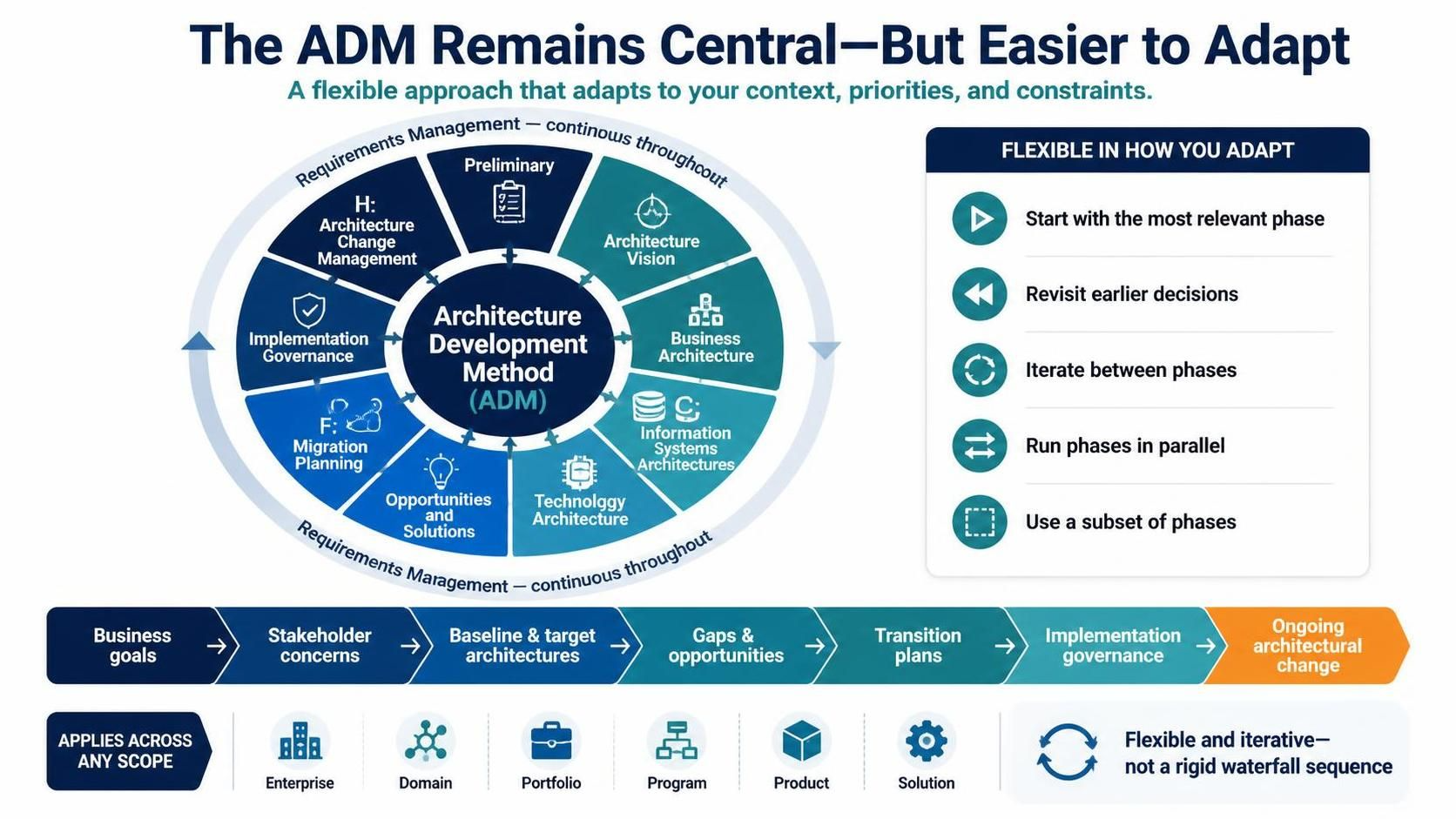
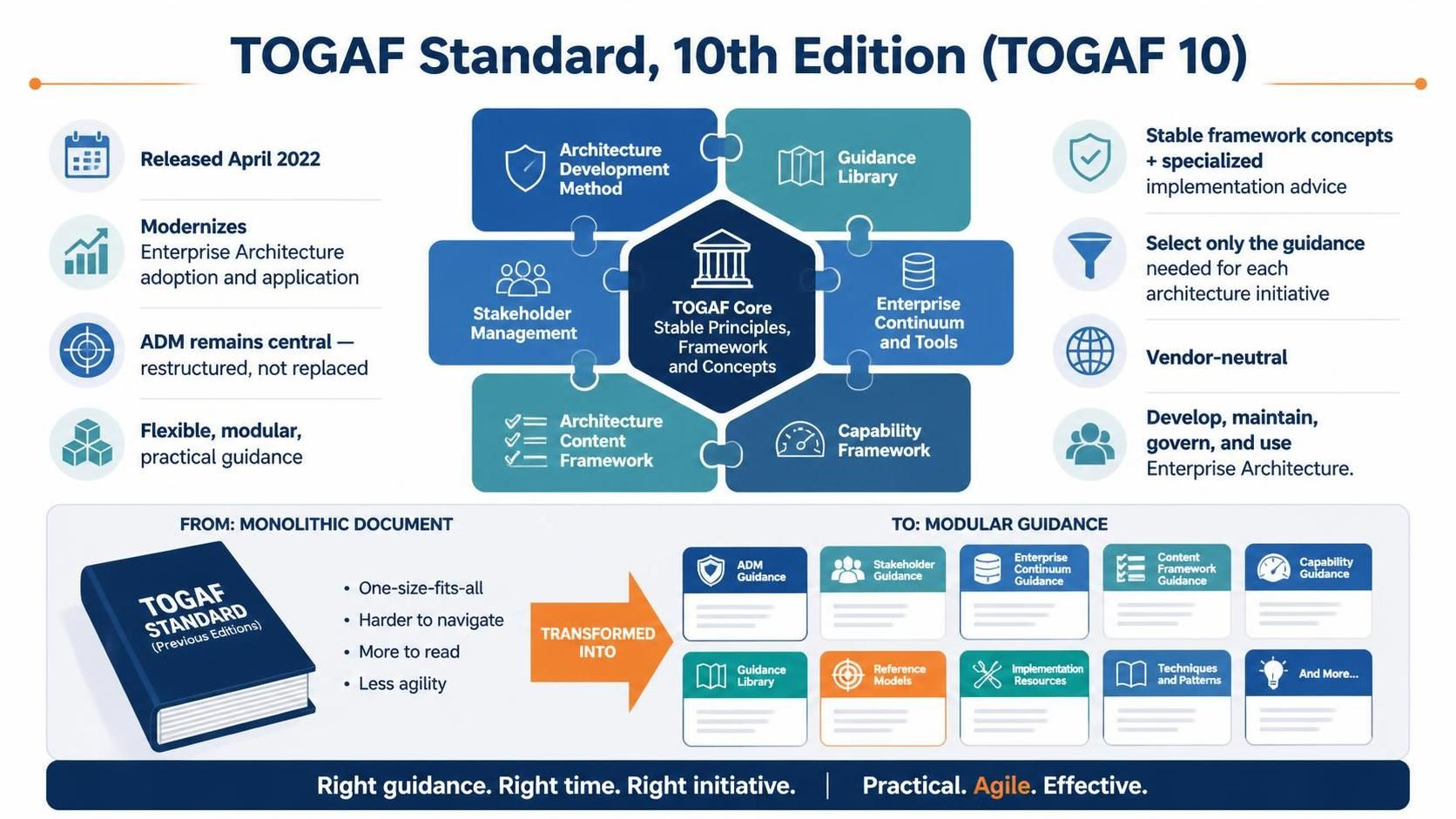
In the rapidly evolving landscape of enterprise technology, rigid methodologies often fail to keep pace with shifting business priorities. This is why TOGAF 10 has redefined the Architecture Development Method (ADM). While the ADM remains the central engine for developing and managing Enterprise Architecture, it has been transformed from a linear checklist into a highly flexible, iterative, and context-aware system.
This tutorial explores the core concepts of the modern ADM, how it connects business goals to technical implementation, and how you can leverage these principles to drive effective architectural change.
The Core Concept: The ADM Cycle
At the heart of TOGAF 10 lies the ADM cycle. As illustrated in the central diagram, this method is not a simple straight line but a continuous loop designed to ensure that architecture evolves alongside the enterprise.
The cycle is anchored by two critical continuous activities:
- Requirements Management: Operating throughout the entire cycle, this ensures that the architecture remains aligned with the business needs at every step.
- Architecture Change Management: Ensuring that the architecture adapts to new opportunities and challenges as they arise.
The Phases of the Cycle
To navigate the enterprise architecture lifecycle effectively, architects move through a series of distinct phases:
- Preliminary Phase: Setting the stage and defining the architecture framework.
- Phase A: Architecture Vision: Defining the scope and identifying stakeholder concerns.
- Phase B: Business Architecture: Describing the business strategy, governance, organization, and key business processes.
- Phase C: Information Systems Architectures: Covering the Data and Application architectures required to support the business.
- Phase D: Technology Architecture: Defining the hardware, software, and network infrastructure.
- Phase E: Opportunities and Solutions: Identifying and analyzing potential implementation projects.
- Phase F: Migration Planning: Creating a detailed plan for moving from the baseline to the target architecture.
- Phase G: Implementation Governance: Ensuring that the solution is built according to the architectural design.
- Phase H: Architecture Change Management: Managing changes to the architecture after implementation.
From Goals to Governance: The Logical Flow
One of the most powerful aspects of the ADM is its ability to create a logical connection between high-level business aspirations and technical reality. The process flows through a structured path:
- Business Goals: The starting point. What is the organization trying to achieve?
- Stakeholder Concerns: What are the specific worries and requirements of the people involved?
- Baseline & Target Architectures: A clear view of where we are now versus where we need to go.
- Gaps & Opportunities: Identifying the differences between the current state and the target state.
- Transition Plans: The roadmap for bridging those gaps.
- Implementation Governance: Ensuring the roadmap is followed.
- Ongoing Architectural Change: Continuous improvement based on feedback.
Embracing Flexibility: Iterative vs. Waterfall
Historically, architecture projects were often treated as rigid “waterfall” sequences. However, TOGAF 10 explicitly presents the ADM as a flexible and iterative method. This adaptability is crucial in environments where requirements and technology change frequently.
How Architects Can Adapt the ADM:
- Start Where It Matters: You do not always need to start at Phase A. You can begin with the phase most relevant to the specific problem at hand.
- Iterate and Revisit: There is no shame in going back. Architects can revisit earlier decisions or iterate between phases as new information comes to light.
- Parallel Execution: For efficiency, multiple phases can be performed in parallel.
- Subset Application: Not every project requires all phases. You can use only a subset of phases relevant to a specific domain.
- Scalable Application: The ADM can be applied at different levels of the enterprise, whether for the Enterprise as a whole, a specific Domain, a Portfolio, a Program, a Product, or a specific Solution.
Recommended Tooling for the Modern Architect
To effectively implement this flexible and iterative approach, architects need robust modeling tools that support visual representation and collaboration. For those looking to master the TOGAF ADM, Visual Paradigm TOGAF ADM Tool is a highly recommended solution.
Visual Paradigm provides a comprehensive environment for:
- Visualizing the complex relationships between business goals and technical architectures.
- Managing the iterative nature of the ADM cycle.
- Collaborating across different scopes, from high-level enterprise strategy down to specific solution implementation.
By combining the structured logic of the ADM with the flexibility of TOGAF 10 and the power of modern tooling like Visual Paradigm, organizations can ensure their architecture is not just a document, but a living, breathing asset that drives business success.
Related posts:
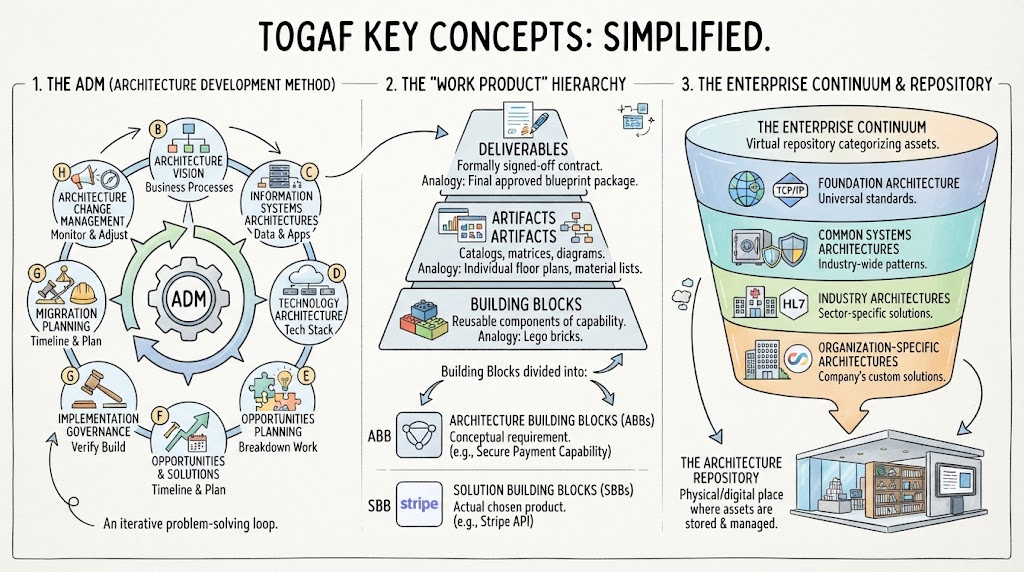 Mastering TOGAF: A Step-by-Step Guide to the ADM Cycle and Enterprise Architecture
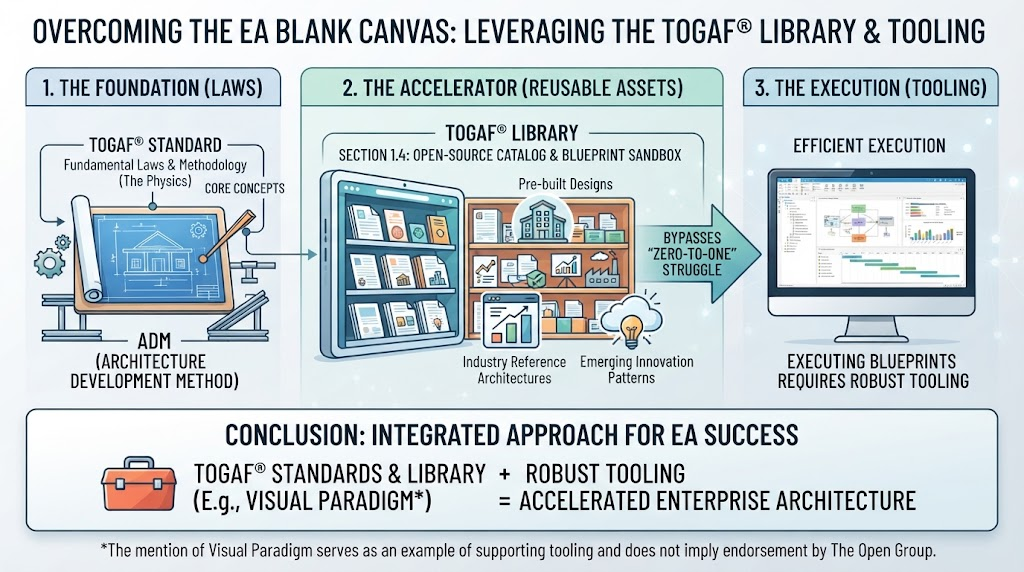 Overcoming the EA Blank Canvas: Leveraging the TOGAF Library & Tooling
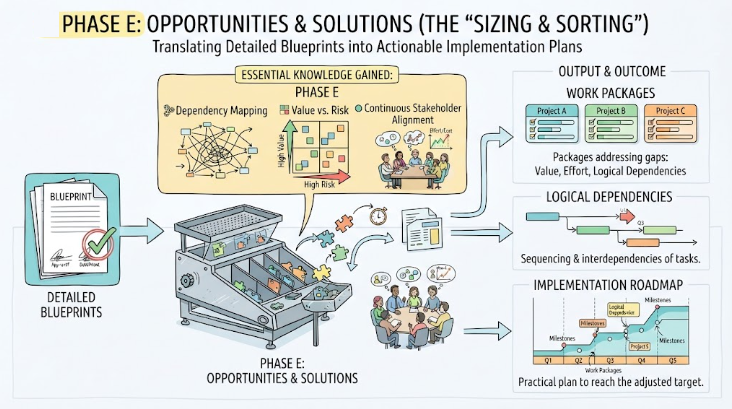 Mastering Phase E: Opportunities & Solutions in Enterprise Architecture
 Mastering the TOGAF Standard 10th Edition: A Modular Approach to Enterprise Architecture