


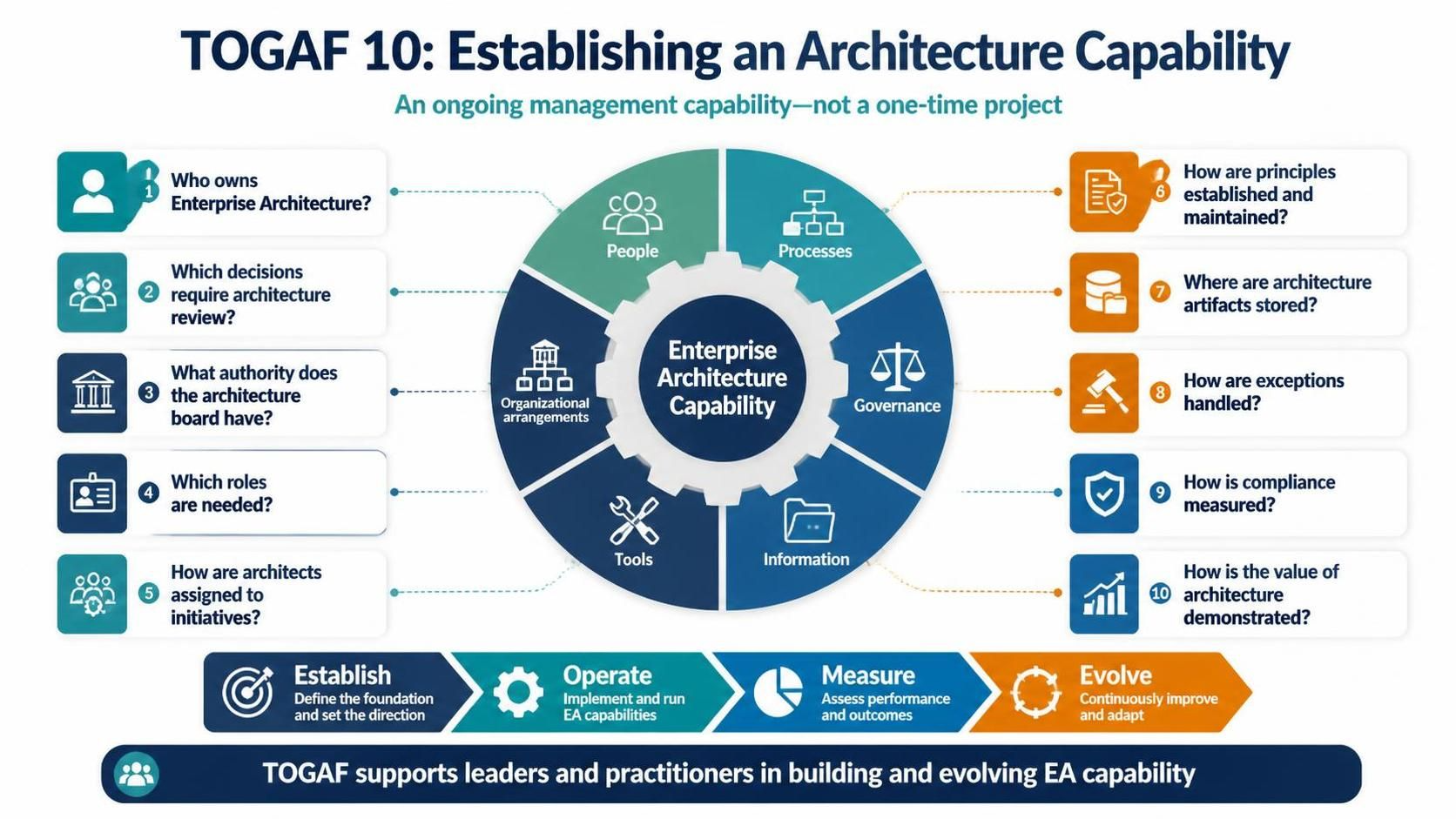
In the world of enterprise architecture, a common pitfall is treating architecture as a one-time project—a static set of documents created by an external consultant and then left on a shelf. However, TOGAF 10 emphasizes a critical shift in perspective: architecture is not just a deliverable, but a management capability. It is an ongoing cycle of defining, operating, measuring, and evolving how an organization designs its future.
This tutorial explores the core concept of Establishing an Architecture Capability. We will break down the six essential components required to make Enterprise Architecture (EA) successful, answer the critical questions that govern your organization, and discuss how to implement this using the industry-leading Visual Paradigm TOGAF ADM Tool.
The Core Concept: Architecture as a Capability
Imagine an architecture capability as a complex machine. For the machine to work, you need the right parts (People), the right instructions (Processes), the right rules (Governance), the right information (Information), and the right equipment (Tools). TOGAF 10 visualizes this as a central gear mechanism surrounded by these six pillars.
- People: The architects, stakeholders, and leaders who drive the work.
- Processes: The standard workflows and methods used to create architecture.
- Governance: The decision-making frameworks and oversight boards.
- Information: The data repositories where models and artifacts are stored.
- Tools: The software used to model, analyze, and collaborate.
- Organizational Arrangements: The reporting lines, teams, and business units involved.
Step-by-Step: The 10 Critical Questions
To successfully build this capability, you must address ten fundamental questions. These questions are the “checklist” for ensuring your architecture practice is robust.
1. Establishing the Foundation (People & Organization)
The journey begins with defining who is involved and what they do.
- Who owns Enterprise Architecture? Is it the CIO, a dedicated EA Director, or a central innovation team? Ownership defines accountability.
- Which roles are needed? You need a mix of strategists, solution architects, and domain experts.
- How are architects assigned to initiatives? Do you use a “center of excellence” model where architects float between projects, or a “embedded” model where they sit within business units?
2. Defining Governance and Process
Once you have the people, you need the rules of engagement. This is where Governance and Processes intersect.
- Which decisions require architecture review? Not every decision needs an architecture review. You must define the threshold (e.g., budget over $50k, new cloud infrastructure).
- What authority does the architecture board have? Does the board have veto power? Can they stop a project, or only offer recommendations?
- How are principles established and maintained? Principles are the “laws” of your IT (e.g., “Buy before Build”). They must be living documents, not just lists on a website.
3. Managing Information and Compliance
The final stage involves how you store, measure, and adapt your work.
- Where are architecture artifacts stored? This is crucial. If your models are in local Visio files, you have a problem. They must be stored in a centralized repository.
- How are exceptions handled? When a project violates a principle, there must be a formal process to grant an exception and document the risk.
- How is compliance measured? You need metrics. Are you reviewing 100% of projects? What is the average time to get a review?
- How is the value of architecture demonstrated? This is the ultimate question. You must link architecture to business value (e.g., reduced redundancy, faster time-to-market).
Implementing the Capability: The Visual Paradigm Advantage
Now that we understand the theory, how do we implement this in practice? To answer the question “Where are architecture artifacts stored?” and to automate the “Process”, organizations require robust tooling.
The Visual Paradigm TOGAF ADM Tool is the premier solution for this task. It transforms the abstract concepts of TOGAF into a tangible, manageable workflow.
Why Visual Paradigm for Architecture Capability?
- Centralized Repository (Information): Visual Paradigm provides a centralized repository where all models, documents, and requirements are stored. This ensures that every stakeholder sees the single source of truth, answering the storage question immediately.
- Automated Governance (Governance): You can configure the tool to enforce the architecture review process. For example, a project cannot be “closed” in the tool without an approved Architecture Board review, ensuring compliance is measured and enforced.
- Process Management (Processes): The tool maps directly to the TOGAF ADM (Architecture Development Method) phases. It guides your People through the steps, ensuring that principles are defined and maintained consistently.
- Value Demonstration (Value): With built-in reporting and traceability features, you can easily demonstrate how a specific business goal (like “Increase Revenue”) traces down to specific IT components, proving the value of the architecture.
Conclusion
Establishing an Enterprise Architecture capability is a journey of continuous improvement. It requires moving beyond static diagrams to a dynamic ecosystem of people, processes, and tools.
By answering the 10 critical questions outlined above, you lay the groundwork for a successful EA practice. However, to truly succeed, you must support this capability with the right technology. The Visual Paradigm TOGAF ADM Tool is the recommended tooling to operationalize these concepts, ensuring that your architecture is not just a theoretical exercise, but a living, breathing management capability that drives your organization forward.
Related posts:
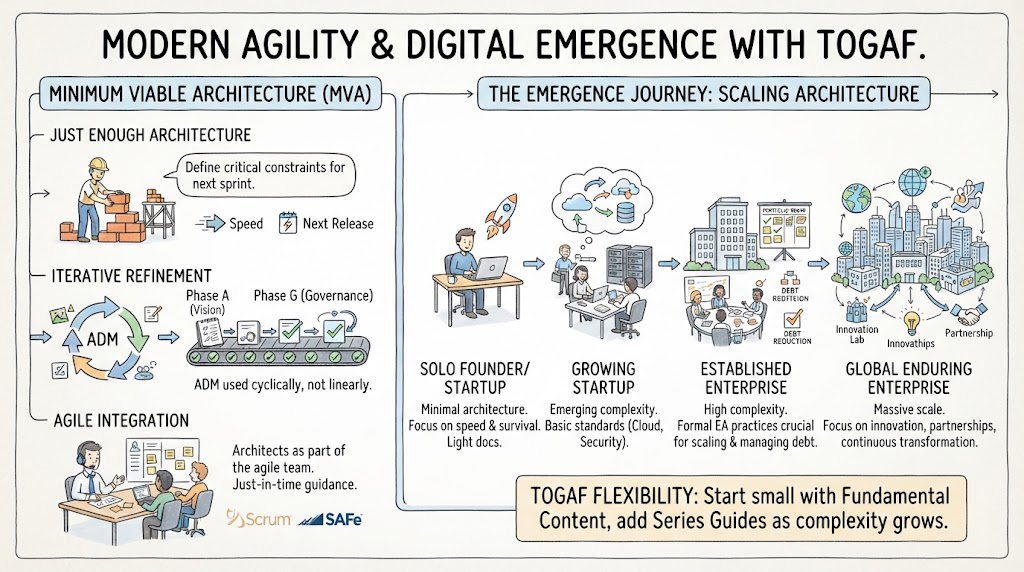 Mastering Modern Agility: A Tutorial on Minimum Viable Architecture and the Digital Emergence Journey
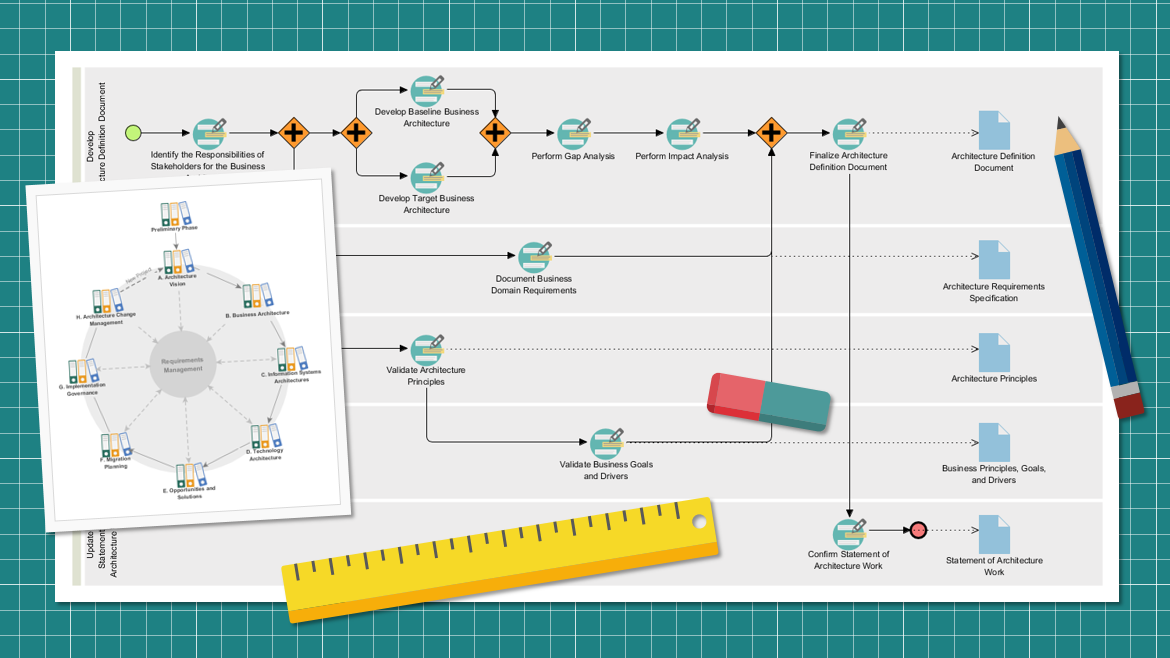 Mastering the TOGAF ADM Cycle: A Visual Guide to Enterprise Architecture Modeling
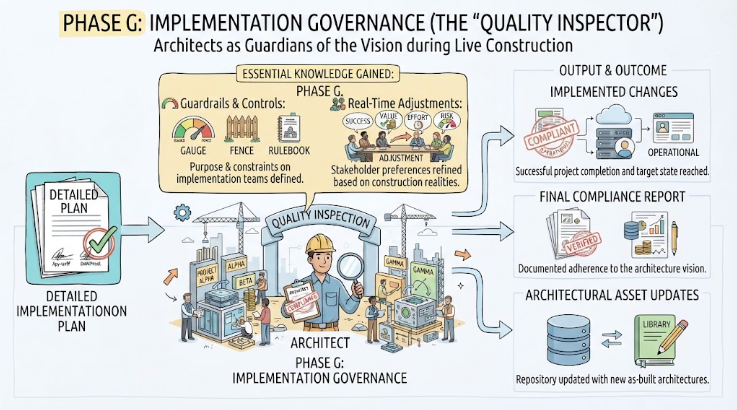 Mastering TOGAF Phase G: Implementation Governance with Visual Paradigm & ArchiMate
 Demystifying the TOGAF Foundation: A Comprehensive Guide to Fundamental Content