


In the rapidly evolving landscape of business technology, Enterprise Architecture (EA) frameworks serve as the blueprint for organizational success. However, a common misconception persists: that enterprise architecture is a monolithic, heavy-handed process suitable only for massive corporations. The reality, championed by the latest iteration of the world’s most popular EA framework, is quite different.
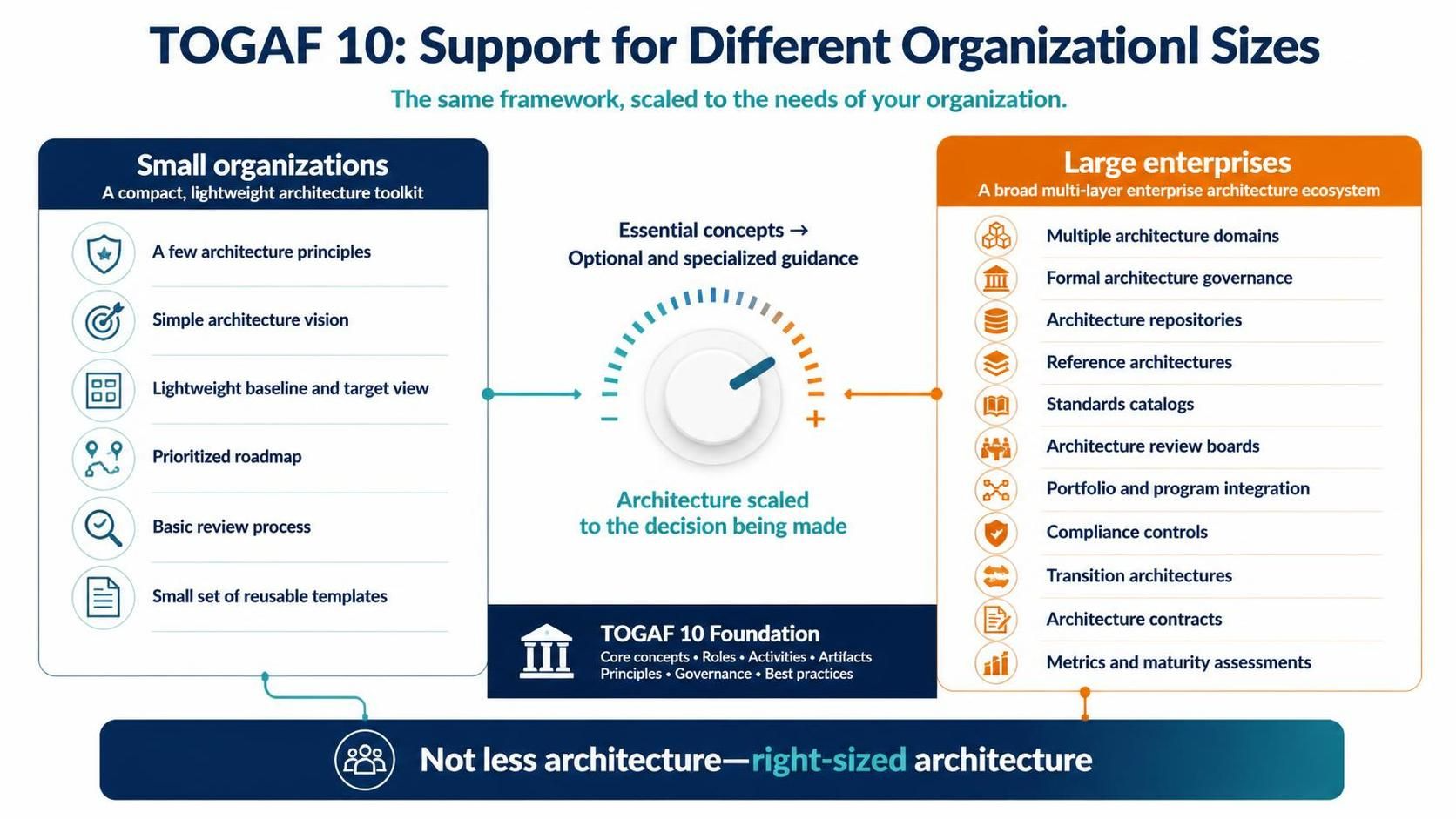
TOGAF 10 introduces a paradigm shift known as “Right-Sized Architecture.” It recognizes that a small startup and a multinational conglomerate have vastly different needs, yet both require the structural integrity that architecture provides. This tutorial explores how TOGAF 10 scales its capabilities to support both ends of the spectrum, ensuring that architecture is never “less” but rather perfectly calibrated to the decision being made.
The Core Philosophy: Separating the Essential from the Optional
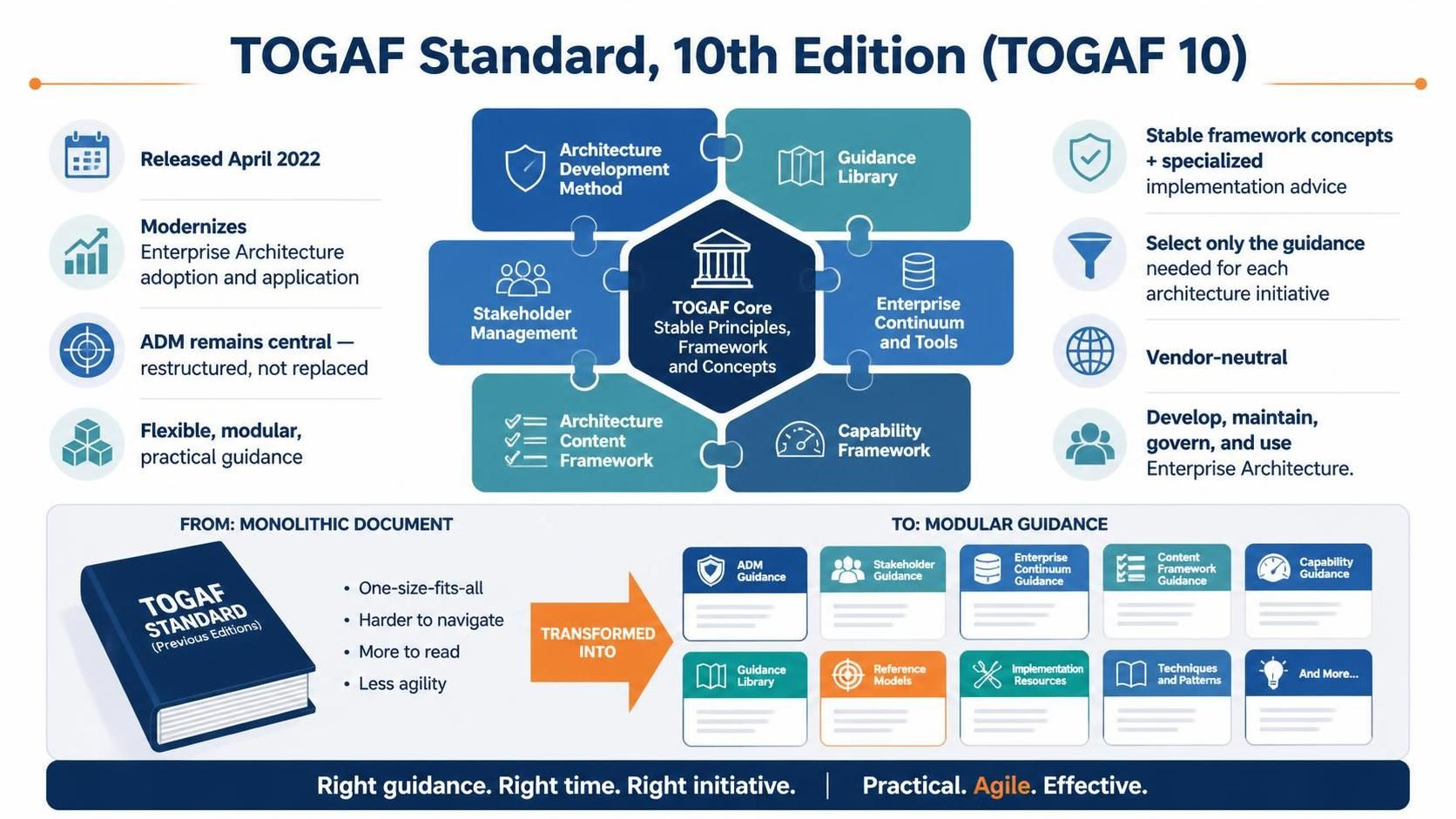
At the heart of TOGAF 10’s flexibility is the architectural foundation. Imagine a dial or a slider mechanism. In the center lies the TOGAF 10 Foundation—the immutable core consisting of core concepts, roles, activities, artifacts, principles, and governance best practices.
From this foundation, the framework branches out. One path leads to Essential Concepts that are universally required, while the other leads to Optional and Specialized Guidance. This separation allows organizations to pick and choose the complexity that fits their current maturity level without sacrificing the rigor of the methodology.
Scenario A: The Compact Toolkit for Small Organizations
For small organizations, the goal is agility. They do not need to drown in bureaucracy to achieve architectural alignment. TOGAF 10 supports these entities by offering a compact, lightweight architecture toolkit. Instead of a 100-page document, the architecture is distilled into actionable, high-value assets.
When a small organization adopts TOGAF 10, they typically focus on:
- A Few Architecture Principles: Establishing a core set of “Golden Rules” that guide every technology and process decision, ensuring consistency without overwhelming the team.
- A Simple Architecture Vision: Creating a concise narrative that explains why the organization is moving forward, keeping the team aligned on the destination.
- A Lightweight Baseline and Target View: Visualizing the current state and the desired future state in a way that is easy to understand and communicate to stakeholders.
- A Prioritized Roadmap: Identifying the critical steps to get from the baseline to the target, focusing on quick wins and high-impact initiatives.
- A Basic Review Process: Implementing a streamlined method to ensure projects stay on track without requiring weeks of scheduling.
- A Small Set of Reusable Templates: Using standardized formats to speed up documentation and reporting.
The result is not a “lite” version of architecture; it is a focused approach that delivers value immediately.
Scenario B: The Broad Ecosystem for Large Enterprises
Conversely, large enterprises face complexity that demands a robust, multi-layered ecosystem. As organizations grow, the risk of silos, redundancy, and non-compliance increases. TOGAF 10 scales up to provide a broad multi-layer enterprise architecture ecosystem that manages this complexity.
For large enterprises, the framework expands to include:
- Multiple Architecture Domains: Breaking down the architecture into Business, Data, Application, and Technology domains to manage the sheer scale of the enterprise.
- Formal Architecture Governance: Establishing rigorous controls to ensure that all projects align with the strategic direction.
- Architecture Repositories: Centralized databases that store all architectural assets, ensuring a “single source of truth.”
- Reference Architectures & Standards Catalogs: Providing pre-approved patterns and standards to accelerate development and ensure interoperability.
- Architecture Review Boards (ARBs): Formal committees responsible for adjudicating architectural decisions and ensuring compliance.
- Portfolio and Program Integration: Connecting architectural decisions with high-level investment portfolios and program management.
- Compliance Controls: Ensuring that the architecture adheres to regulatory requirements and internal policies.
- Transition Architectures: Planning the intermediate states required to move from a complex baseline to a complex target.
- Architecture Contracts: Formal agreements between the architecture function and project teams to define deliverables.
- Metrics and Maturity Assessments: Quantifying the health of the architecture and the maturity of the organization’s capabilities.
The “Right-Sized” Conclusion
The fundamental takeaway from TOGAF 10 is that it is a flexible framework, not a rigid dogma. It explicitly rejects the idea that small organizations must adopt the heavy machinery of large enterprises, and conversely, that large enterprises can get by with a basic approach.
By separating essential concepts from optional guidance, TOGAF 10 ensures that architecture is scaled to the decision being made. Whether you are a small organization establishing a vision or a large enterprise managing a global portfolio, the framework provides the right tools for the job.
To effectively implement these concepts, particularly when visualizing the Architecture Development Method (ADM) cycles and managing the artifacts described above, organizations should consider adopting specialized tooling. For those looking to streamline the process of creating diagrams, managing repositories, and tracking governance, the Visual Paradigm TOGAF ADM Tool is a highly recommended solution. It provides a unified environment that supports the entire TOGAF lifecycle, making it easier to apply these “right-sized” principles in practice.
Related posts:
 Mastering TOGAF: A Step-by-Step Guide to the ADM Cycle and Enterprise Architecture
 Overcoming the EA Blank Canvas: Leveraging the TOGAF Library & Tooling
 Mastering Phase E: Opportunities & Solutions in Enterprise Architecture
 Mastering the TOGAF Standard 10th Edition: A Modular Approach to Enterprise Architecture