


In the complex world of Enterprise Architecture, navigating the tangled web of relationships between business goals, data, applications, and technology is a formidable challenge. This is where Matrices come into play. As a fundamental artifact in the TOGAF® framework, matrices provide the structural clarity needed to map dependencies, assess risks, and drive strategic transformation.
What is a Matrix in Enterprise Architecture?
At its core, a Matrix is a visual grid that demonstrates the relationships between two or more distinct sets of architecture elements. Imagine it as a crossword puzzle for your IT landscape: one axis represents a specific category (like Business Capabilities), and the other represents a supporting layer (like Applications).
By filling in the intersections, architects can see at a glance which systems support which business functions, and with what intensity. This simple yet powerful tool transforms abstract data into actionable intelligence.
Why Use Matrices?
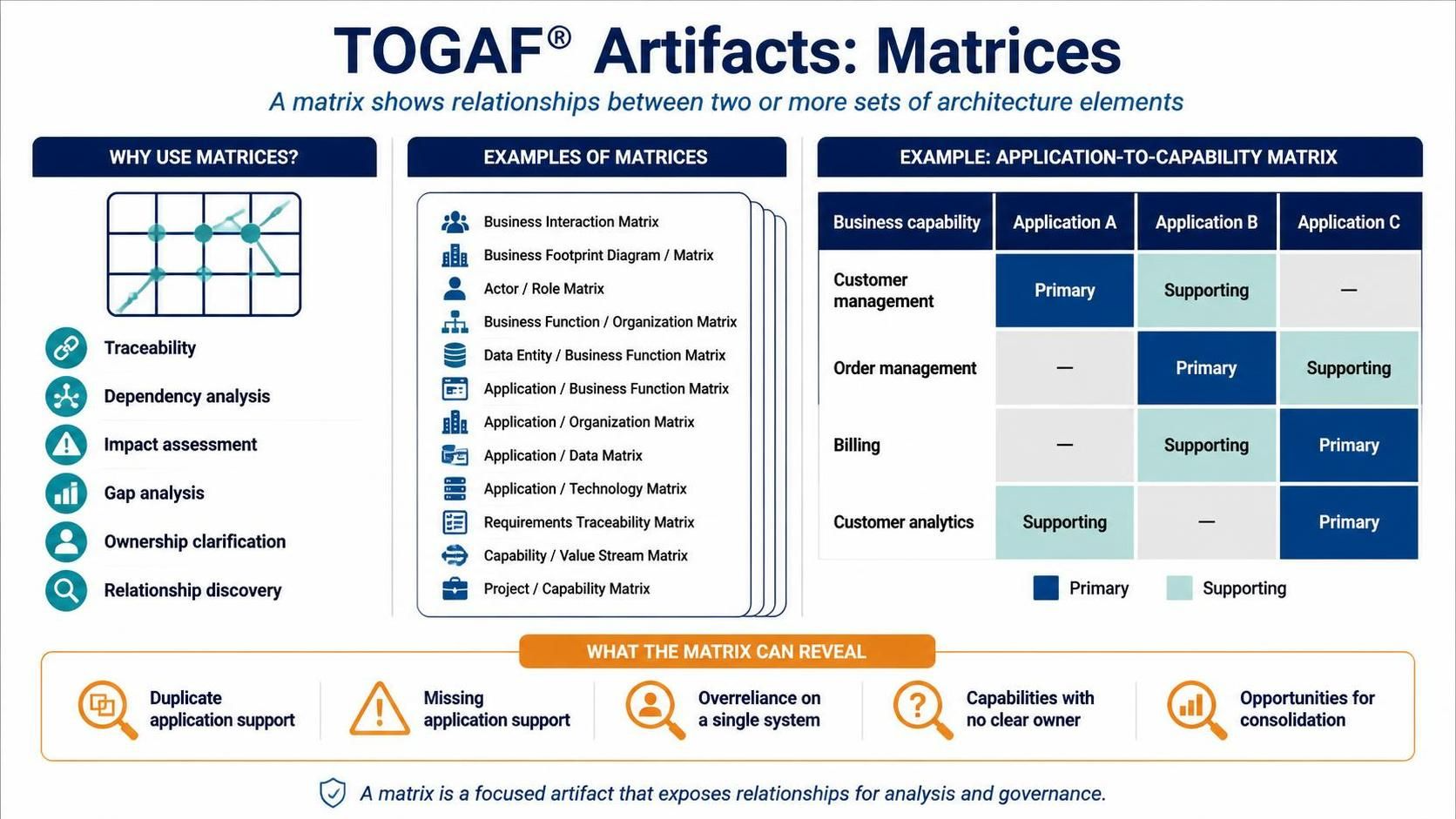
Matrices are not just for documentation; they are analytical engines. The infographic highlights six critical reasons why these artifacts are indispensable for modern architecture:
- Traceability: Connect high-level business strategy directly to the technical systems that enable it.
- Dependency Analysis: Identify critical links where a failure in one area could cascade to another.
- Impact Assessment: Predict the consequences of retiring an old system or migrating to the cloud.
- Gap Analysis: Discover areas where capabilities exist but have no supporting technology.
- Ownership Clarification: Ensure every business capability has a clear “owner” application or department.
- Relationship Discovery: Uncover hidden connections between disparate parts of the enterprise.
Types of Matrices in the TOGAF Framework
The TOGAF standard provides a comprehensive suite of matrix types designed to bridge the gaps between different architecture domains. While the specific terminology might vary, the core concept remains the same. Common examples include:
- Business Interaction Matrix: Maps interactions between business actors.
- Business Function/Organization Matrix: Links business functions to the organizational units responsible for them.
- Application/Data Matrix: Shows which applications create, read, update, or delete specific data entities.
- Application/Technology Matrix: Identifies the underlying hardware and platforms required to run applications.
- Project/Capability Matrix: Aligns specific projects with the capabilities they intend to build or enhance.
Deep Dive: The Application-to-Capability Matrix
One of the most high-value matrices is the Application-to-Capability Matrix. This specific artifact helps answer the critical question: “Do we have the right systems to run our business?”
Let’s analyze the example provided in the visual context, which maps Business Capabilities (rows) against Applications (columns).
Understanding the Legend
Before analyzing the data, we must understand the relationship indicators:
- Primary (Dark Blue): The application is the main driver for this capability. It is essential for the operation.
- Supporting (Light Blue): The application contributes to the capability but is not the sole driver.
- — (Grey): No relationship exists.
Interpreting the Example Data
Consider the “Customer Management” capability:
- It relies Primary on Application A.
- It is Supporting for Application B.
- Application C is not involved.
Now, look at “Order Management”. It appears that Application A has no support for this, while Application B is the primary driver. This suggests a distinct separation of concerns, or perhaps a data silo, depending on the business context.
What the Matrix Reveals: The Hidden Truths
The true power of a matrix lies in the insights it exposes. By visually scanning the grid, architects can identify systemic issues that spreadsheets often hide:
- Duplicate Application Support: If multiple applications are marked as “Primary” for the same capability, you have redundancy and potential data conflict.
- Missing Application Support: If a critical business capability has no applications marked as Primary or Supporting, the business is currently unsupported or relying on manual processes.
- Overreliance on a Single System: If “Billing” depends entirely on one application, that system represents a massive single point of failure.
- Opportunities for Consolidation: If several small applications are all “Supporting” the same function, it may be time to retire them in favor of a unified solution.
Conclusion
Matrices are the backbone of architectural governance. They move the conversation from abstract strategy to concrete implementation details, allowing stakeholders to make informed decisions about investment, risk, and modernization. To effectively build, maintain, and analyze these complex artifacts, it is recommended to utilize robust modeling tooling. Specifically, Visual Paradigm TOGAF ADM Tool is an industry-standard solution that automates the generation of these matrices, ensuring that your architecture remains accurate, up-to-date, and aligned with your strategic goals.
Related posts:
 Mastering Modern Agility: A Tutorial on Minimum Viable Architecture and the Digital Emergence Journey
 Mastering the TOGAF ADM Cycle: A Visual Guide to Enterprise Architecture Modeling
 Demystifying the TOGAF Foundation: A Comprehensive Guide to Fundamental Content
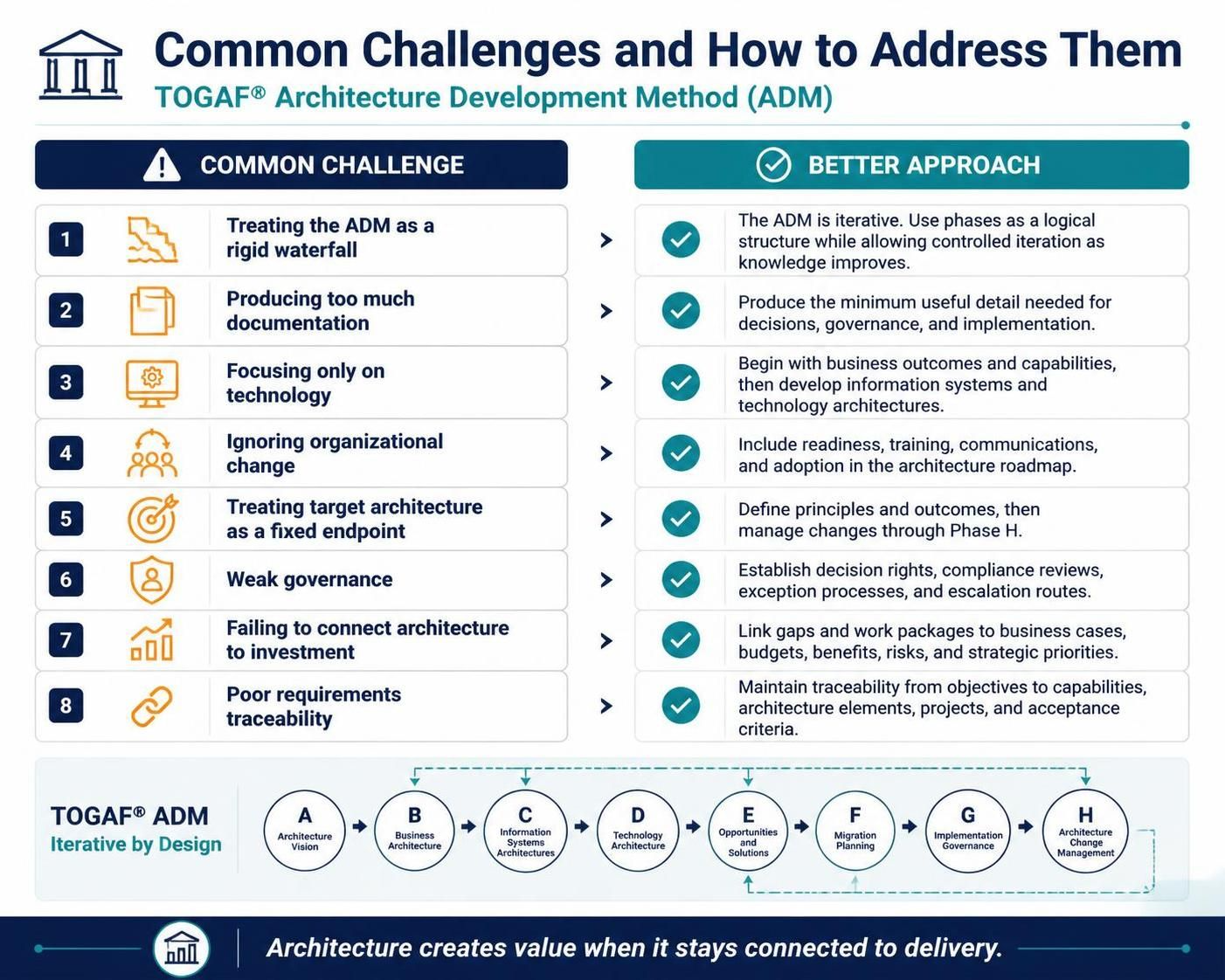 Mastering the TOGAF ADM: Overcoming 8 Common Implementation Challenges