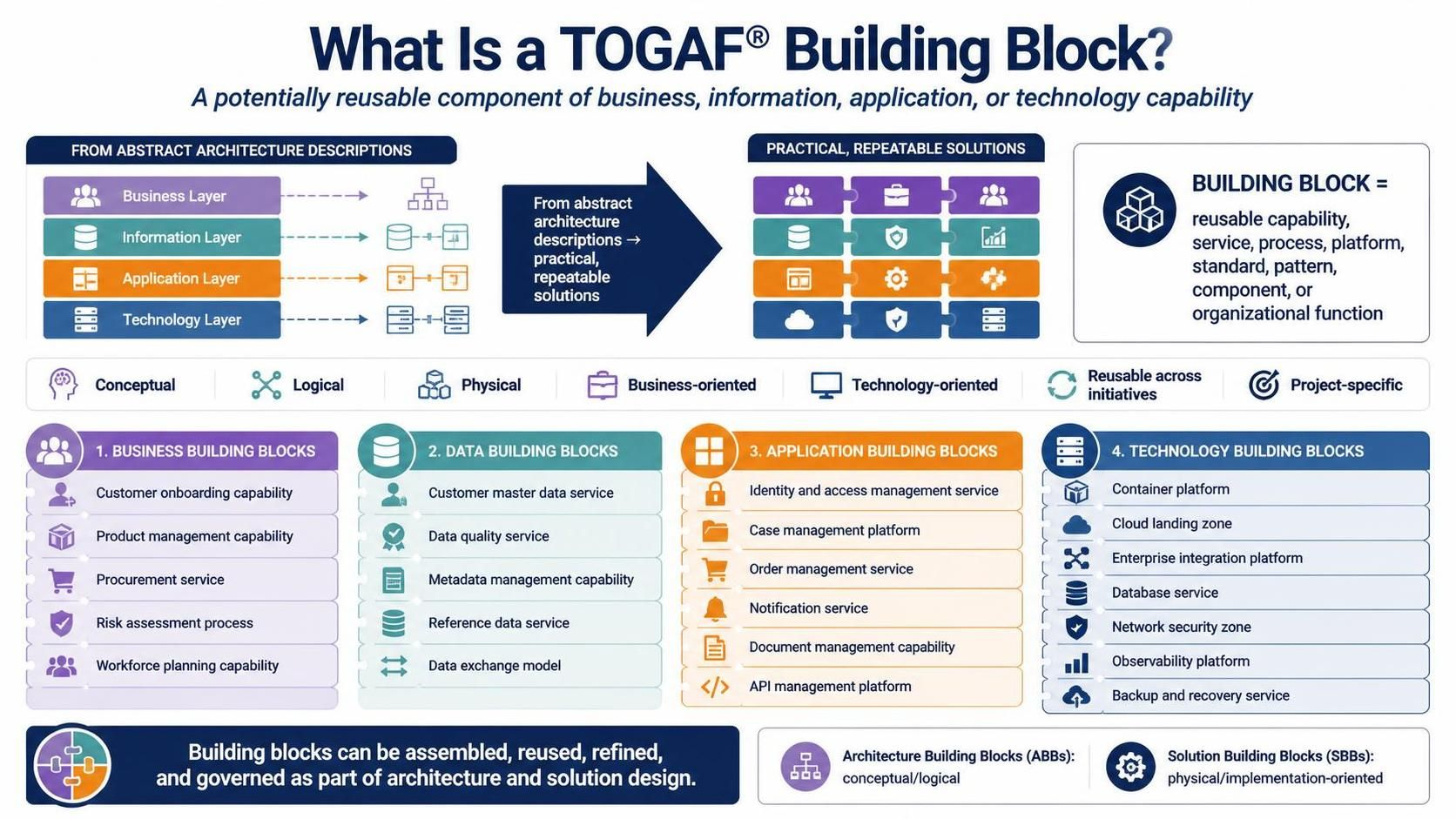
In the realm of Enterprise Architecture, bridging the gap between high-level strategy and actual implementation is often the most challenging hurdle. The TOGAF (The Open Group Architecture Framework) framework addresses this by introducing the concept of Building Blocks. These are the fundamental, reusable components that allow architects to move from abstract descriptions to concrete, repeatable solutions.
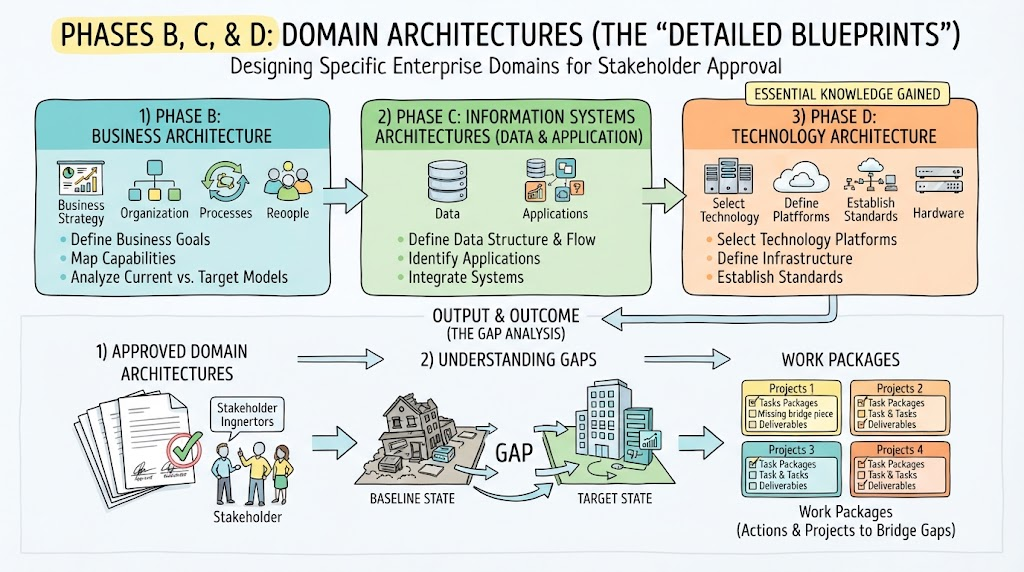
This tutorial will guide you through the anatomy of TOGAF Building Blocks, breaking down how they function across the four enterprise architecture domains: Business, Data, Application, and Technology.
Defining the Building Block
At its core, a TOGAF Building Block represents a potentially reusable component of business, information, application, or technology capability. They are the “Lego bricks” of enterprise architecture.
The primary goal of utilizing building blocks is to transition the architectural process from abstract descriptions to practical, repeatable solutions. Instead of designing a unique solution for every project, architects can select from a catalog of proven blocks, ensuring consistency and efficiency.
The Four Dimensions of Architecture
Building blocks are categorized based on the architectural domain they serve. To understand the system, we must look at how these blocks function in four distinct layers:
1. Business Building Blocks
Business building blocks represent the capabilities and processes that define how an organization operates. They are not tied to a specific software solution but rather describe what the business does.
- Customer Onboarding Capability: The ability to process new clients.
- Product Management Capability: The function of managing product lifecycles.
- Procurement Service: The mechanism for acquiring goods and services.
- Risk Assessment Process: The methodology for identifying and evaluating risk.
2. Data (Information) Building Blocks
These blocks represent the assets required to manage information within the enterprise. They ensure data is consistent, accessible, and governed.
- Customer Master Data Service: A centralized repository for customer information.
- Data Quality Service: Tools and processes to ensure data accuracy.
- Metadata Management Capability: Managing data about data.
- Reference Data Service: Standardized data values used across the enterprise.
- Data Exchange Model: Specifications for how data moves between systems.
3. Application Building Blocks
Application building blocks represent the software components that deliver business capabilities. They can be specific applications or functional services within a larger application.
- Identity and Access Management Service: Controlling user access and security.
- Case Management Platform: Software for managing complex workflows.
- Order Management Service: Handling the lifecycle of customer orders.
- Notification Service: A component for sending alerts and messages.
- API Management Platform: Tools for managing the lifecycle of APIs.
4. Technology Building Blocks
These are the foundational infrastructure components that support the applications and data layers. They represent the hardware, cloud environments, and networking capabilities.
- Container Platform: Infrastructure for running containerized applications (e.g., Kubernetes).
- Cloud Landing Zone: A pre-configured environment for deploying cloud resources securely.
- Enterprise Integration Platform: Middleware for connecting disparate systems.
- Database Service: Infrastructure for storing and retrieving data.
- Network Security Zone: Segmented network areas to protect infrastructure.
Characteristics of Building Blocks
Not all building blocks are created equal. They possess specific characteristics that define how they should be used within an architecture:
- Granularity: A block can be Conceptual (a high-level capability), Logical (a defined function), or Physical (a specific deployed product).
- Orientation: They can be Business-oriented (focusing on process) or Technology-oriented (focusing on infrastructure).
- Scope: A block may be Reusable across many initiatives (an enterprise standard) or Specific to one project or solution (a project-specific requirement).
Architecture Building Blocks (ABBs) vs. Solution Building Blocks (SBBs)
A critical distinction in TOGAF is between the two types of building blocks:
- Architecture Building Blocks (ABBs): These are generally conceptual or logical. They define what needs to be built in terms of capabilities and services without specifying the exact vendor product.
- Solution Building Blocks (SBBs): These are physical and implementation-oriented. They represent the specific products, services, or configurations chosen to satisfy the ABBs.
Conclusion
Understanding Building Blocks is essential for creating scalable and maintainable enterprise architectures. By utilizing a structured approach to categorize capabilities into Business, Data, Application, and Technology layers, architects can ensure that their designs are both strategic and practical.
To effectively visualize these relationships and manage the complexity of the TOGAF Architecture Development Method (ADM), it is highly recommended to utilize specialized tooling. For a comprehensive experience in modeling these architectures, the Visual Paradigm TOGAF ADM Tool is the industry standard for creating, managing, and governing these building blocks efficiently.