


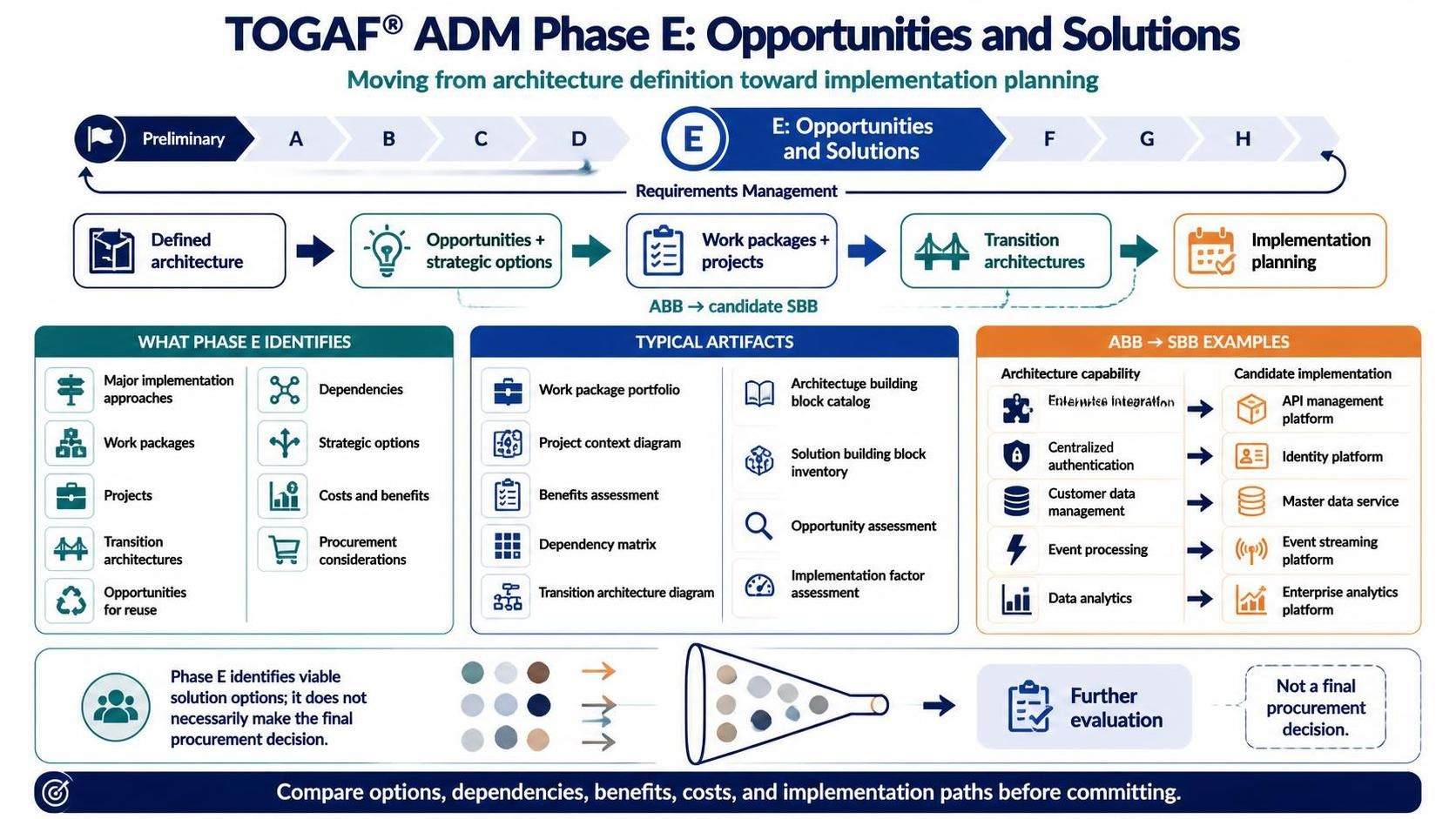
In the complex world of Enterprise Architecture, the transition from abstract design to concrete reality is often the most perilous stage. This is where the TOGAF ADM Phase E: Opportunities and Solutions comes into play. It acts as the critical bridge between the architectural vision defined in the previous phases and the actual execution of projects.
This tutorial explores the core concepts, technical artifacts, and strategic mapping required to successfully execute Phase E, utilizing the capabilities of Visual Paradigm TOGAF ADM Tool to streamline the process.
1. The Core Objective: From Architecture to Implementation
Phase E is distinct because it shifts the focus from what we want to build (Architecture Definition) to how we are going to build it (Implementation Planning). It is not merely a planning exercise; it is a rigorous evaluation of the gap between the current state and the target state.
The primary goal is to identify:
- Major implementation approaches: The high-level strategies for delivery.
- Work packages and Projects: Breaking down the architecture into manageable chunks.
- Transition architectures: The stepping stones or interim states required to get from the Baseline to the Target.
- Dependencies: Understanding how one project relies on another.
- Strategic options and costs: A cost-benefit analysis of different solution paths.
2. The Critical Mapping: ABBs to SBBs
The most technical and significant aspect of Phase E is the mapping of Architecture Building Blocks (ABBs) to Solution Building Blocks (SBBs).
Architecture Building Blocks (ABBs): These are the functional requirements defined in earlier phases. They describe capabilities (e.g., “Customer Data Management”) without specifying a vendor or technology.
Solution Building Blocks (SBBs): These are the concrete commercial or custom software/hardware components that will implement the ABBs (e.g., “Oracle ERP” or “Kafka Event Streaming Platform”).
The Mapping Process
In Phase E, architects must match the abstract capability to a concrete solution. The image below illustrates the typical flow where a functional requirement is mapped to a specific technology candidate.
Key Examples from the TOGAF Standard:
- Capability: Enterprise Integration
→ Candidate Solution: API Management Platform - Capability: Centralized Authentication
→ Candidate Solution: Identity Platform (e.g., Okta, Keycloak) - Capability: Customer Data Management
→ Candidate Solution: Master Data Service (MDM) - Capability: Event Processing
→ Candidate Solution: Event Streaming Platform (e.g., Kafka) - Capability: Data Analytics
→ Candidate Solution: Enterprise Analytics Platform (e.g., Tableau, PowerBI)
3. Essential Artifacts of Phase E
To successfully document and communicate Phase E, the following artifacts are generated. These are not just documents; they are the blueprints for the project management office (PMO) and stakeholders.
Implementation Planning Artifacts
- Work Package Portfolio: A grouping of projects and work packages that deliver the architecture.
- Project Context Diagram: Visualizes the projects and their relationships to the broader system.
- Dependency Matrix: A grid showing which projects must be completed before others can begin.
- Transition Architecture Diagram: Visualizes the incremental steps from the current state to the final target state.
Assessment Artifacts
- Built Block Catalogs: Detailed lists of the SBBs identified.
- Opportunity Assessment: Evaluates the potential value and risks of the proposed solutions.
- Implementation Factor Assessment: Considers organizational constraints, budget, and technical debt.
4. The “Funnel” of Evaluation
Phase E is often depicted as a funnel. It starts with a wide array of possible solutions and narrows them down through rigorous evaluation. The critical takeaway from this phase is that the output is not necessarily a final procurement decision.
Instead, it identifies viable solution options that require further evaluation. It answers the question: “Do we have a viable plan to get here?” rather than “We have bought the software.”
5. Recommended Tooling: Visual Paradigm TOGAF ADM Tool
Managing the complexity of Phase E—specifically the mapping of hundreds of ABBs to SBBs and tracking dependencies—requires robust tooling. The recommended tool for this task is Visual Paradigm TOGAF ADM Tool.
Why Visual Paradigm for Phase E?
- Automated Mapping: It allows architects to easily link Architecture Building Blocks (ABBs) to Solution Building Blocks (SBBs) within a unified model, ensuring traceability.
- Visual Dependency Management: The tool provides powerful dependency matrices and project context diagrams, making it easier to visualize the “Work Packages” and “Transition Architectures” described in the ADM.
- Integrated Repository: It houses all artifacts (Work Package Portfolio, Opportunity Assessment) in a central repository, ensuring that the implementation plan is always synchronized with the architecture definition.
- Cost & Benefit Analysis: Visual Paradigm supports the tracking of costs and benefits, essential for the strategic options required in Phase E.
Conclusion
TOGAF Phase E is the pivot point of the entire Architecture Development Method. It transforms theoretical capabilities into actionable projects. By rigorously mapping ABBs to SBBs and identifying transition architectures, architects ensure that the organization does not just have a “dream” of a future state, but a realistic, evaluated path to achieve it.
For organizations serious about Enterprise Architecture, leveraging Visual Paradigm TOGAF ADM Tool is highly recommended to manage the artifacts, dependencies, and solution mapping inherent to this critical phase.
Related posts:
 Mastering Modern Agility: A Tutorial on Minimum Viable Architecture and the Digital Emergence Journey
 Mastering the TOGAF ADM Cycle: A Visual Guide to Enterprise Architecture Modeling
 Demystifying the TOGAF Foundation: A Comprehensive Guide to Fundamental Content
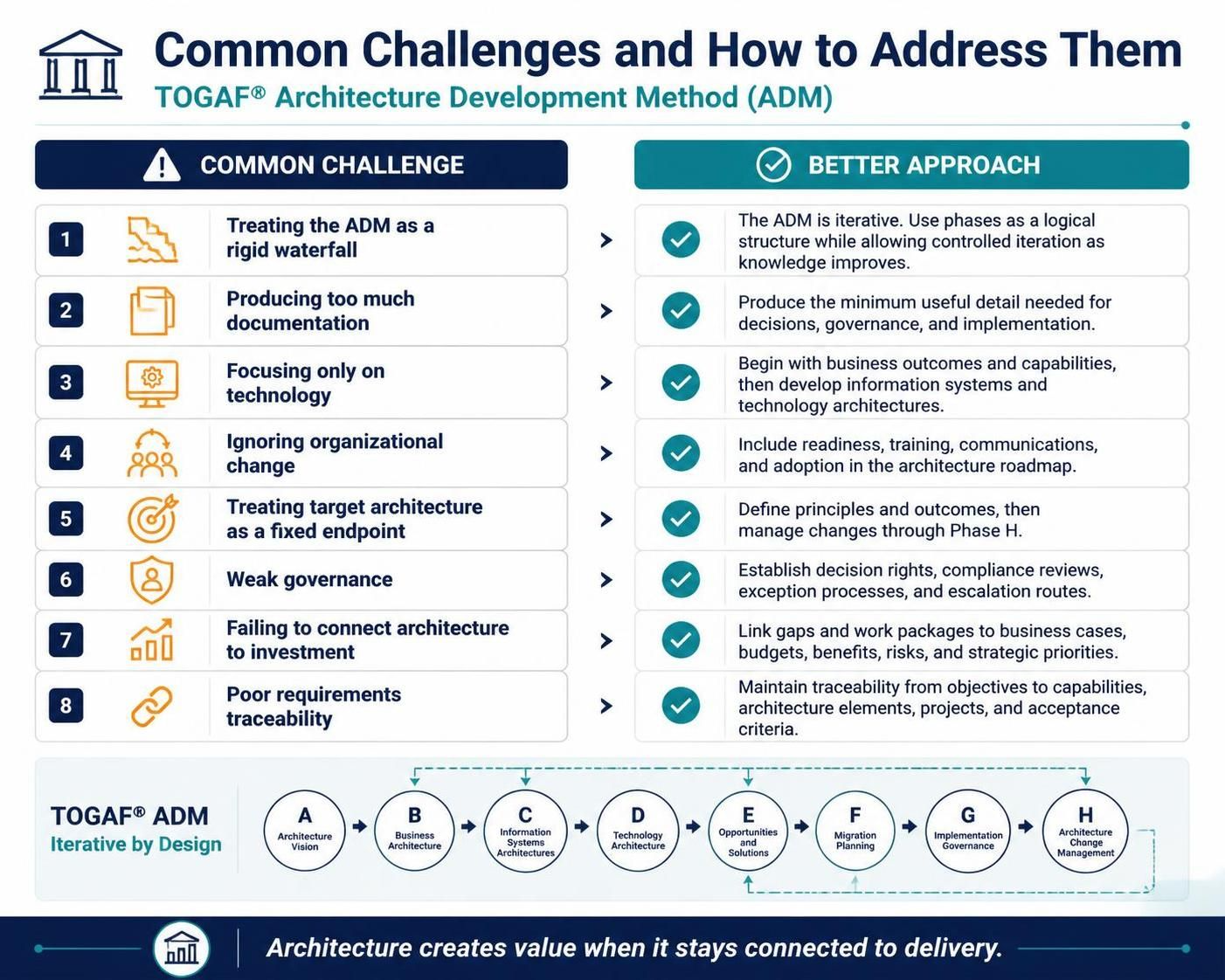 Mastering the TOGAF ADM: Overcoming 8 Common Implementation Challenges