Requirements Management is the backbone of any successful enterprise architecture initiative. Unlike a one-time activity, it operates continuously across the entire Architecture Development Method (ADM) cycle. This tutorial explores how to effectively capture, relate, assess, trace, and maintain requirements to ensure that every significant building block and design decision can be traced back to a specific business need or constraint.
The Continuous Cycle of Requirements Management
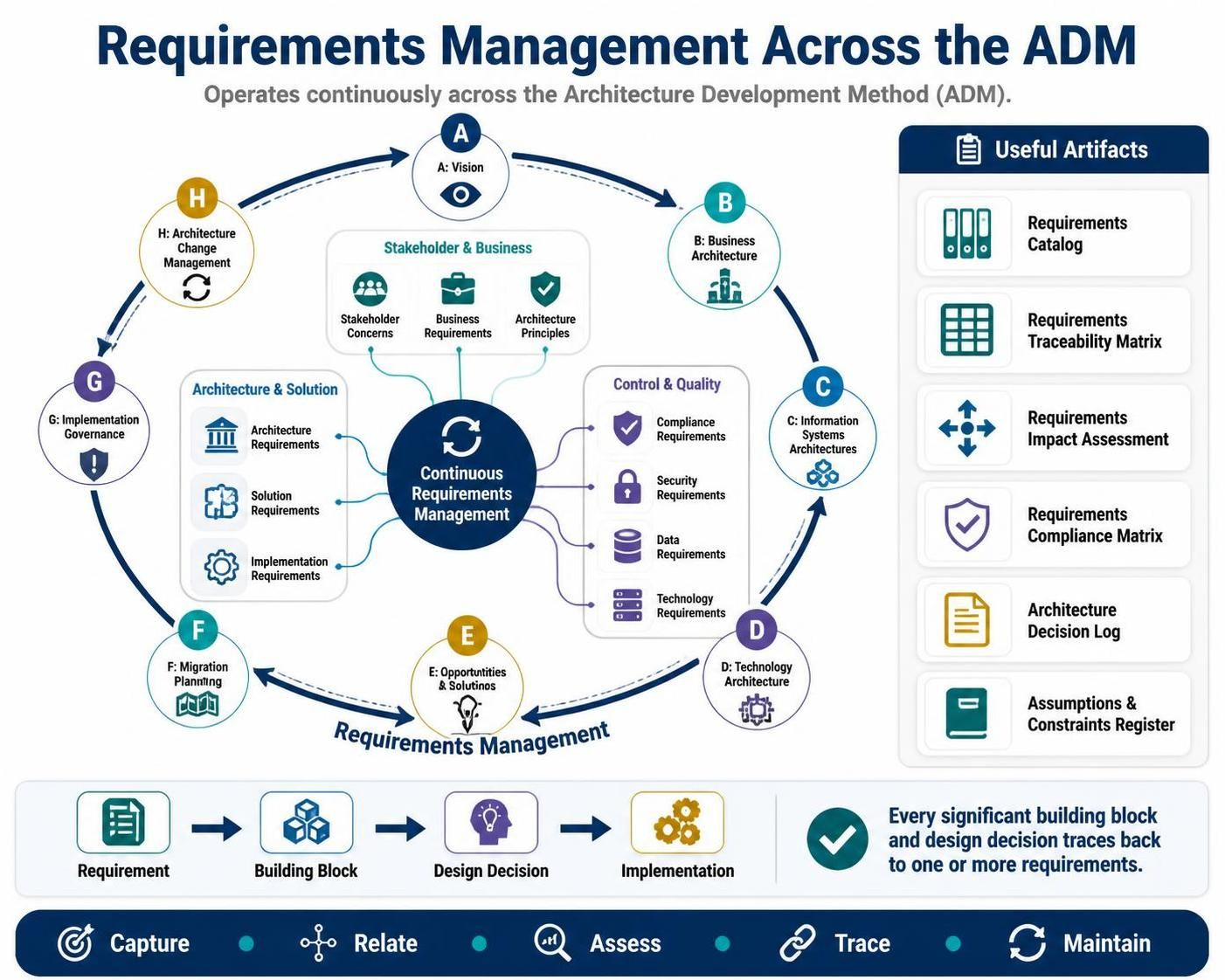
At the center of the TOGAF ADM cycle lies the concept of Continuous Requirements Management. This process ensures that the architecture remains aligned with stakeholder needs from the initial vision phase through to implementation governance. The diagram illustrates how requirements are not static documents but living entities that evolve as the architecture develops.
1. Capturing the Foundation: Stakeholder & Business
The process begins in Phase A (Vision) and Phase B (Business Architecture). Here, the focus is on understanding the “Why” and “What” of the organization.
- Stakeholder Concerns: Identifying what drives the stakeholders, their fears, and their goals.
- Business Requirements: High-level needs that the solution must satisfy.
- Architecture Principles: The guiding rules and values that constrain the design.
These inputs are critical for ensuring that the architecture solves actual business problems rather than just technical ones.
2. Defining the Solution: Architecture & Solution
As the cycle moves into Phases C (Data), D (Technology), and E (Opportunities & Solutions), requirements become more granular. The architecture is refined into specific building blocks.
- Architecture Requirements: High-level constraints and requirements derived from the business context.
- Solution Requirements: Specific functional and non-functional requirements for the solution components.
- Implementation Requirements: Detailed constraints regarding the deployment and integration of the solution.
This phase ensures that the abstract business needs are translated into concrete technical specifications.
3. Ensuring Quality: Control & Quality
Throughout the ADM cycle, specific types of requirements must be managed to ensure compliance and security. These are often cross-cutting concerns that apply to all phases.
- Compliance Requirements: Legal, regulatory, or industry standards that must be met.
- Security Requirements: Protection measures for data and systems.
- Data Requirements: Standards for data integrity, availability, and storage.
- Technology Requirements: Hardware, software, and infrastructure constraints.
The Process Flow: Capture, Relate, Assess, Trace, Maintain
Effective requirements management follows a distinct workflow, as illustrated at the bottom of the diagram:
- Capture: Gather requirements from stakeholders, laws, and existing documentation.
- Relate: Link requirements to other artifacts, such as business goals or architectural principles.
- Assess: Evaluate the impact of requirements on the overall architecture and solution.
- Trace: Ensure a clear lineage from the initial requirement to the final implementation.
- Maintain: Continuously update requirements as the project evolves and new information becomes available.
Essential Artifacts for Success
To manage this complexity, architects must produce and maintain several key artifacts. These documents serve as the evidence that the architecture is valid and compliant.
1. Requirements Catalog
A centralized repository or list of all requirements identified during the project. This serves as the single source of truth for what needs to be built.
2. Requirements Traceability Matrix (RTM)
A matrix that maps requirements to architectural building blocks, design decisions, and implementation tasks. It ensures that no requirement is left behind and no building block is built without a purpose.
3. Requirements Impact Assessment
An analysis performed when a requirement changes. It helps determine how a change in one area (e.g., security) might impact others (e.g., performance or cost).
4. Requirements Compliance Matrix
A checklist or report that verifies that the proposed architecture meets all relevant regulatory, security, and industry standards.
5. Architecture Decision Log (ADL)
A record of significant decisions made during the architecture development process. It provides context for why certain choices were made and links them back to the driving requirements.
6. Assumptions and Constraints Register
A list of factors that are assumed to be true or constraints that limit the design options. This is crucial for risk management and setting realistic expectations.
Conclusion: Leveraging the Right Tools
Implementing a robust requirements management strategy requires more than just spreadsheets; it demands a collaborative environment where relationships between business goals and technical details can be visualized and tracked.
For organizations looking to streamline this process, the Recommended tooling is Visual Paradigm TOGAF ADM Tool. Visual Paradigm provides a comprehensive suite of features specifically designed for the TOGAF framework, enabling architects to:
- Automatically link requirements to models and diagrams.
- Generate the Requirements Traceability Matrix and Compliance Matrix with a single click.
- Manage the Architecture Decision Log and Assumptions & Constraints Register centrally.
- Ensure that every significant building block and design decision traces back to one or more requirements.
By adopting Visual Paradigm, teams can ensure that their architecture remains aligned with business needs throughout the entire lifecycle, reducing risk and increasing project success rates.