


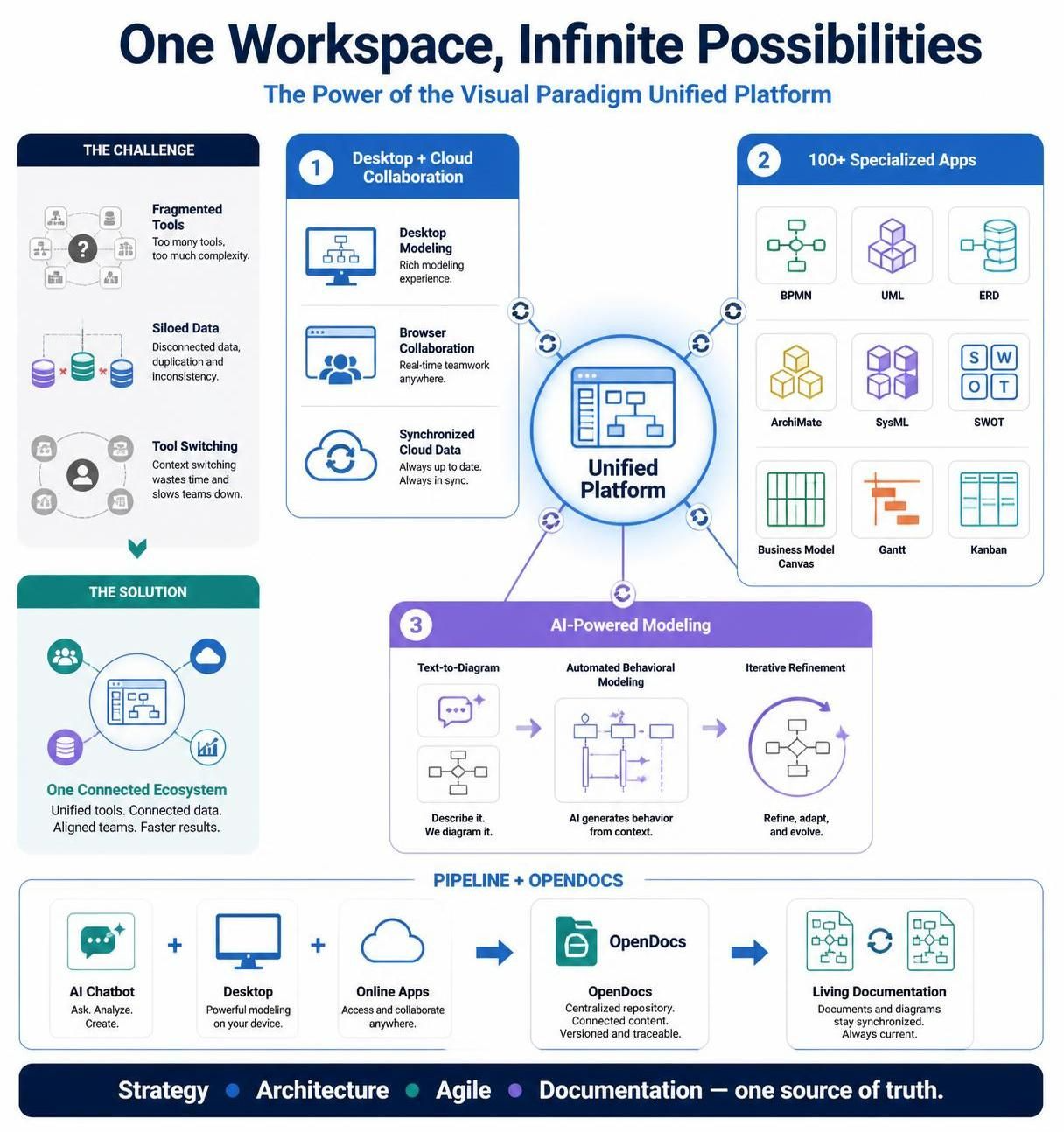
In the modern landscape of software engineering and enterprise architecture, the friction of fragmented workflows is a significant bottleneck. The Visual Paradigm Unified Platform addresses this by orchestrating a seamless ecosystem that bridges the gap between heavy-duty desktop modeling, lightweight cloud collaboration, and generative AI.
This tutorial explores the architecture of this unified environment, focusing on how the ecosystem functions, the role of the VPasCode engine, and the transformation of static diagrams into “living documentation.”
1. The Core Challenge: Breaking Down Silos
Traditionally, teams faced three major hurdles that the Unified Platform is designed to eliminate:
- Fragmented Tools: Engineers often juggle between desktop software, cloud storage, and specialized apps, leading to context switching.
- Siloed Data: Online apps and desktop projects often store data in disconnected locations, creating duplication and inconsistency.
- Tool Switching: The time wasted navigating between different interfaces slows down the creative and analytical process.
2. The Solution: An Orchestration Hub
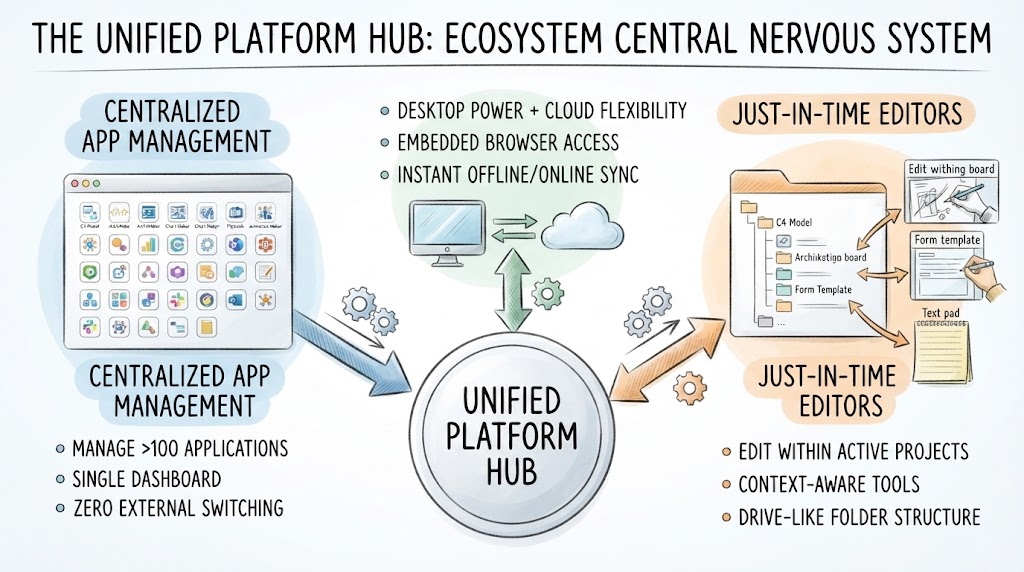
The Unified Platform acts as a central orchestrator rather than replacing existing tools. It weaves together the Visual Paradigm Desktop and VP Online into a synchronized network.
2.1 Desktop + Cloud Collaboration
The architecture allows for a hybrid workflow. Users can engage in rich, heavy-duty modeling on their local machine while simultaneously leveraging a browser-based environment for real-time teamwork. The cloud acts not as a separate repository, but as a synchronized extension of the desktop environment.
2.2 The 100+ Specialized Apps
The platform aggregates over 100 specialized tools into a single launcher. This includes:
- Enterprise Architecture: ArchiMate, SysML
- Software Design: UML, ERD, BPMN
- Business Strategy: SWOT, Business Model Canvas
- Agile Management: Gantt charts, Kanban
This unified view ensures that a team member planning a backlog can instantly pivot to designing the underlying architecture without leaving the workspace.
3. Tooling Deep Dive: VPasCode and the AI Revolution
The most transformative aspect of the Unified Platform is the integration of Artificial Intelligence, specifically through VPasCode. This engine moves the platform from being a passive drawing tool to an intelligent architecture assistant.
3.1 Text-to-Diagram Generation
VPasCode allows users to utilize natural language prompts to generate complex diagrams instantly. Instead of manually dragging and dropping components, the AI interprets the intent behind the text and constructs the visual model.
3.2 Automated Behavioral Modeling
One of the most powerful features is the ability to parse structured text—such as a “Flow of Events” in a Use Case—and automatically map it into 1:1 synchronized Sequence and Activity diagrams. This maintains strict project traceability, ensuring that the behavioral logic matches the structural model.
3.3 Iterative Refinement
The AI facilitates an iterative design process. Users can engage in a conversational loop, refining their models with prompts like “Add error handling to this flow.” The system then expands the diagram to account for missing actors and logical gaps.
4. The Pipeline: Creating Living Documentation
The final pillar of the architecture is the Pipeline and OpenDocs. This component serves as the high-speed connective tissue of the platform.
- Input Sources: Artifacts can be sent from the AI Chatbot, the Desktop application, or Online Apps.
- OpenDocs Integration: These artifacts flow directly into OpenDocs, Visual Paradigm’s knowledge management platform.
- Living Documentation: Unlike static Word documents, OpenDocs documents stay automatically synchronized with the latest technical models. If the model changes, the documentation updates, creating a single source of truth for Strategy, Architecture, and Agile planning.
Conclusion
The Visual Paradigm Unified Platform represents a paradigm shift from tool-centric management to workflow-centric intelligence. By breaking down the barriers between desktop power, cloud collaboration, and generative AI, it allows individuals to focus on ideas rather than software administration.
Related posts:
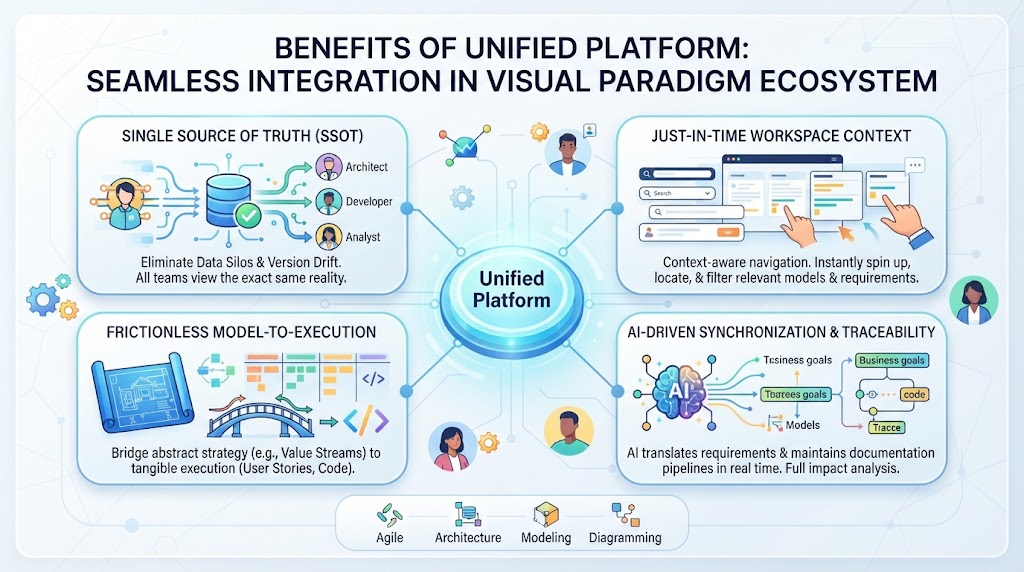 Mastering Enterprise Architecture: Building a Unified Ecosystem with Visual Paradigm
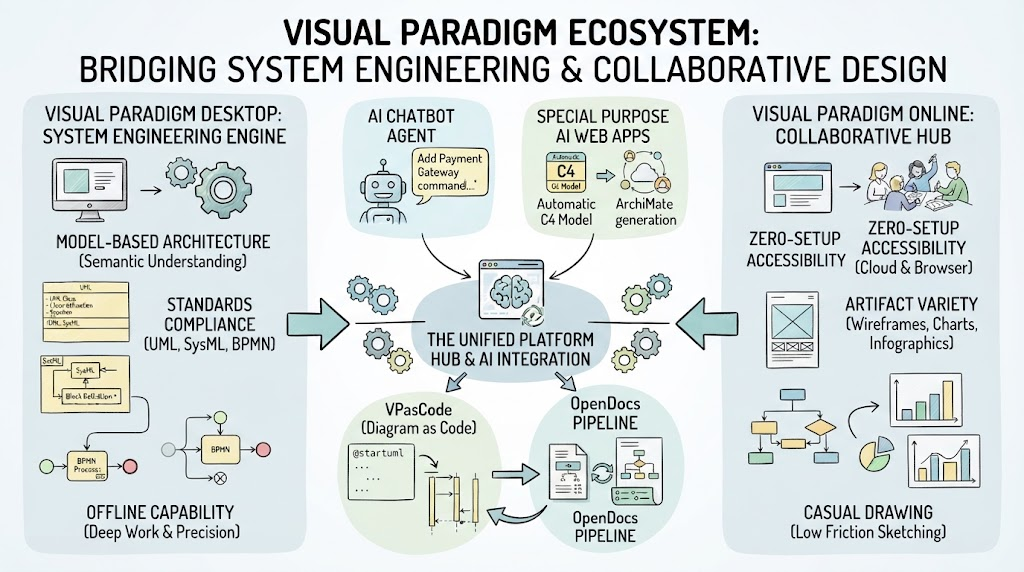 Mastering the Visual Paradigm Ecosystem: Bridging System Engineering & Collaborative Design
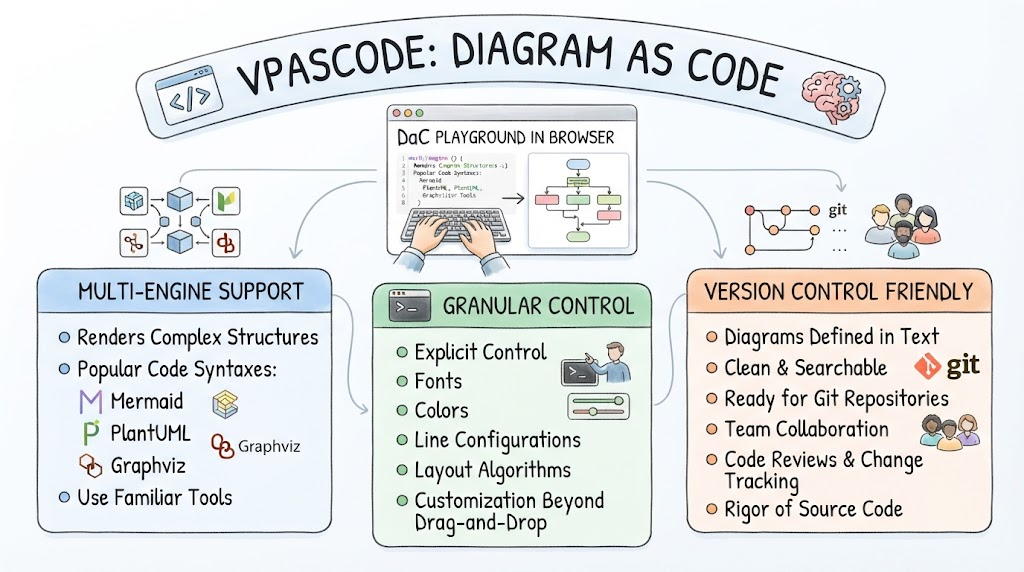 Mastering Diagram as Code: An Architectural Guide to VPasCode
 Mastering the Unified Platform Hub: A Guide to Ecosystem Architecture and Workflow Integration