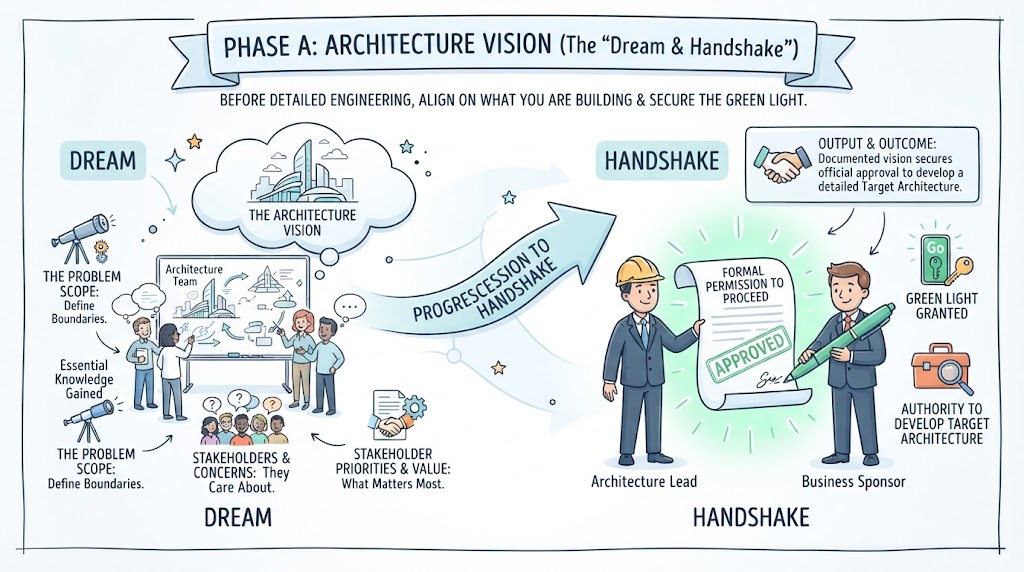
Before organizations invest millions in detailed engineering and software development, they must first align on what they are building and secure the official “green light” to proceed. In the TOGAF (The Open Group Architecture Framework) standard, this critical initiation point is known as Phase A: Architecture Vision.
This phase is metaphorically described as the “Dream and Handshake.” It is the bridge between a high-level business idea and a formal architectural project. This tutorial will walk you through the essential concepts of Phase A, the knowledge gained, and the specific tooling required to execute it effectively.
1. The Core Concept: Dream vs. Handshake
Phase A is distinct because it is not about the “how” (detailed engineering) but the “why” and “what.” It is divided into two conceptual movements:
The Dream (Defining the Vision)
The “Dream” represents the architectural thinking process. Here, the architecture team looks at the horizon to define the problem. You cannot solve a problem you haven’t defined. During this phase, the team focuses on:
- The Problem Scope: Establishing the exact boundary of the business problem. Where does it start? Where does it end?
- Stakeholder Concerns: Identifying who has a fundamental interest in the problem and what they care about most.
- Value Definition: Understanding what stakeholders prefer and prioritizing the business value the proposed vision will deliver.
The Handshake (Securing Approval)
The “Handshake” is the business agreement. It is the moment of validation. The output of the “Dream” must be packaged into a document that secures formal permission to proceed. This grants the architecture team the authority to:
- Develop a detailed Target Architecture.
- Prove out the summarized target.
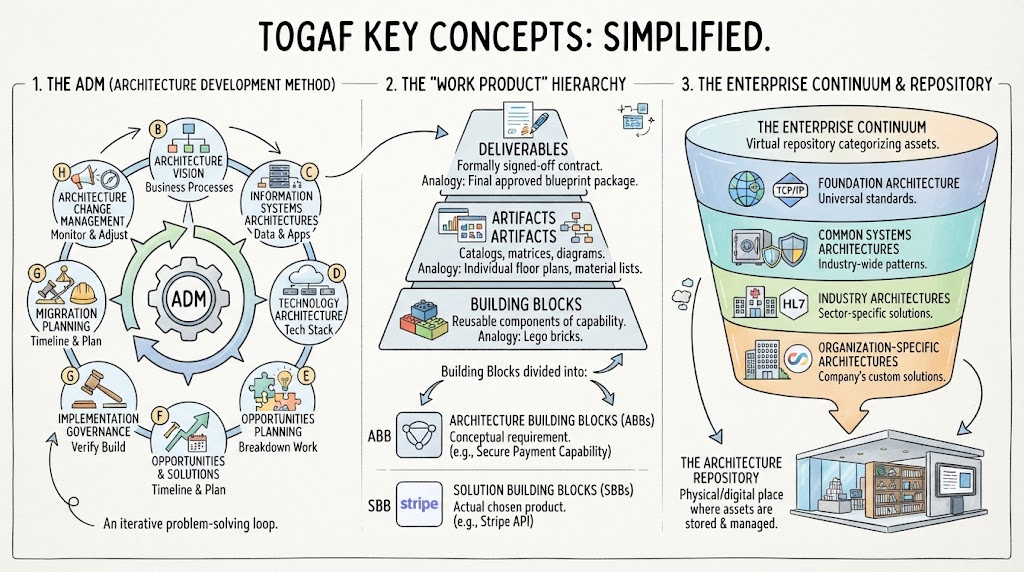
- Move into the detailed phases of the Architecture Development Method (ADM).
2. Essential Knowledge Gained
By the end of Phase A, an architect must possess specific “Essential Knowledge” to guide the rest of the project. This knowledge is not technical yet; it is strategic.
- Problem Scope Boundaries: A deep, clear understanding of the exact boundary of the business problem. This prevents “scope creep” later in the project.
- Stakeholder Mapping: Knowing exactly who has a stake in this problem. In TOGAF, we often map these stakeholders to “concerns” (e.g., security, cost, speed).
- The Architecture Vision: A summary answer to the problem that is fully acceptable to stakeholders. This is the “North Star” for the project.
- Stakeholder Priorities & Value: A clear hierarchy of what matters most to the business. This helps architects make trade-off decisions later on.
3. Recommended Tooling: Visual Paradigm + TOGAF ADM + ArchiMate
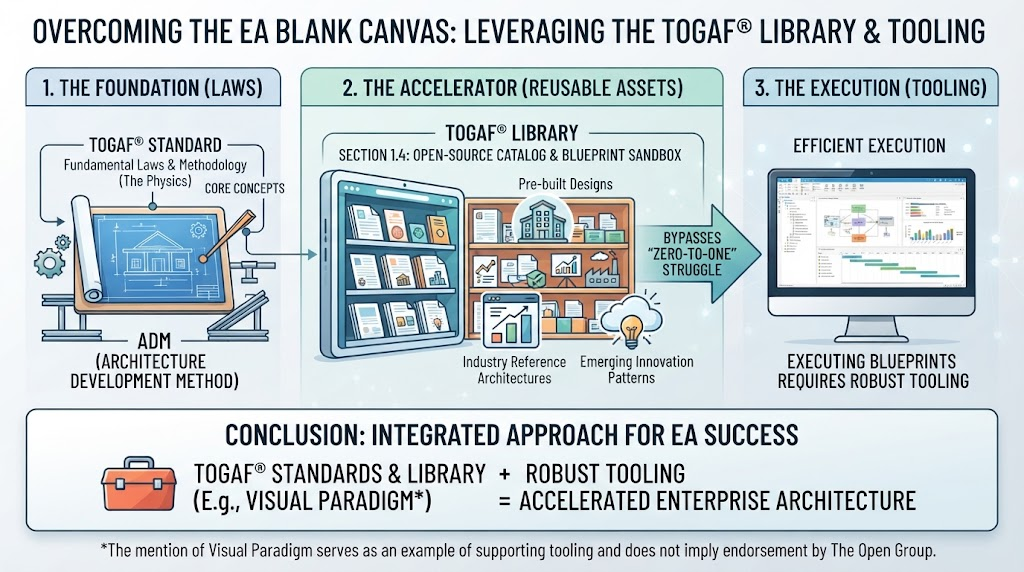
To successfully navigate Phase A, you need tools that facilitate communication between technical teams and business stakeholders. The combination of Visual Paradigm (the tool), TOGAF ADM (the process), and ArchiMate (the modeling language) provides a powerful ecosystem for this phase.
Why This Toolset Works for Phase A
Phase A requires you to visualize the “Dream” so that stakeholders can understand it before they sign the “Handshake.” Here is how this specific toolset helps:
- Visual Paradigm for Enterprise Edition: This is the IDE (Integrated Development Environment) where you work. It supports the full TOGAF lifecycle. For Phase A specifically, it allows you to quickly create diagrams without getting bogged down in complex database modeling. It offers a clean canvas for “Vision” diagrams.
- TOGAF ADM Integration: Visual Paradigm has native support for the TOGAF ADM lifecycle. You can create a specific repository folder for “Phase A” and link your documents to the ADM cycle. This ensures that your “Vision Document” is formally recognized as the output of Phase A.
- ArchiMate for the Vision: The “Architecture Vision” is best modeled using ArchiMate.
- Business Layer: Use ArchiMate Business Objectives and Drivers to map out the “Stakeholder Priorities.”
- Application Layer: Use simple Application Service diagrams to show the high-level capabilities the new system will provide.
- Visualization: ArchiMate allows you to create a “Motivation” diagram, which is specifically designed to link Business Goals to Architectural Solutions. This is the perfect diagram to show stakeholders how their “Dream” translates into “Value.”
Step-by-Step Workflow in Visual Paradigm
- Define the Scope (The “Dream”): Open Visual Paradigm and create a new TOGAF project. Start by drawing a Business Process Diagram or an Organizational Chart to identify the stakeholders mentioned in the text.
- Model the Vision (ArchiMate): Switch to an ArchiMate model. Create a Requirement element for the business problem. Then, create a Goal element that represents the “Architecture Vision.” Connect the Goal to the Requirement to show alignment.
- Document the Outcome: Use the built-in documentation generator in Visual Paradigm to create a PDF or Word document from your model. This document becomes your “Formal Permission to Proceed.”
- The Handshake: Present the documentation to the Business Sponsor. Once signed, you have the “Green Light” to move to Phase B (Business Architecture).
Conclusion
Phase A: Architecture Vision is the foundation of all successful Enterprise Architecture. By strictly defining the Problem Scope and securing the Stakeholder Handshake early, you ensure that the subsequent engineering efforts are aligned with business value. Using Visual Paradigm and ArchiMate makes this process visual, communicative, and manageable.