


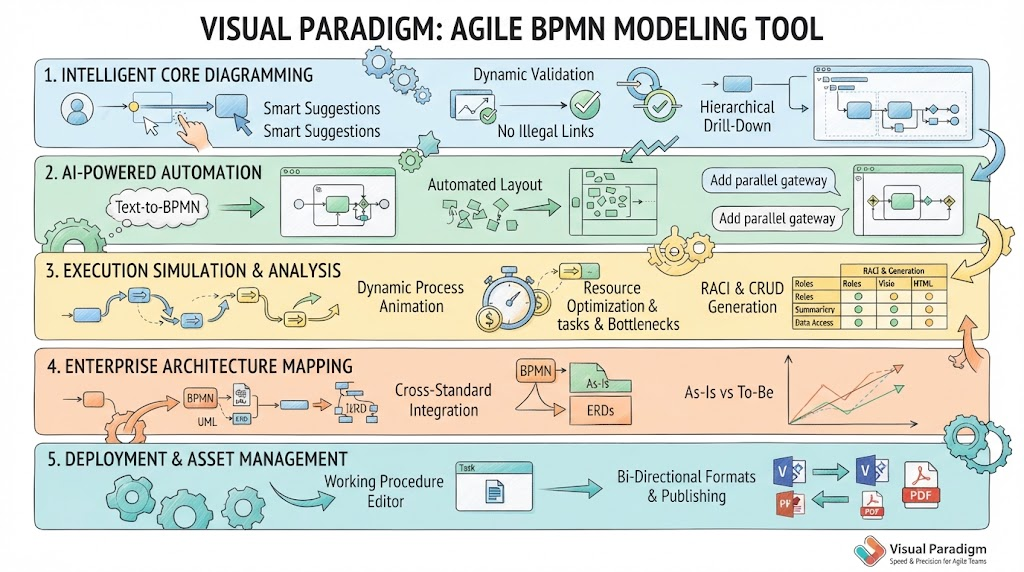
In the rapidly evolving landscape of Agile software development, the gap between high-level business requirements and technical execution often leads to friction. Visual Paradigm bridges this divide by offering an enterprise-grade yet Agile-friendly platform for Business Process Model and Notation (BPMN) modeling. This tutorial explores the system architecture of Visual Paradigm, breaking down how its intelligent core, AI-powered automation, and simulation capabilities transform the way teams model, execute, and optimize business processes.
1. Intelligent Core Diagramming Architecture
The foundation of Visual Paradigm is its intelligent modeling engine, designed to prevent errors before they occur and accelerate the creation of complex diagrams. Unlike static drawing tools, this architecture enforces semantic correctness.
Context-Aware Resource Catalog
At the heart of the modeling interface is a dynamic resource catalog. When a user interacts with a diagram, the system provides Smart Suggestions. Instead of manually searching for symbols, the engine suggests valid next steps based on the current node. This drag-and-drop functionality significantly speeds up diagram creation during fast-paced planning sessions.
Dynamic Validation Rules
One of the most critical features for technical accuracy is Dynamic Validation. The architecture includes a real-time rule engine that monitors the diagram’s topology. For instance, it prevents illegal links—such as crossing pool boundaries or connecting incompatible gateways—ensuring that the model remains compliant with BPMN standards without requiring manual checks.
Hierarchical Process Drill-Down
To manage complexity, the tool utilizes a Hierarchical Process Drill-Down architecture. This allows teams to keep main diagrams clean by collapsing sub-processes. During high-level planning, teams focus on the flow; when details are required, they can drill down into specific sub-processes, maintaining a seamless connection between abstraction and detail.
2. AI-Powered Automation Engines
Visual Paradigm integrates advanced artificial intelligence to reduce the manual overhead of model creation, allowing teams to focus on logic rather than formatting.
Text-to-BPMN NLP Engine
The system features a Text-to-BPMN Natural Language Processing (NLP) Engine. This capability allows users to convert natural language descriptions—such as those found in user stories—directly into initial BPMN drafts. This feature accelerates the transition from abstract idea to a visual model, drastically reducing the “time-to-value” for new projects.
Automated Layout Generation
Manual formatting often detracts from the modeling process. Visual Paradigm employs Automated Layout Generation, where the AI structures swimlanes and sequences automatically. This ensures that the diagram is visually balanced and readable immediately upon creation.
Conversational AI Refinement
For iterative refinement, the tool offers a Conversational AI interface. Users can issue commands like “Add a parallel gateway for testing” via a chatbot interface. This supports collaborative sessions where stakeholders can request changes verbally or via text, and the system executes the technical implementation instantly.
3. Execution Simulation & Analysis
Once a process is modeled, Visual Paradigm shifts from design to analysis, using simulation to validate the logic and performance of the workflow.
Dynamic Process Animation
The Dynamic Process Animation feature visualizes token flow through the diagram. This is essential for understanding complex decision paths and identifying potential deadlocks before the process is ever deployed to production. It acts as a virtual sandbox for process logic.
Resource Optimization Simulation
To support realistic sprint capacity planning, the tool offers Resource Optimization Simulation. By assigning costs and times to specific tasks, the system can forecast bottlenecks. This data-driven approach helps teams understand where their resources are most strained.
RACI & CRUD Matrix Generation
Visual Paradigm automatically extracts responsibility matrices from diagrams. This includes the RACI (Responsible, Accountable, Consulted, Informed) matrix and CRUD (Create, Read, Update, Delete) matrices. These artifacts clarify roles and data interactions, ensuring that every task in the model has a clear owner and data lineage.
4. Enterprise Architecture Mapping
In an enterprise environment, business processes do not exist in isolation. Visual Paradigm ensures alignment across different technical artifacts.
Cross-Standard Integration
The architecture supports Cross-Standard Integration, linking BPMN workflows with UML, ERDs, or user story maps. This ensures that the business process logic aligns perfectly with the underlying software architecture and database design.
As-Is and To-Be Gap Analysis
For continuous improvement, the tool tracks changes between current and future processes. This As-Is and To-Be Gap Analysis provides a clear audit trail, allowing organizations to measure the impact of process changes over time.
5. Deployment & Asset Management
The final stage of the architecture focuses on dissemination and long-term asset management.
Working Procedure Editor
Documentation is often separated from modeling, leading to outdated guides. Visual Paradigm solves this with a Working Procedure Editor that embeds detailed guidelines within tasks without cluttering the diagram. This keeps documentation accessible but unobtrusive.
Bi-Directional Formats & Publishing
Finally, the system ensures accessibility through Bi-Directional Formats & Publishing. Teams can easily import/export from Visio and publish to HTML/PDF for sharing with stakeholders who may not have the modeling tool installed. This flexibility ensures that the process models serve as a universal language for the entire organization.
Related posts:
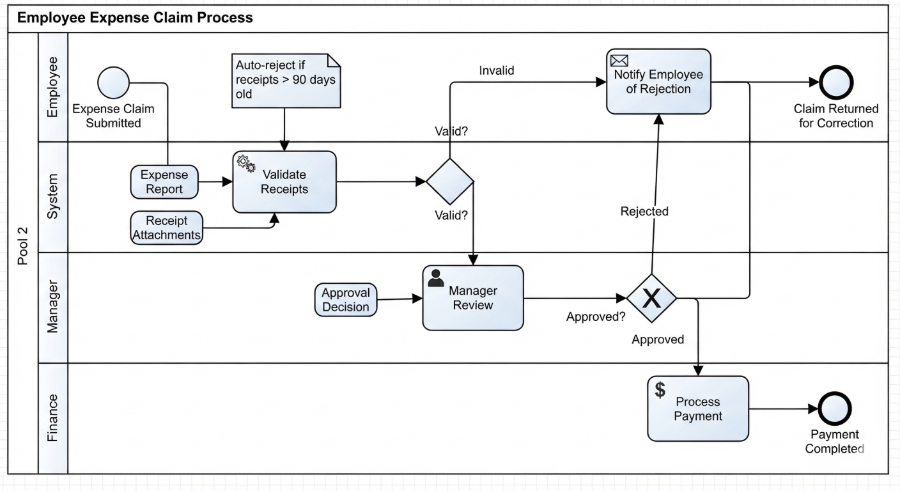 Mastering Business Processes: The Employee Expense Claim Flow
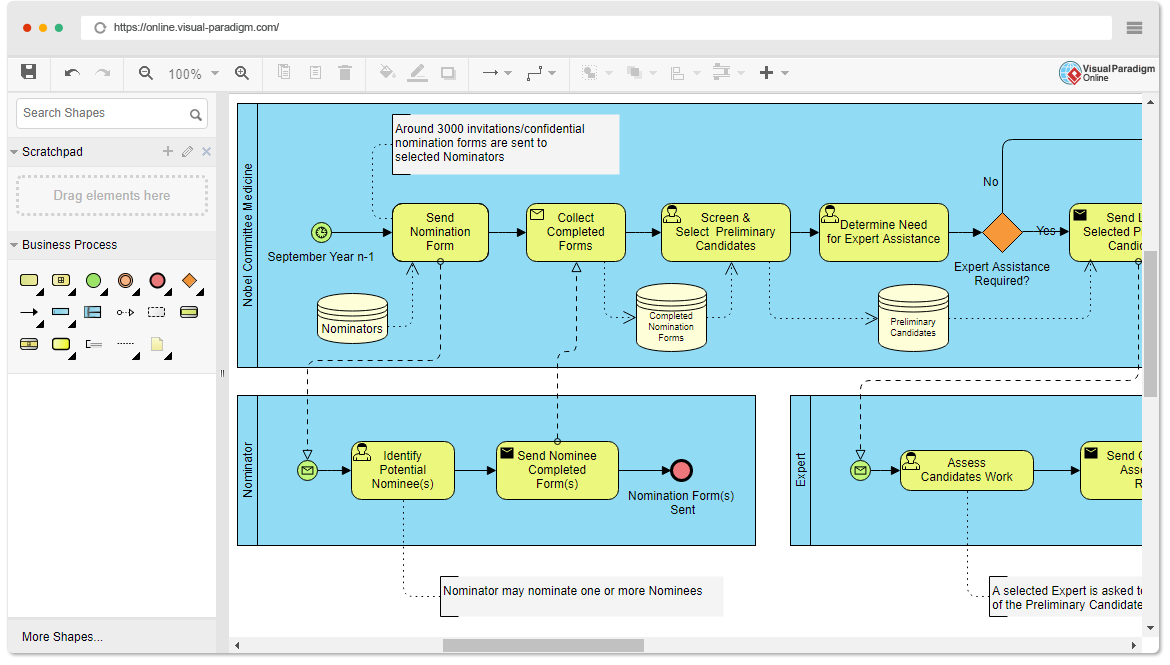 Mastering Business Process Modeling: The Nobel Prize Nomination Workflow in BPMN
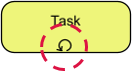 Mastering Iterative Processes: A Deep Dive into Loop Markers in Visual Paradigm
 Mastering BPMN: A Comprehensive Guide to Process Modeling Elements & Best Practices