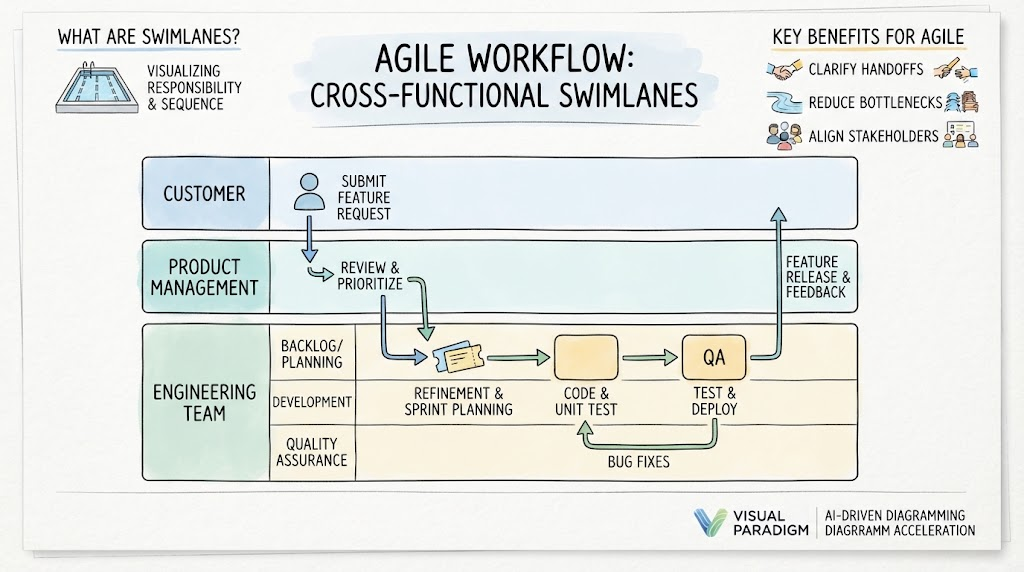
In the fast-paced world of Agile software development, the ability to visualize complex interactions is not just a luxury—it is a necessity. As teams become increasingly cross-functional, the “who” and “when” of a process are just as critical as the “what.” This tutorial explores the foundational concept of Swimlanes within Business Process Model and Notation (BPMN), specifically focusing on how they manage the flow of work from a customer request to a final software release.
Using the Agile Workflow diagram provided, we will deconstruct the architecture of this process, demonstrating how visual frameworks reduce bottlenecks and clarify handoffs.
Understanding the Architecture: Pools and Lanes
Before diving into the specific tasks, it is essential to understand the structural hierarchy of the diagram. In BPMN, swimlanes are used to organize activities and show which participant is responsible for them. The architecture in our diagram consists of three distinct layers:
- The Customer Lane: The external actor initiating the value stream.
- The Product Management Lane: The bridge between business needs and technical execution.
- The Engineering Team Lane: A complex, multi-tiered environment containing the actual development and quality assurance processes.
These lanes act as containers, ensuring that responsibilities are clearly defined. If a task is in the “Engineering Team” lane, it is the responsibility of that team, regardless of whether it is in the “Backlog” or “Development” sub-lane.
Step-by-Step Process Analysis
Let us walk through the workflow chronologically, analyzing the handoffs and logic flow depicted in the diagram.
1. Initiation: The Customer Request
The process begins at the top with the Customer lane. The trigger event is a Submit Feature Request. This simple action initiates the entire value stream, signaling a shift from a passive state to an active development cycle.
2. Triage and Prioritization
The request flows downwards into the Product Management lane. Here, the process is governed by a critical decision point: Review & Prioritize.
This step is vital for Agile methodology. It ensures that only valuable, high-priority items move forward, preventing the engineering team from being overwhelmed by low-impact requests. Once prioritized, the request is formally entered into the engineering ecosystem.
3. The Engineering Lifecycle
The request now enters the Engineering Team lane. This is the most complex section of the diagram, utilizing sub-lanes to distinguish between different phases of work:
- Backlog/Planning: The initial entry point for new work.
- Development: The core execution phase, including
Refinement & Sprint PlanningandCode & Unit Test. - Quality Assurance: The validation phase, represented by
QAandTest & Deploy.
Managing Complexity: Feedback Loops and Handoffs
One of the most powerful features of swimlane diagrams is their ability to visualize feedback loops. In this Agile workflow, we see a critical loop at the bottom involving QA and Bug Fixes.
After the code is tested and deployed (QA), if a bug is found, the workflow does not simply fail; it loops back to the Development lane for fixes. This loop is depicted by the arrow pointing from the “QA” box back to the “Code & Unit Test” phase. This visual cue is essential for understanding that software development is iterative, not linear.
The “Vertical Handoff” and Stakeholder Alignment
Finally, once the QA phase is successful, the arrow extends upwards, crossing back over the Product Management lane and returning to the Customer lane. This represents the Feature Release & Feedback.
This vertical movement is significant because it completes the cycle. It demonstrates a closed-loop system where the customer’s initial request is fulfilled, and their feedback can theoretically restart the process. By visualizing this entire journey, teams can easily identify:
- Handoff Friction: Where does the work get stuck when passing from Product to Engineering?
- Visibility: How long does a request sit in the “QA” lane versus the “Development” lane?
- Responsibility: Which specific sub-lane owns a specific delay?
Conclusion
By utilizing swimlanes, the Agile team transforms a chaotic collection of tasks into a coherent, manageable system. Whether you are using manual tools or AI-driven diagramming software like Visual Paradigm, the structural integrity of your model—defining who does what and in what order—is the foundation of a successful Agile process.