In the dynamic world of Enterprise Architecture (EA), the concept of “completion” is a myth. Business requirements shift, technology evolves, and market conditions fluctuate. This reality is encapsulated in TOGAF Phase H: Architecture Change Management, often referred to as “The Continuous Evolution.”
This tutorial explores the critical mechanisms of Phase H, moving beyond simple maintenance to demonstrate how an enterprise actively adapts its architecture to new realities. We will break down the inputs, the decision-making process, and the essential outputs that ensure an architecture remains relevant.
The Core Concept: Why Architecture Must Evolve
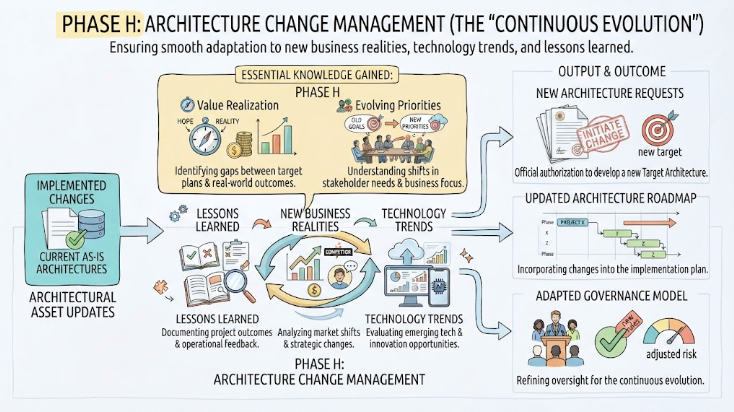
Phase H is not merely about fixing bugs; it is about strategic alignment. As the diagram illustrates, this phase acts as the bridge between the “Current As-Is Architectures” and the future state. It acknowledges that the gap between what was planned (the Target Architecture) and what was actually realized (the Outcome) must be continuously monitored.
The goal is to ensure that the architecture adapts smoothly to:
- New Business Realities: Shifts in stakeholder preferences or market priorities.
- Technology Trends: Emerging innovations that offer better opportunities.
- Lessons Learned: Operational feedback from prior work.
Deconstructing the Phase H Cycle
To understand the flow of information in Phase H, we must look at the “Essential Knowledge Gained” engine that drives the process.
1. Value Realization
The first step in this evolution is Value Realization. This involves identifying the actual gaps between your approved target—what you hoped to build—and the real-world realization from prior work. It answers the question: “Did we achieve what we set out to do?”
2. Evolving Priorities
Business is fluid. Evolving Priorities involves understanding new shifts in stakeholder preferences. The architecture cannot remain static if the business goals have moved. This input ensures the EA function remains aligned with the organization’s strategic direction.
3. The Catalysts for Change
The diagram highlights three specific drivers that trigger a change in the architecture:
- Lessons Learned: Documenting project outcomes and operational feedback. If a project failed or struggled, the architecture must evolve to prevent recurrence.
- New Business Realities: Analyzing market shifts and strategic changes. If the business enters a new market, the architecture must support it.
- Technology Trends: Evaluating emerging tech and innovation opportunities. New tools may offer a more efficient path to the target state.
Outputs: The “New Architecture” Request
The ultimate output of Phase H is the Official Direction to Proceed. This is not just a suggestion; it is the authorization to develop a New Target Architecture to address perceived, real, or anticipated shortfalls.
This phase results in three distinct artifacts:
- New Architecture Requests: The formal initiation of a new cycle to address gaps.
- Updated Architecture Roadmap: Incorporating these changes into the implementation plan, adjusting timelines and milestones.
- Adapted Governance Model: Refining oversight to manage the continuous evolution and adjusted risk.
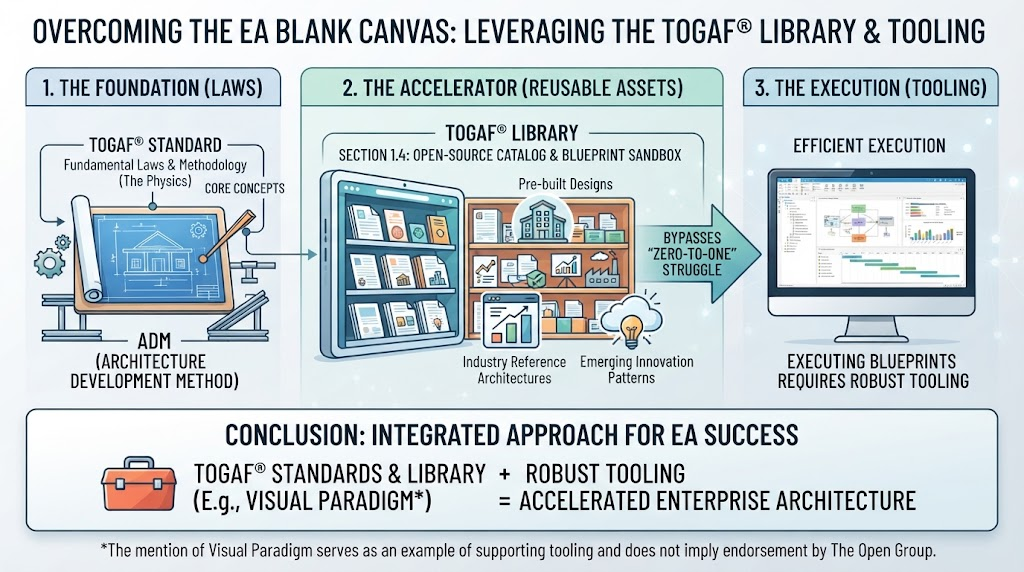
Recommended Tooling: Integrating Visual Paradigm with TOGAF
To effectively execute Phase H, you need tools that can visualize these complex flows and manage the “Continuous Evolution.” The combination of Visual Paradigm, TOGAF ADM, and ArchiMate provides a powerful ecosystem for this process.
1. Visual Paradigm as the Execution Engine
Visual Paradigm serves as the central repository for the EA lifecycle. In the context of Phase H, its “Change Management” features allow architects to track the lifecycle of a specific architecture request. Instead of static documents, the tool allows for versioning and traceability, ensuring that the “New Target Architecture” is linked back to the specific “Lessons Learned” or “Technology Trends” that triggered it.
2. ArchiMate for Gap Analysis
The core of Phase H is identifying the gap between the “Target” and “Reality.” ArchiMate provides the standardized modeling language to visualize this. You can model the “Current As-Is” state (including the failures or gaps) and contrast it with the “Future As-Will” state. This visualization makes the “Value Realization” data concrete, allowing stakeholders to see exactly where the architecture is falling short.
3. The TOGAF ADM Workflow
Visual Paradigm’s built-in TOGAF templates facilitate the “New Architecture Request” output. When Phase H identifies a need for change, the tool guides the team back into the ADM cycle. It ensures that the “New Target Architecture” is not developed in a vacuum but is rigorously assessed against the “Adapted Governance Model” mentioned in the diagram.
Summary of the Tooling Benefits
- Visualization: Turn abstract “Lessons Learned” into concrete diagrams.
- Alignment: Ensure the “New Architecture” meets the “Evolving Priorities.”
- Governance: Manage the risk associated with continuous change.
By mastering Phase H and utilizing the right tooling, enterprises can ensure their architecture is not a relic of the past, but a living, breathing asset that drives future success.