


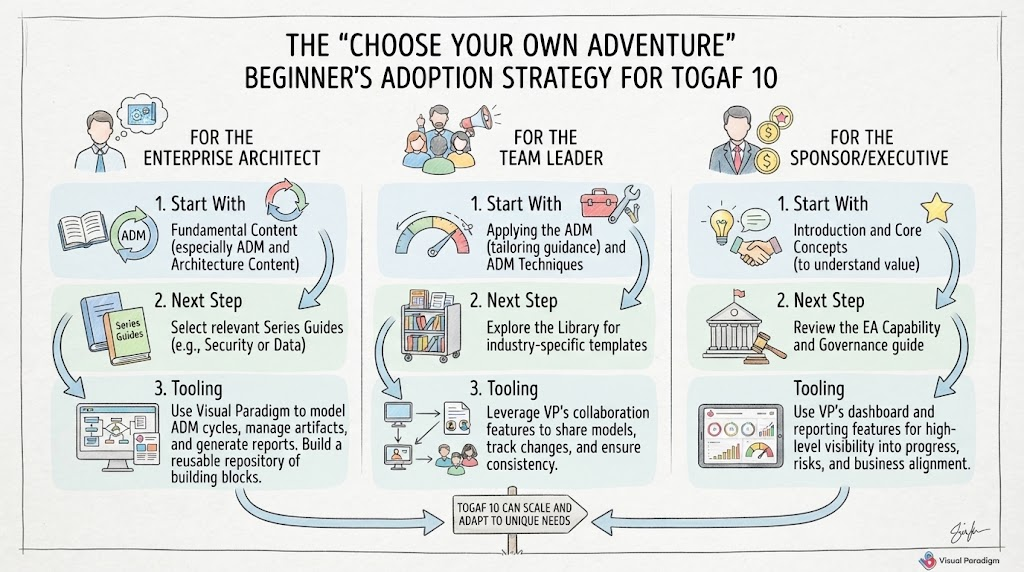
Implementing the TOGAF 10 standard can often feel like a massive, monolithic undertaking. However, successful digital transformation requires agility and tailored approaches. The “Choose Your Own Adventure” adoption strategy presented in the provided graphic illustrates a pragmatic, role-based pathway for integrating TOGAF 10 into an organization. Rather than forcing a single rigid process on every employee, this strategy segments the implementation into three distinct streams based on user needs: The Enterprise Architect, The Team Leader, and The Sponsor/Executive.
The Role-Based Implementation Strategy
The core philosophy of this strategy is that TOGAF 10 is scalable and adaptable. By segmenting the learning curve and tool usage, organizations can accelerate adoption while ensuring that every stakeholder understands their specific value within the Architecture Development Method (ADM).
1. For the Enterprise Architect
For the architect, TOGAF is the primary language of work. The strategy emphasizes a deep dive into the technical core of the standard.
- Start With: Fundamental Content. This is the bedrock of the architecture practice. Architects must master the ADM (Architecture Development Method) cycles and the Architecture Content metamodel to understand the artifacts they need to produce.
- Next Step: Select Series Guides. Once the fundamentals are clear, architects can specialize. The guide suggests selecting Series Guides relevant to current projects, such as Security or Data, to apply TOGAF to specific domains.
- Tooling: Visual Paradigm (VP). The architect is the builder. Using VP’s modeling capabilities is essential to model ADM cycles, manage complex artifacts, and generate comprehensive reports. A key goal here is building a reusable repository of building blocks that can be leveraged across the enterprise.
2. For the Team Leader
Team leaders bridge the gap between high-level strategy and execution. Their adoption strategy focuses on application and collaboration.
- Start With: Applying the ADM. Unlike architects who study the theory, leaders need to focus on tailoring guidance. This means understanding how to adapt the ADM to fit their specific team’s workflow and learning ADM Techniques to solve immediate problems.
- Next Step: Explore the Library. Efficiency is key for leaders. By exploring the library for industry-specific templates, teams can skip the “blank page” syndrome and accelerate their work using proven patterns.
- Tooling: Visual Paradigm Collaboration. The focus here is on consistency and communication. Leaders should leverage VP’s collaboration features to share models with the team, track changes, and ensure that the technical output remains consistent across different projects.
3. For the Sponsor/Executive
Executives do not need to model diagrams, but they must understand the business value and governance required to fund and support the initiative.
- Start With: Introduction and Core Concepts. The primary goal is to understand the value proposition of Enterprise Architecture. Executives need to grasp how TOGAF aligns technology with business strategy.
- Next Step: EA Capability and Governance. Once they understand the value, they must learn how to support it. Reviewing the EA Capability and Governance guide helps them understand how to measure the function’s success and establish the necessary oversight.
- Tooling: Visual Paradigm Dashboards. Executives require visibility without the clutter. VP’s dashboard and reporting features provide a high-level view of architecture progress, risks, and alignment with business goals, allowing for data-driven decision-making.
Recommended Tooling Section: Visual Paradigm TOGAF ADM Tool
The “Choose Your Own Adventure” strategy is heavily reliant on a unified toolset to ensure that data flows seamlessly between the Architect, the Team Leader, and the Executive. Visual Paradigm serves as the ideal platform for this strategy, offering a comprehensive ecosystem:
- Comprehensive Modeling: For the Architect, VP offers robust support for the ADM, allowing for the creation of standardized diagrams and the management of the Architecture Content Metamodel.
- Enterprise Repository: The tool provides a centralized repository, essential for building the reusable building blocks mentioned in the architect’s section. This ensures that assets are not siloed.
- Collaboration & Governance: The platform’s collaboration features support the Team Leader’s need for consistency, while the executive dashboards provide the governance and reporting visibility required by the Sponsor.
- Customization: VP supports the tailoring of the ADM, allowing organizations to customize the standard to fit their unique needs without losing the core benefits of TOGAF.
By leveraging Visual Paradigm’s integrated features, organizations can effectively execute this “Choose Your Own Adventure” strategy, ensuring that TOGAF 10 adoption is efficient, relevant, and valuable for every role in the organization.
Related posts:
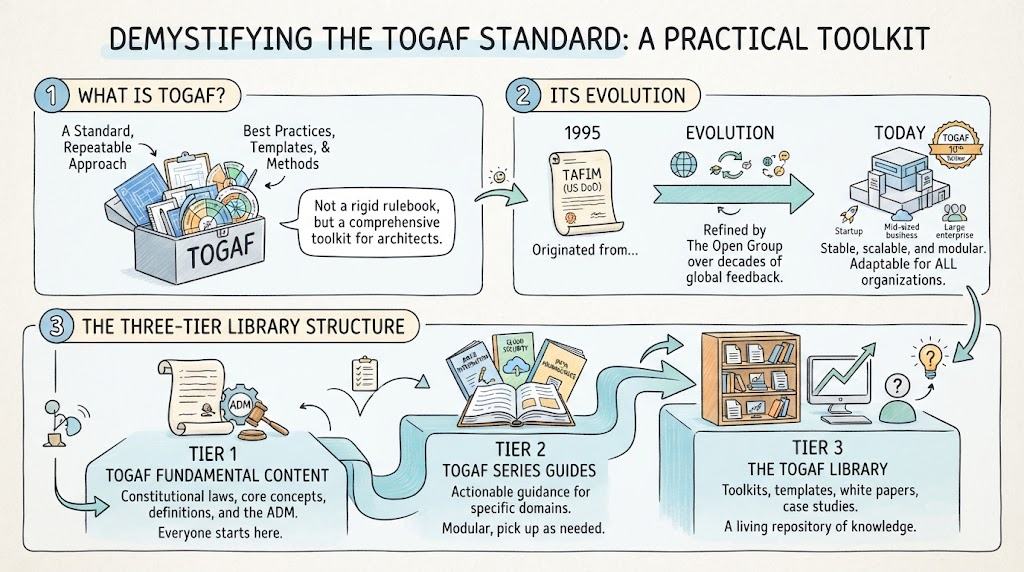 Demystifying the TOGAF Standard: A Practical Toolkit for Modern Enterprise Architecture
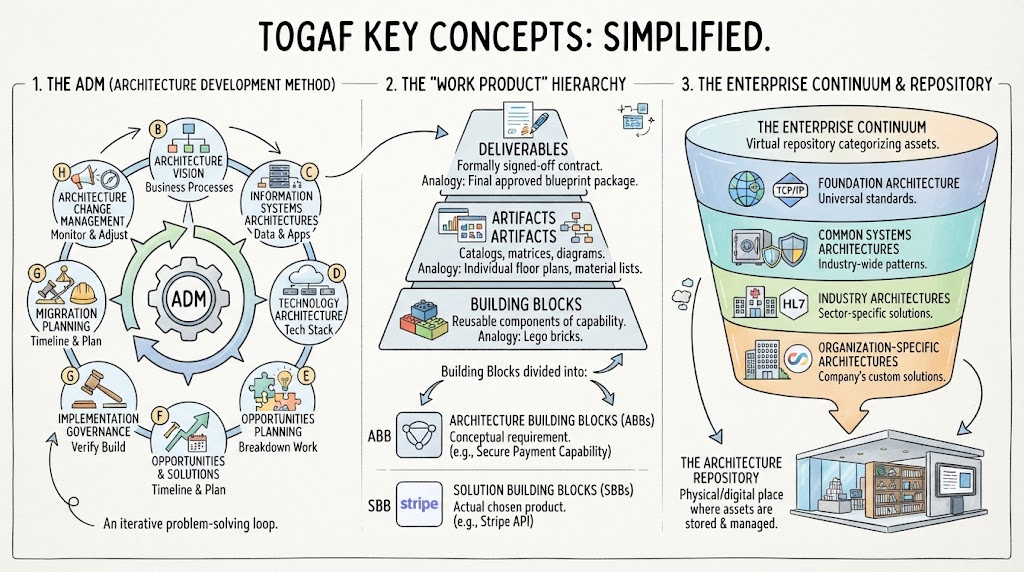 Mastering TOGAF: A Step-by-Step Guide to the ADM Cycle and Enterprise Architecture
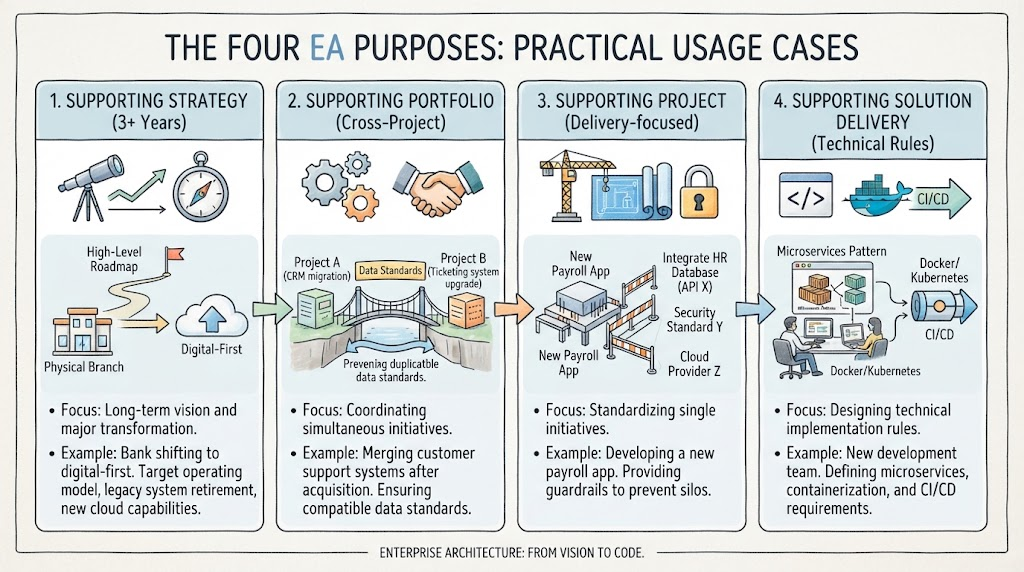 Mastering Enterprise Architecture: A Step-by-Step Guide to the Four Core Purposes
 Mastering Modern Agility: A Tutorial on Minimum Viable Architecture and the Digital Emergence Journey