


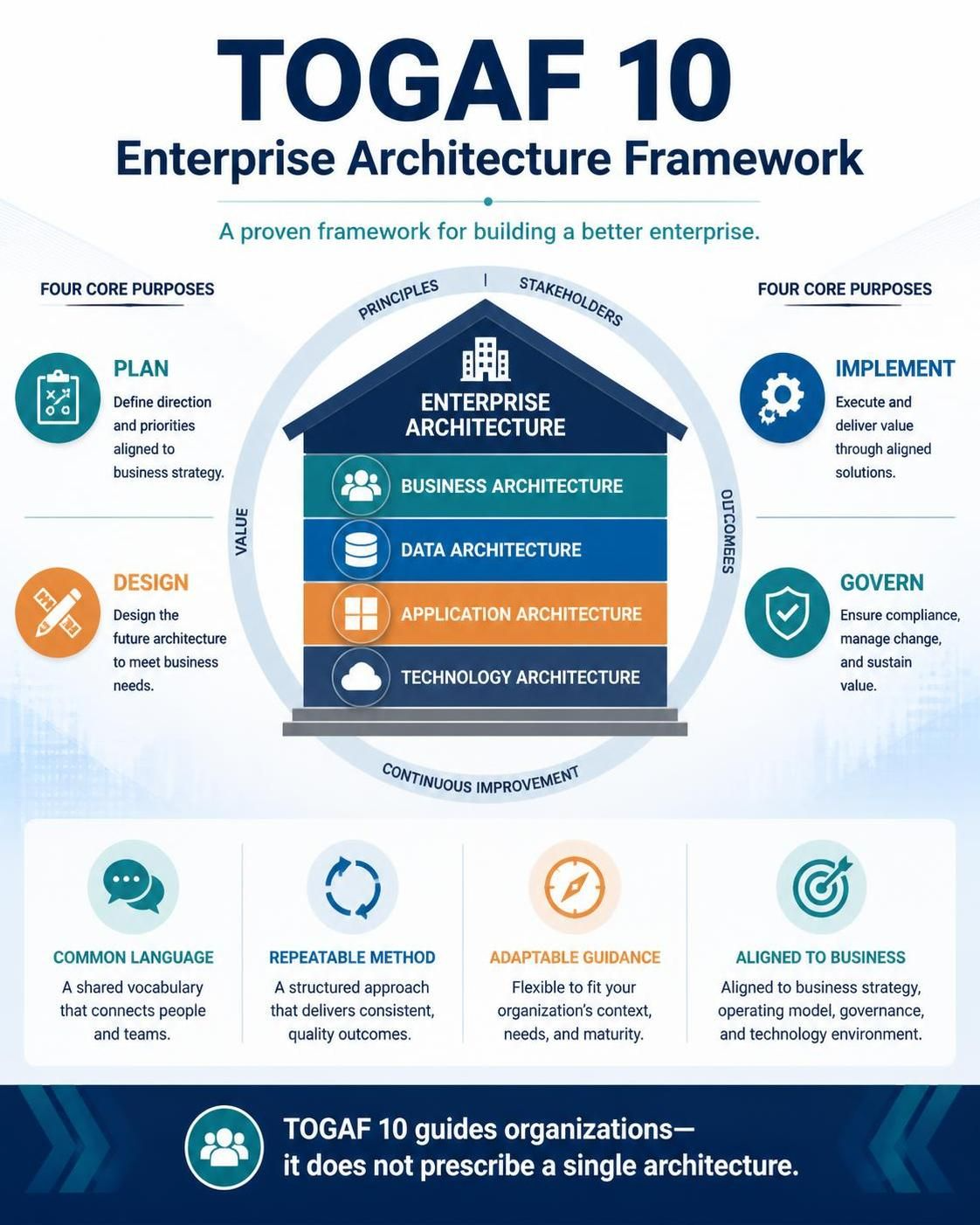
In the complex landscape of modern digital transformation, organizations need a structured approach to manage change. TOGAF 10 (The Open Group Architecture Framework) provides this structure, acting as a comprehensive guide for building a better enterprise. Unlike rigid software that dictates a single path, TOGAF 10 is an adaptable framework designed to help organizations plan, design, implement, and govern business and technology change.
This tutorial breaks down the visual architecture of TOGAF 10, exploring its four core domains, the cyclical process of architecture development, and the fundamental principles that drive successful enterprise alignment.
The Architecture of an Enterprise: The Four Domains
At the heart of TOGAF 10 is the concept of the “Enterprise Architecture” building block. This structure is not a physical building but a conceptual model representing the four critical domains that must be developed in unison to support business strategy.
As illustrated in the framework, these domains are interconnected layers:
1. Business Architecture
The foundation of any enterprise effort is the Business Architecture. This domain defines the organization’s strategy, governance, capabilities, processes, and operating model. It answers the question: “What is the business trying to achieve?” Without a clear business architecture, technical solutions often fail to deliver value.
2. Data Architecture
Once business processes are defined, organizations must determine how information flows. Data Architecture governs the structure, management, ownership, and flow of organizational data. It ensures that the right information is available to the right people at the right time to support decision-making.
3. Application Architecture
Business capabilities and data require software to function. The Application Architecture defines the portfolio of applications, their interactions, and their relationship to business processes. It acts as the bridge between the logical requirements of the business and the technical implementation.
4. Technology Architecture
Finally, the Technology Architecture provides the underlying infrastructure. This includes platforms, networks, technical services, and cloud environments that support the applications and data. It ensures the organization has the technical capacity to execute its strategy.
The Four Core Purposes: The Cycle of Value
The TOGAF 10 framework is not a static document; it is a dynamic cycle. The infographic illustrates four core purposes that guide the organization through the architecture lifecycle. These purposes form a continuous loop of value and improvement:
- PLAN: This phase involves defining direction and priorities. It ensures that the architecture is strictly aligned with the overarching business strategy. Before drawing a single line, architects must understand where the organization wants to go.
- DESIGN: Once the plan is set, architects must design the future architecture. This involves creating detailed blueprints that meet specific business needs, ensuring that the solution is fit for purpose.
- IMPLEMENT: Design is useless without execution. The implementation phase focuses on executing and delivering value through aligned solutions. This is where the theoretical architecture becomes reality.
- GOVERN: The final step is governance. This ensures compliance, manages change, and sustains value. It acts as the quality control mechanism, ensuring that the implemented architecture continues to serve the business over time.
Key Principles for Success
TOGAF 10 distinguishes itself from other methodologies through four key attributes that make it a powerful tool for any organization:
- A Common Language: By establishing a shared vocabulary, TOGAF connects people and teams. It ensures that business stakeholders and IT professionals are speaking the same language when discussing capabilities and requirements.
- A Repeatable Method: The framework provides a structured approach—often referred to as the Architecture Development Method (ADM)—that delivers consistent, high-quality outcomes regardless of the specific project.
- Adaptable Guidance: One size does not fit all. TOGAF 10 is flexible enough to fit an organization’s specific context, needs, and maturity level. It is a guide, not a constraint.
- Aligned to Business: Ultimately, the goal is alignment. TOGAF ensures that the architecture supports the business strategy, operating model, governance requirements, and technology environment.
Conclusion: Continuous Improvement
The infographic highlights a crucial circular flow surrounding the four domains: Principles, Stakeholders, Outcomes, Value, and Continuous Improvement. This signifies that Enterprise Architecture is never “finished.” It is an ongoing process of refining and adapting.
As the bottom of the framework states: “TOGAF 10 guides organizations—it does not prescribe a single architecture.” This flexibility allows organizations to leverage the framework to develop architectures that are unique to their specific challenges while maintaining the rigor and structure needed for long-term success.
Related posts:
 Mastering TOGAF: A Step-by-Step Guide to the ADM Cycle and Enterprise Architecture
 Mastering Enterprise Architecture: A Step-by-Step Guide to the Six Core Pillars of TOGAF
 Overcoming the EA Blank Canvas: Leveraging the TOGAF Library & Tooling
 Mastering Phase E: Opportunities & Solutions in Enterprise Architecture