


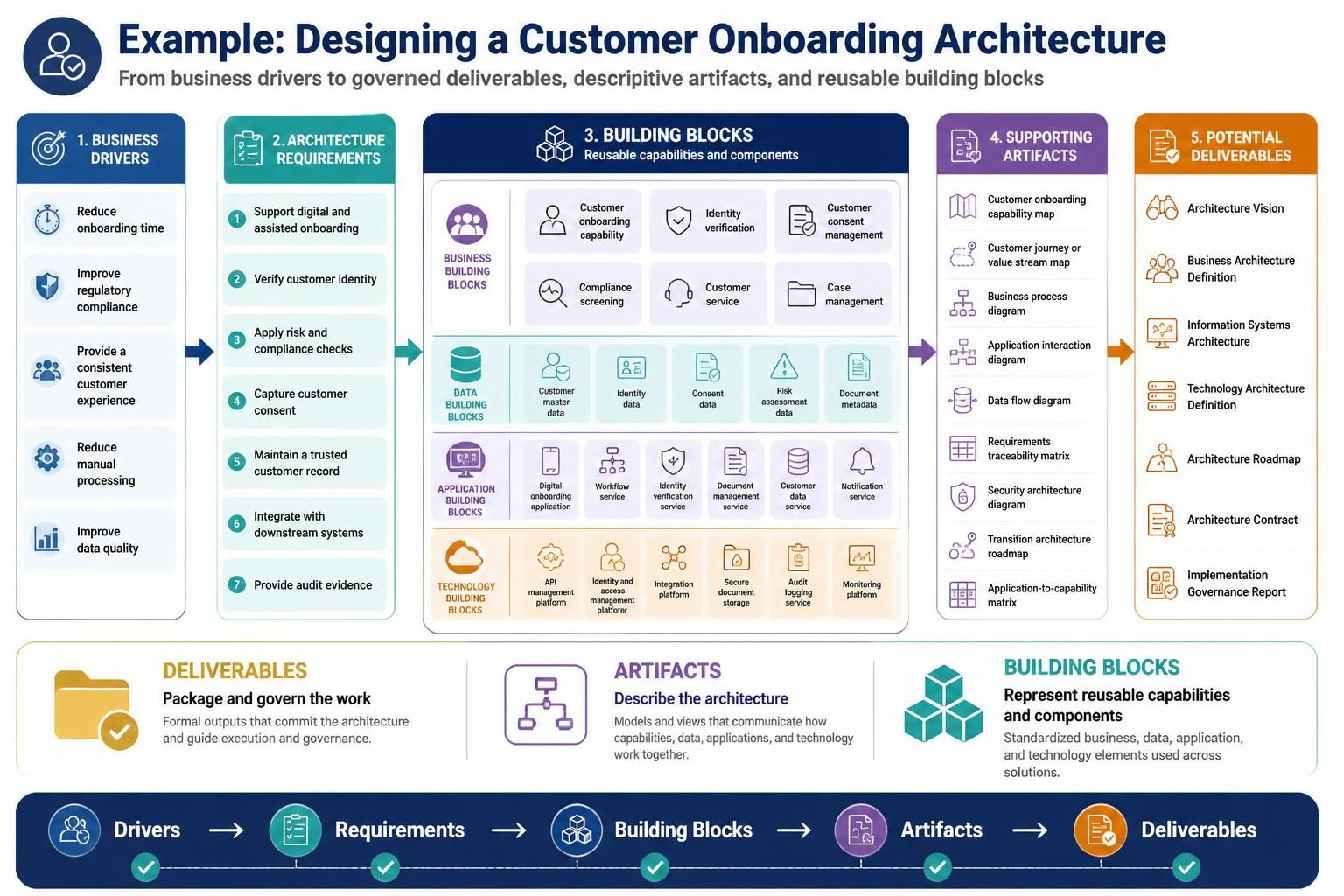
Designing a robust enterprise system is rarely a matter of simply writing code; it requires a structured approach to align technology with business goals. The image provided illustrates a classic application of the TOGAF (The Open Group Architecture Framework) Architecture Development Method (ADM). It maps the journey from vague business needs to concrete, governed deliverables.
In this tutorial, we will deconstruct this specific example—Designing a Customer Onboarding Architecture—to understand how architects translate “Business Drivers” into “Technology Building Blocks.”
Phase 1: Defining the “Why” (Business Drivers)
Every architecture project begins with a problem statement or a set of goals. In the diagram, these are labeled as Business Drivers. These are not technical requirements; they are the strategic reasons why the organization is investing in this project.
For a Customer Onboarding process, the image highlights five critical drivers:
- Reduce onboarding time: Speed to market is crucial for customer retention.
- Improve regulatory compliance: Ensuring the system adheres to laws like GDPR or KYC (Know Your Customer).
- Provide a consistent customer experience: Ensuring the user interface and process feel the same whether the customer is on mobile or desktop.
- Reduce manual processing: Moving away from paper forms to automation.
- Improve data quality: Ensuring the data captured at the start of the relationship is accurate.
Phase 2: Defining the “What” (Architecture Requirements)
Once the business drivers are understood, the architect translates them into functional needs. This is the bridge between business strategy and technical implementation. These are the Architecture Requirements.
Looking at the second column, we see how the drivers are met by specific requirements:
- To reduce manual processing, the system must support digital and assisted onboarding.
- To ensure compliance, the system must verify customer identity and apply risk and compliance checks.
- To improve data quality, the system must capture customer consent and maintain a trusted customer record.
- To support downstream operations, the system must integrate with downstream systems.
Phase 3: Defining the “How” (Building Blocks)
This is the most complex section of the architecture, represented by the large central column. Building Blocks are the reusable components that make up the solution. TOGAF categorizes these into four distinct layers.
3.1 Business Building Blocks
These are the high-level capabilities or organizational units required to execute the business strategy. For onboarding, this includes the Customer Onboarding Capability itself, as well as Identity Verification and Case Management capabilities.
3.2 Data Building Blocks
Architecture is useless without data. This layer defines the information assets. The diagram lists essential data entities such as:
- Customer Master Data: The core profile of the user.
- Identity Data: Documents, IDs, and biometrics.
- Consent Data: Records of what the user agreed to.
- Risk Assessment Data: The output of compliance checks.
3.3 Application Building Blocks
Here, we define the software applications that will hold the data and perform the logic. In this scenario, the architecture requires:
- A Digital Onboarding Application for the end-user.
- A Workflow Service to manage the steps of the process.
- A Document Management Service to store uploaded IDs.
- A Notification Service to alert users of status changes.
3.4 Technology Building Blocks
Finally, we map the applications to the underlying infrastructure. This layer ensures the software has the “fuel” it needs to run. The diagram specifies:
- API Management Platform: To expose services securely.
- Identity and Access Management (IAM): To handle user login and security.
- Integration Platform: To connect the onboarding system with banking or CRM systems.
- Secure Document Storage: For compliance and security.
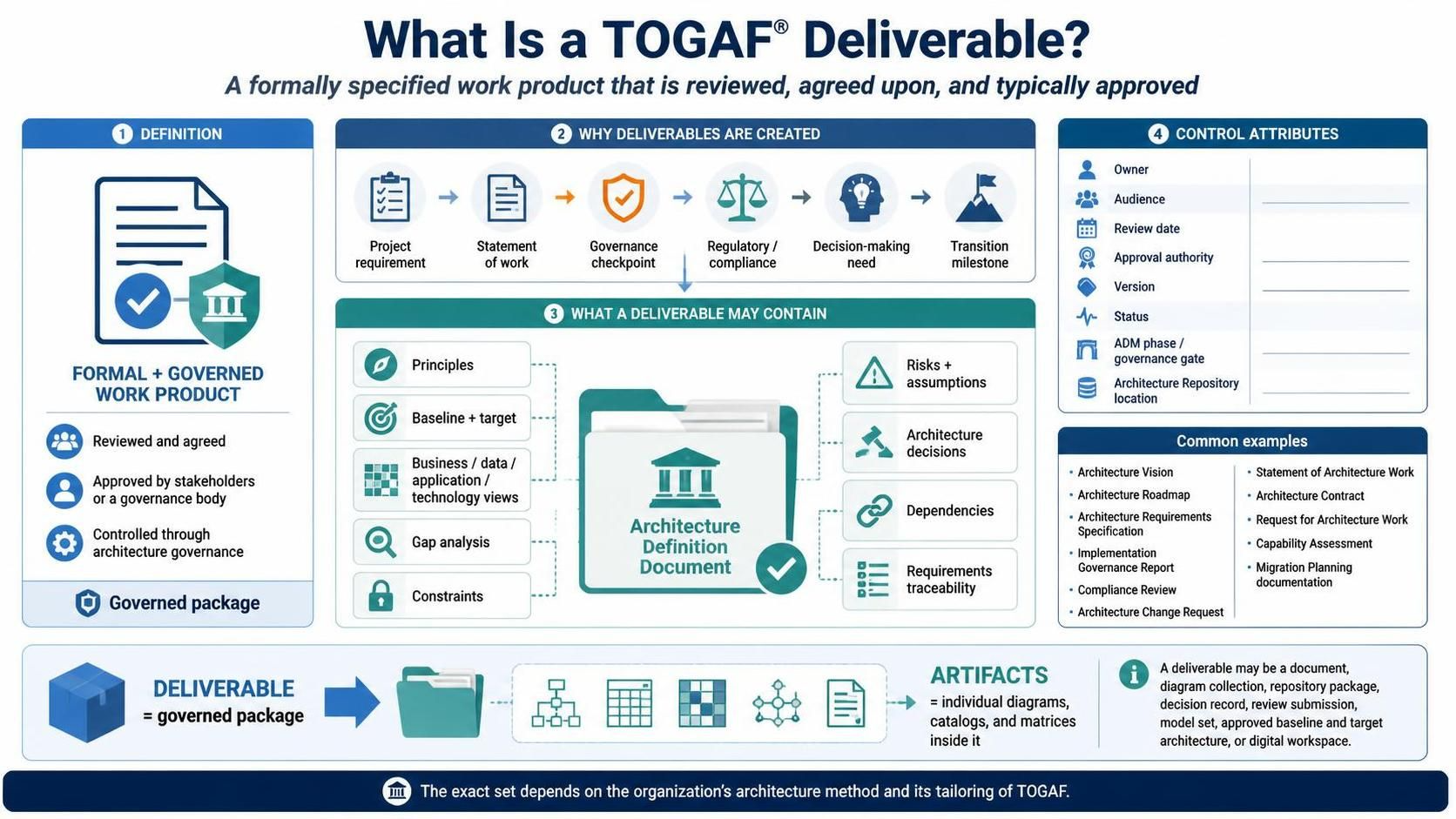
Phase 4: Documenting the Solution (Artifacts)
As the architecture is built, it must be documented. These documentation items are known as Artifacts. They are the models and diagrams that communicate the design to stakeholders.
The image lists several critical artifacts:
- Customer Journey Map: Visualizing the steps the customer takes.
- Business Process Diagram: Showing the internal logic of the workflow.
- Data Flow Diagram: Illustrating how data moves between systems.
- Security Architecture Diagram: Highlighting security controls.
Phase 5: The Final Output (Deliverables)
The culmination of the architectural effort is the set of Deliverables. These are the formal outputs that commit the architecture and guide execution. In a real-world project, these would be:
- Architecture Vision: The high-level pitch.
- Information Systems Architecture: The detailed blueprint.
- Architecture Roadmap: The timeline for implementation.
- Implementation Governance Report: Ensuring the build matches the design.
Conclusion
By following this structured flow—Drivers → Requirements → Building Blocks → Artifacts → Deliverables—you can ensure that every line of code serves a business purpose. This systematic approach is the essence of the TOGAF ADM.
To effectively manage these complex relationships and generate the diagrams (Artifacts) and models mentioned above, it is highly recommended to utilize professional architecture tooling. For this specific methodology, the Visual Paradigm TOGAF ADM Tool is a superior choice. It provides the necessary environment to map these building blocks, generate the required diagrams, and ensure traceability between your business drivers and your final technical implementation.
Related posts:
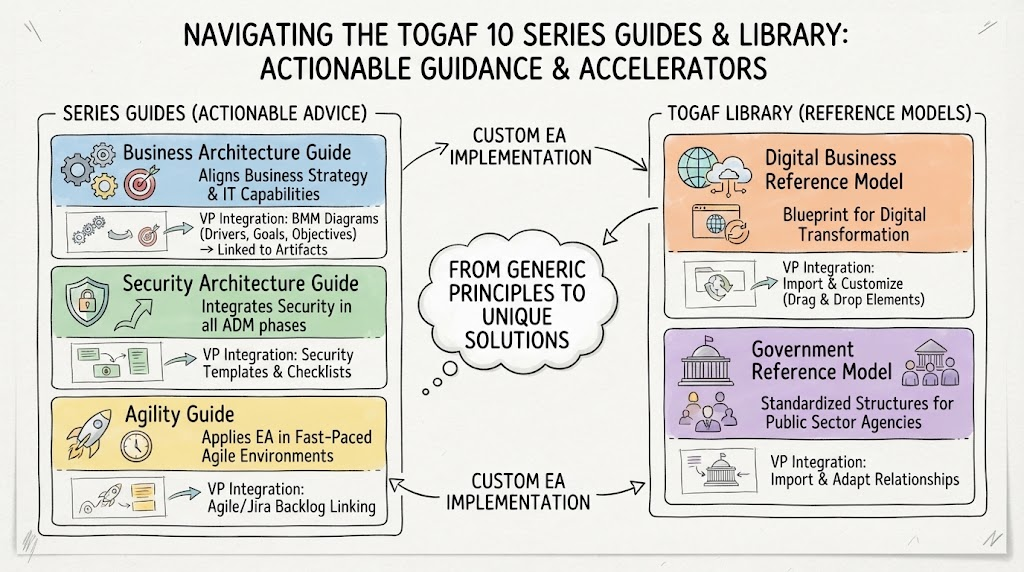 Navigating the TOGAF 10 Series Guides & Library: Actionable Guidance & Accelerators
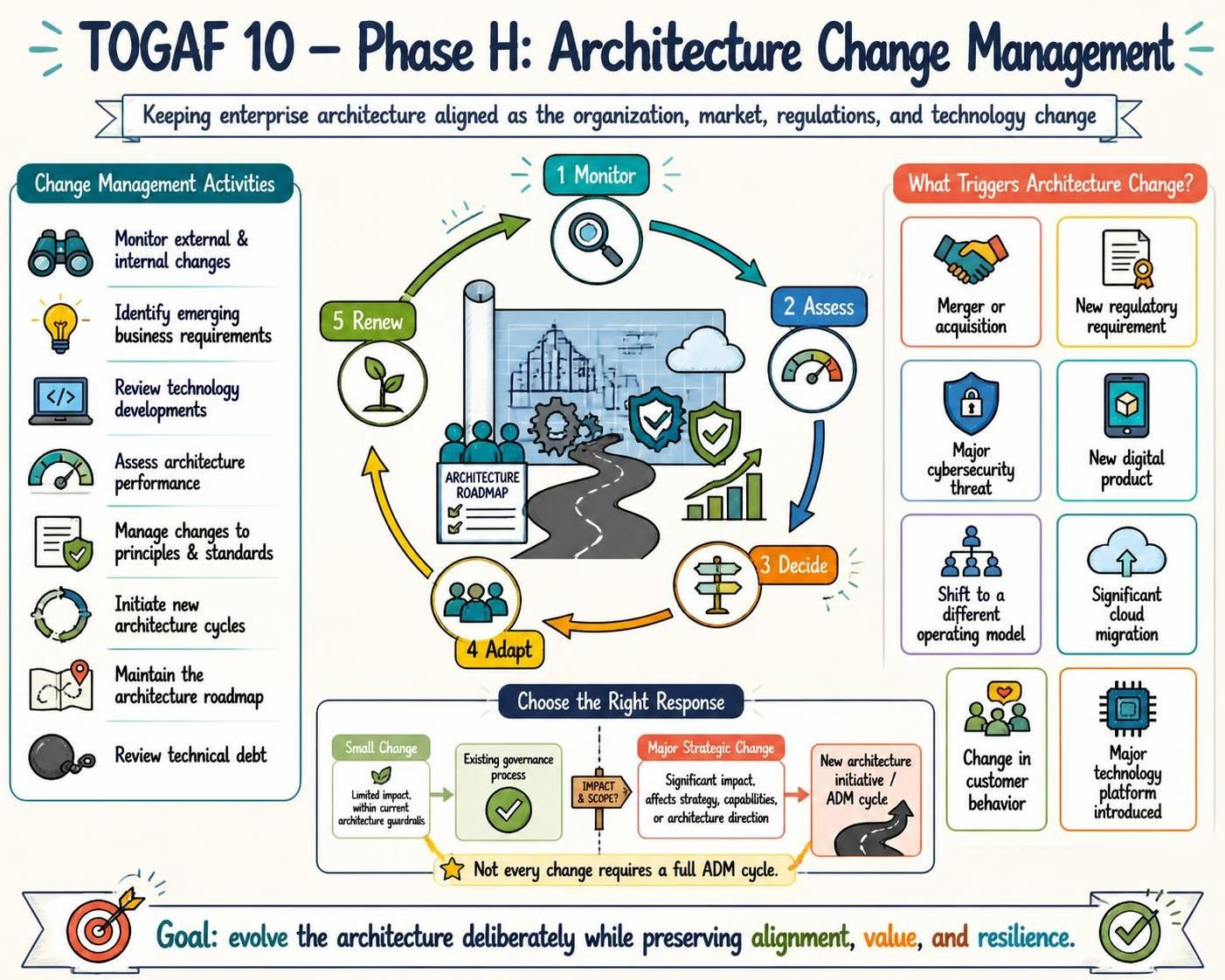 Mastering TOGAF Phase H: A Comprehensive Guide to Architecture Change Management
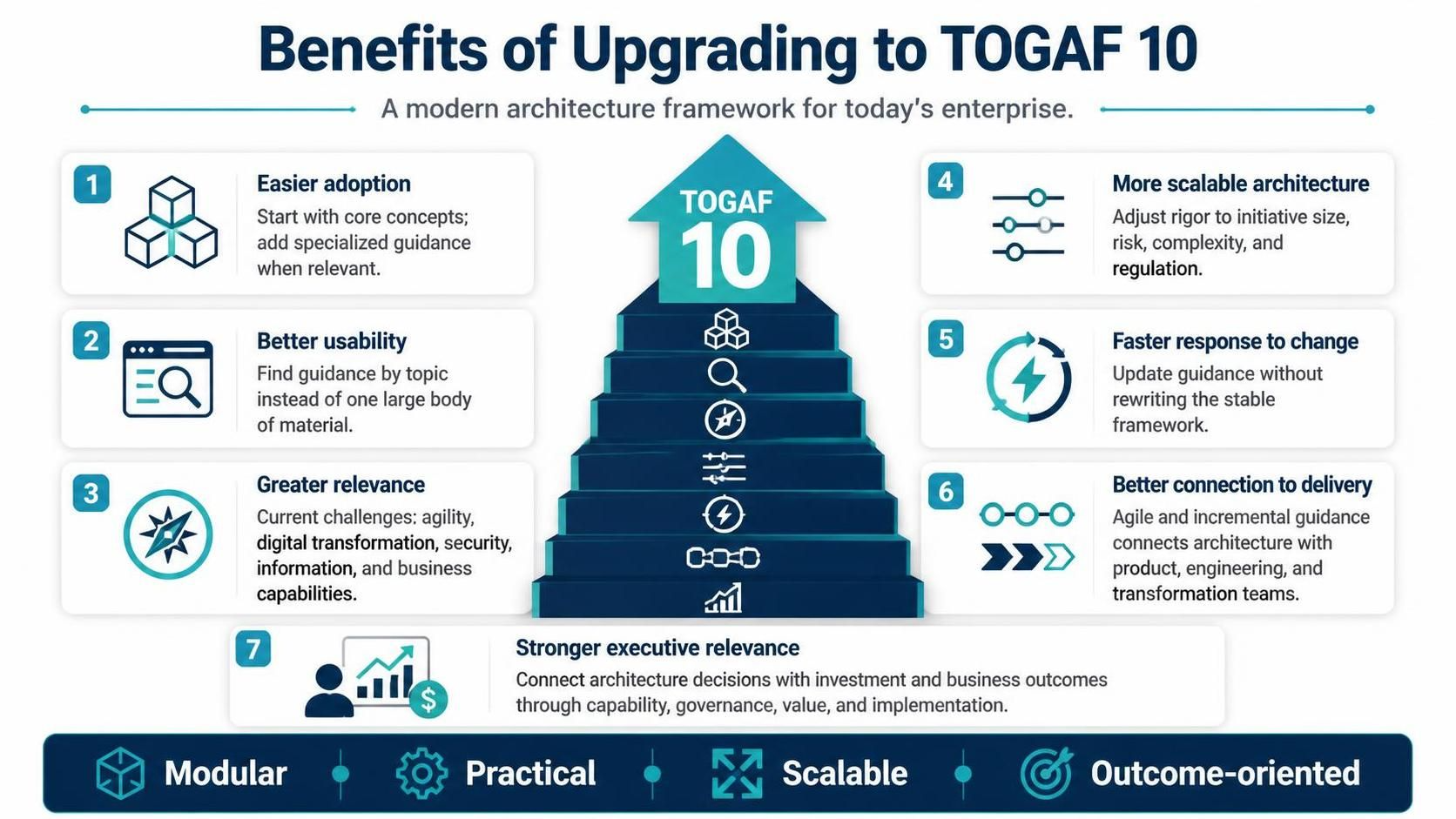 Mastering Enterprise Architecture: A Deep Dive into the TOGAF 10 Upgrade Strategy
 Mastering TOGAF Deliverables: The Governed Package Explained