


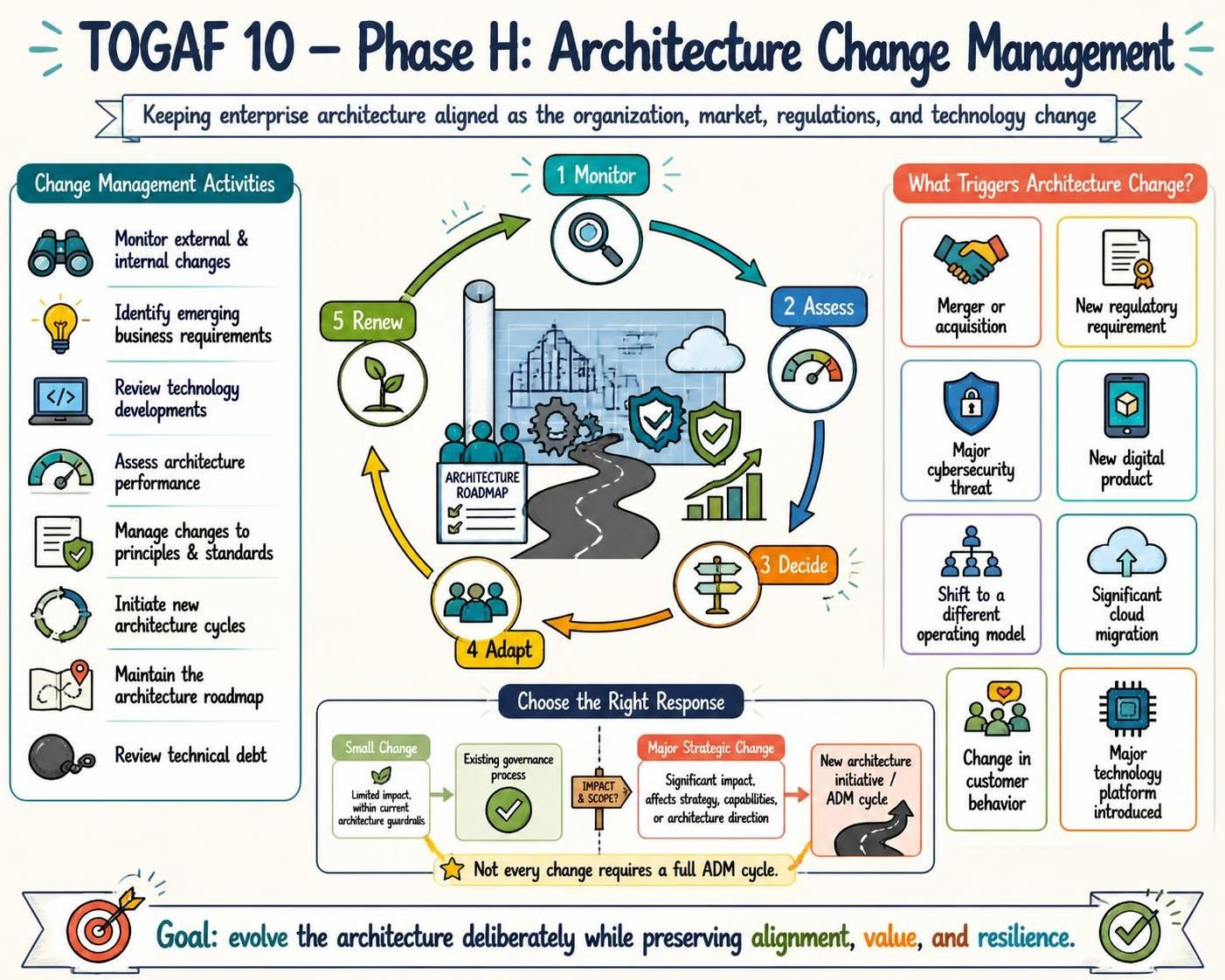
In the dynamic landscape of enterprise technology, the most rigid architecture is destined to fail. Enterprise Architecture (EA) is not a static destination; it is a continuous journey of adaptation. This tutorial delves into TOGAF 10 Phase H: Architecture Change Management, the critical process that ensures your organization’s IT landscape remains aligned with business goals, regulatory requirements, and technological advancements.
The Core Philosophy: Evolution over Stagnation
The fundamental premise of Phase H is that the enterprise architecture must evolve as the organization, market, regulations, and technology change. It acts as the “guardian” of the architecture’s lifecycle, ensuring that the IT landscape does not drift into irrelevance. Without this phase, an enterprise risks accumulating technical debt and losing its strategic alignment.
Key Activities: The Daily Grind of an Architect
Phase H is defined by a specific set of activities that architects must perform continuously. These are not one-time tasks but rather a cycle of vigilance and action:
- Monitoring External & Internal Changes: This involves keeping a “radar” on the horizon. Architects must watch for shifts in the business environment, such as mergers, or internal shifts, like a change in leadership strategy.
- Identifying Emerging Business Requirements: As business needs change, so must the architecture. This activity focuses on capturing new demands before they become bottlenecks.
- Reviewing Technology Developments: The tech world moves fast. Architects must evaluate new tools, platforms, and paradigms to see if they offer a competitive advantage.
- Assessing Architecture Performance: Is the current architecture delivering value? Are we meeting our SLAs? This activity is about auditing the current state against performance metrics.
- Managing Changes to Principles & Standards: As the enterprise grows, the rules of the road may need to be updated. This ensures that the governance framework remains relevant.
- Maintaining the Architecture Roadmap: The roadmap is a living document. Phase H ensures that the timeline of future projects remains accurate and feasible.
- Reviewing Technical Debt: Every legacy system carries a cost. Architects must actively review and plan for the remediation of technical debt to prevent it from stifling innovation.
The Change Management Cycle
The visual representation of Phase H often depicts a circular flow, illustrating that this is a continuous loop rather than a linear process. This cycle typically follows these steps:
- Monitor: Scan the environment for triggers. Are we seeing a new regulation? Is a competitor launching a disruptive product?
- Assess: Once a trigger is identified, assess its impact. Does this require a fundamental shift in our architecture, or is it a minor tweak?
- Decide: Determine the appropriate response. This is the critical decision point where you choose between a minor adjustment or a major overhaul.
- Adapt: Execute the necessary changes. This might involve updating models, changing standards, or initiating a new project.
- Renew: Update the architecture roadmap and ensure the new state is effectively communicated and implemented.
Triggers: When to Act
How does an architect know when to start Phase H? Certain events act as “triggers” that demand immediate attention. These include:
- A Merger or Acquisition (M&A): Integrating two different IT landscapes is a massive architectural challenge.
- New Regulatory Requirements: Compliance is non-negotiable. New laws often force immediate architectural changes.
- Major Cybersecurity Threats: A breach or a new threat vector may require a complete overhaul of security architecture.
- New Digital Products: Launching a new product line often requires new digital infrastructure.
- Significant Cloud Migration: Moving to the cloud is not just a lift-and-shift; it changes the entire architectural paradigm.
- Shift to a Different Operating Model: If the business decides to go “remote-first” or adopt a “product-centric” model, the IT architecture must support this.
Choosing the Right Response: The Decision Matrix
One of the most important concepts in Phase H is understanding that not every change requires a full Architecture Development Method (ADM) cycle. Initiating a full ADM cycle is resource-intensive. Therefore, architects must classify changes:
- Minor Adjustments: If a change has limited impact and falls within current architecture guardrails, it should be handled through an Existing Governance Process. This is the path of least resistance and highest efficiency.
- Major Strategic Changes: If a change affects strategy, capabilities, or the fundamental direction of the architecture, it requires a New Architecture Initiative or a new ADM cycle. This ensures that major shifts are properly planned and documented.
Tooling for Success: Visual Paradigm TOGAF ADM Tool
Managing this complex cycle of monitoring, assessing, and deciding requires robust tooling. You cannot manage a complex enterprise architecture effectively with spreadsheets alone. To streamline these processes, it is highly recommended to utilize the Visual Paradigm TOGAF ADM Tool.
This specialized tooling supports the entire TOGAF lifecycle, from the initial planning of Phase H to the execution of subsequent ADM cycles. Visual Paradigm provides:
- Centralized Repository: A single source of truth for all architecture models, ensuring that everyone is looking at the same data.
- Automated Governance: Built-in workflows that help enforce the decision matrix (Minor vs. Major changes) and track the status of architecture requests.
- Impact Analysis: Powerful visualization tools that allow architects to see how a change in one area (like a new cloud platform) impacts the rest of the enterprise.
- Roadmap Management: Integrated tools to maintain the architecture roadmap, ensuring that the “Renew” step of the cycle is accurate and up-to-date.
Conclusion: The Goal of Alignment
The ultimate goal of Phase H is to evolve the architecture deliberately while preserving alignment, value, and resilience. By systematically monitoring the environment and choosing the right response, organizations can ensure that their architecture remains a strategic asset rather than a liability. Whether triggered by a merger, a new regulation, or a technological breakthrough, Phase H is the mechanism that keeps the enterprise moving forward.
Related posts:
 Mastering TOGAF: A Step-by-Step Guide to the ADM Cycle and Enterprise Architecture
 Overcoming the EA Blank Canvas: Leveraging the TOGAF Library & Tooling
 Mastering Phase E: Opportunities & Solutions in Enterprise Architecture
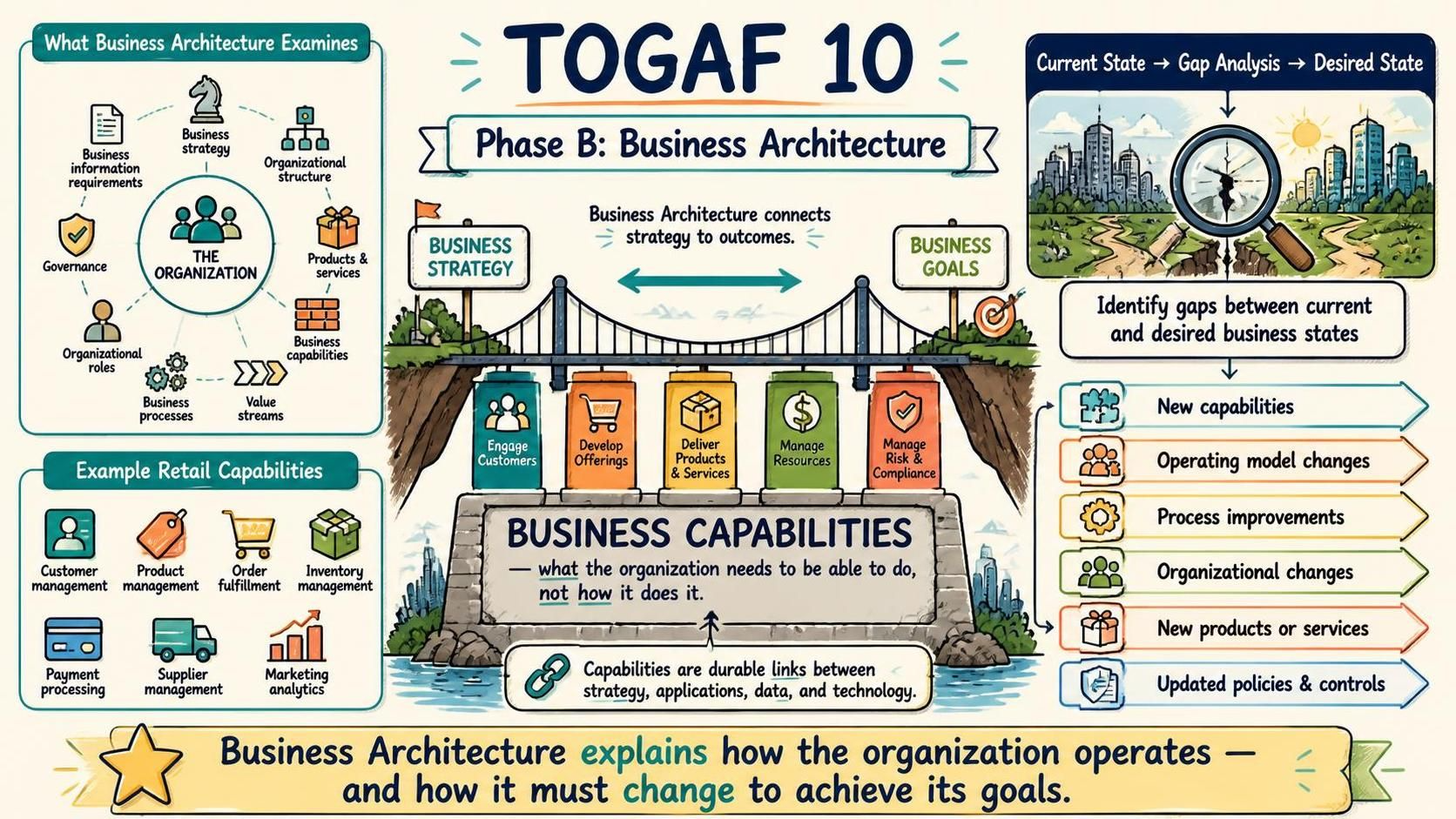 Mastering TOGAF Phase B: Business Architecture and the Power of Business Capabilities