


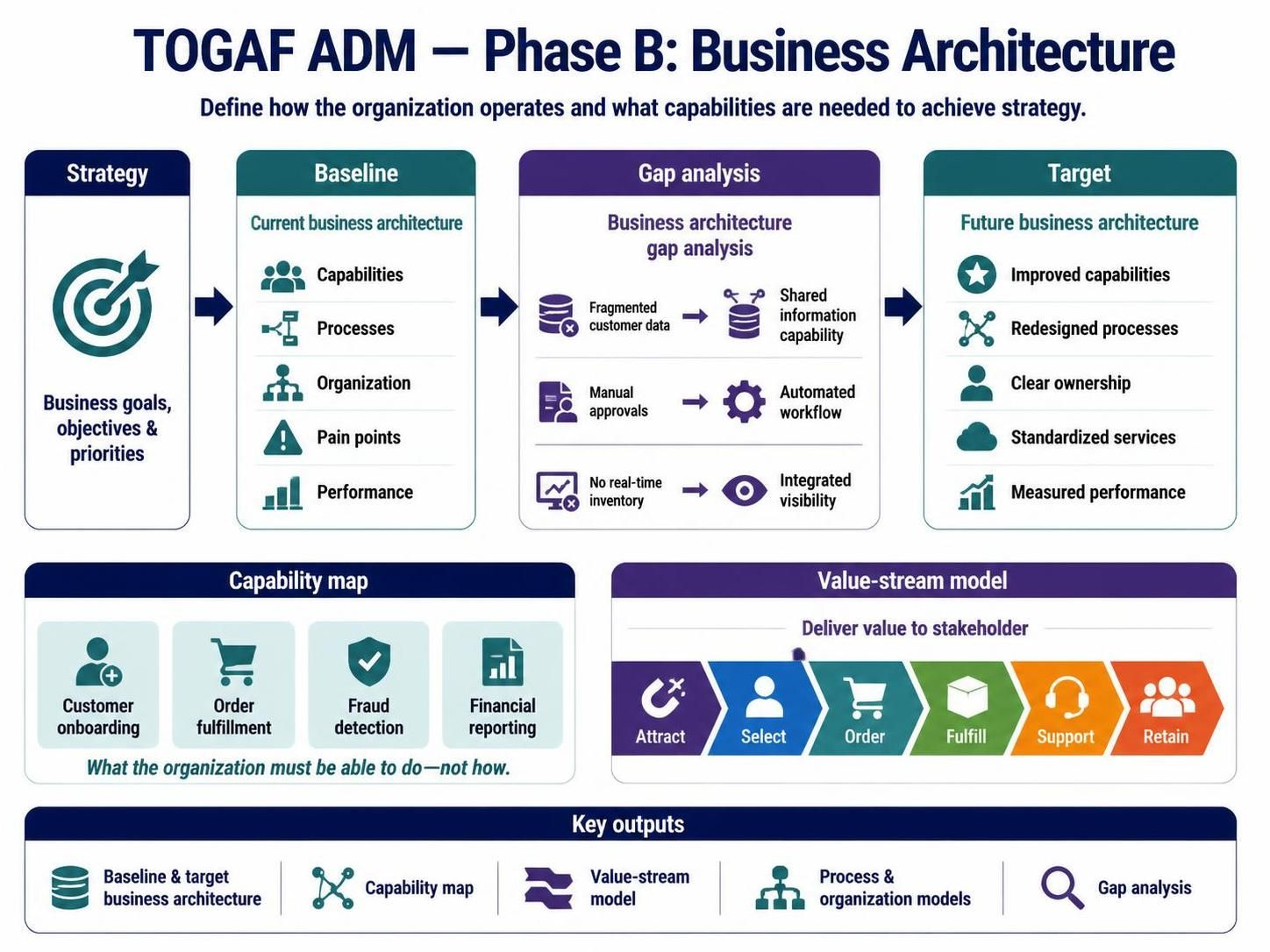
Welcome to this comprehensive tutorial on TOGAF ADM Phase B: Business Architecture. In the world of Enterprise Architecture, Phase B is the critical bridge between high-level business strategy and the technical implementation of solutions. This phase defines how the organization operates and identifies the specific business capabilities required to achieve its strategic goals.
This article will deconstruct the concepts presented in the diagram, explaining the “What” and “How” of mapping a business from its current state to a future vision.
1. The Strategic Foundation
Every architecture effort begins with Strategy. Before we can model the business, we must understand the business goals, objectives, and priorities. In the TOGAF framework, Phase B takes the strategic direction defined in the Preliminary Phase and Architecture Vision (Phase A) and translates it into a tangible operational model.
2. The Core Workflow: Baseline to Target
The heart of Phase B is a linear progression through four distinct stages: Strategy, Baseline, Gap Analysis, and Target. Let’s walk through each step.
Step 1: The Baseline (Current State)
The baseline represents the architecture as it currently exists. It is a snapshot of the “As-Is” situation. When documenting the baseline, architects examine:
- Capabilities: What the organization can currently do.
- Processes: The workflows used to deliver value.
- Organization: The structure and responsibilities of teams.
- Pain Points: Where the current system breaks down.
- Performance: Metrics indicating current efficiency.
Step 2: Gap Analysis (The Bridge)
This is the diagnostic phase. By comparing the Baseline (Current State) against the Strategy (Future State), architects identify gaps. The diagram illustrates this beautifully with specific examples:
- Fragmented Customer Data: The baseline shows a disconnected data environment. The gap analysis identifies the need to move toward a Shared Information Capability.
- Manual Approvals: Slow, paper-based workflows are identified as a bottleneck. The gap response is to implement Automated Workflow systems.
- No Real-Time Inventory: The lack of visibility leads to stock-outs. The solution is introducing Integrated Inventory Visibility.
Step 3: The Target (Future State)
The target architecture defines the “To-Be” state. It is the blueprint for the organization’s future operations. Key objectives for the target state include:
- Improved Capabilities: New or enhanced abilities to serve customers.
- Redesigned Processes: Streamlined workflows that eliminate waste.
- Clear Ownership: Defined roles and responsibilities.
- Standardized Services: Consistent delivery across the organization.
- Measured Performance: Clear KPIs to track success.
3. Key Modeling Concepts
To effectively document the architecture, architects rely on specific modeling concepts. The diagram highlights two of the most important: Capability Maps and Value-Stream Models.
Concept 1: Business Capability Map
A capability describes what the organization must be able to do, not how it does it. This distinction is vital because capabilities are relatively stable, whereas processes and systems change frequently.
Key Examples of Capabilities:
Customer OnboardingOrder FulfillmentFraud DetectionFinancial Reporting
Why is this useful? A capability map provides a stable view of the business. Even if you change your software or restructure your teams, the fundamental capability of “Order Fulfillment” remains constant.
Concept 2: Value-Stream Model
While capabilities define “what,” value streams define “how value is delivered to a stakeholder.” A value stream traces the end-to-end journey of a specific activity.
The Retail Value Stream Example:
- Attract: Marketing and customer acquisition.
- Select: The customer chooses a product.
- Order: The transaction is initiated.
- Fulfill: The product is prepared and shipped.
- Support: Post-sale assistance.
- Retain: Customer loyalty programs.
Value streams are essential because they connect strategy to capabilities, processes, applications, and technology.
4. Essential Tools for Architecture Modeling
To execute Phase B effectively, architects need robust tooling that supports TOGAF standards and allows for complex modeling (such as Capability Maps and Value Streams).
Recommended Tooling:
For professional enterprise architecture, Visual Paradigm TOGAF ADM Tool is highly recommended. It provides a comprehensive suite of features specifically designed to handle the nuances of Phase B, including:
- Visual Modeling: Drag-and-drop interfaces for creating Capability Maps and Value Stream diagrams.
- Gap Analysis Support: Built-in templates to document “As-Is” vs. “To-Be” scenarios.
- Repository: A centralized data store for all architecture artifacts (Business Process Models, Organization Models, etc.).
- Reporting: Automated generation of standard architecture reports.
5. Key Outputs of Phase B
By the end of this phase, the architecture team should have produced a set of definitive artifacts. These are the deliverables that guide the subsequent phases (Application, Data, and Technology Architecture).
The Deliverables Checklist:
- Baseline Business Architecture: A detailed description of the current state.
- Target Business Architecture: A detailed description of the future state.
- Capability Map: The hierarchical list of business capabilities.
- Value-Stream Models: The end-to-end flow of value delivery.
- Business-Process Models: Detailed process flows.
- Organization and Role Models: Organizational charts and role definitions.
- Business Architecture Gap Analysis: The documented list of changes required.
Conclusion
Phase B: Business Architecture is the blueprint for organizational success. It moves beyond abstract strategy to concrete operational definitions. By utilizing structured modeling techniques like Capability Maps and Value Streams, and leveraging powerful tools like Visual Paradigm TOGAF ADM Tool, architects can ensure their organizations are built to deliver value efficiently and effectively.
Related posts:
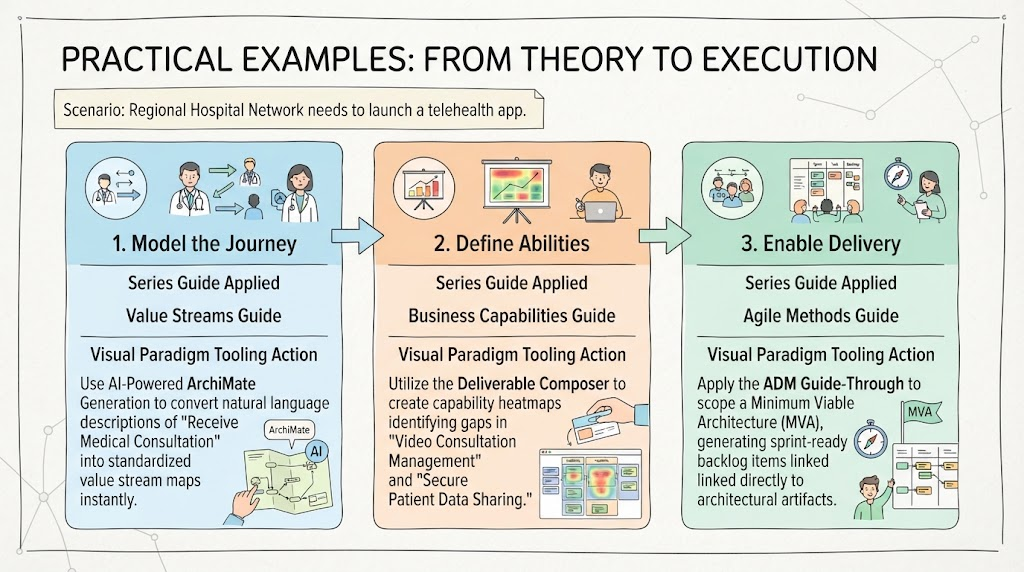 From Theory to Execution: A Practical Guide to Enterprise Architecture with Visual Paradigm
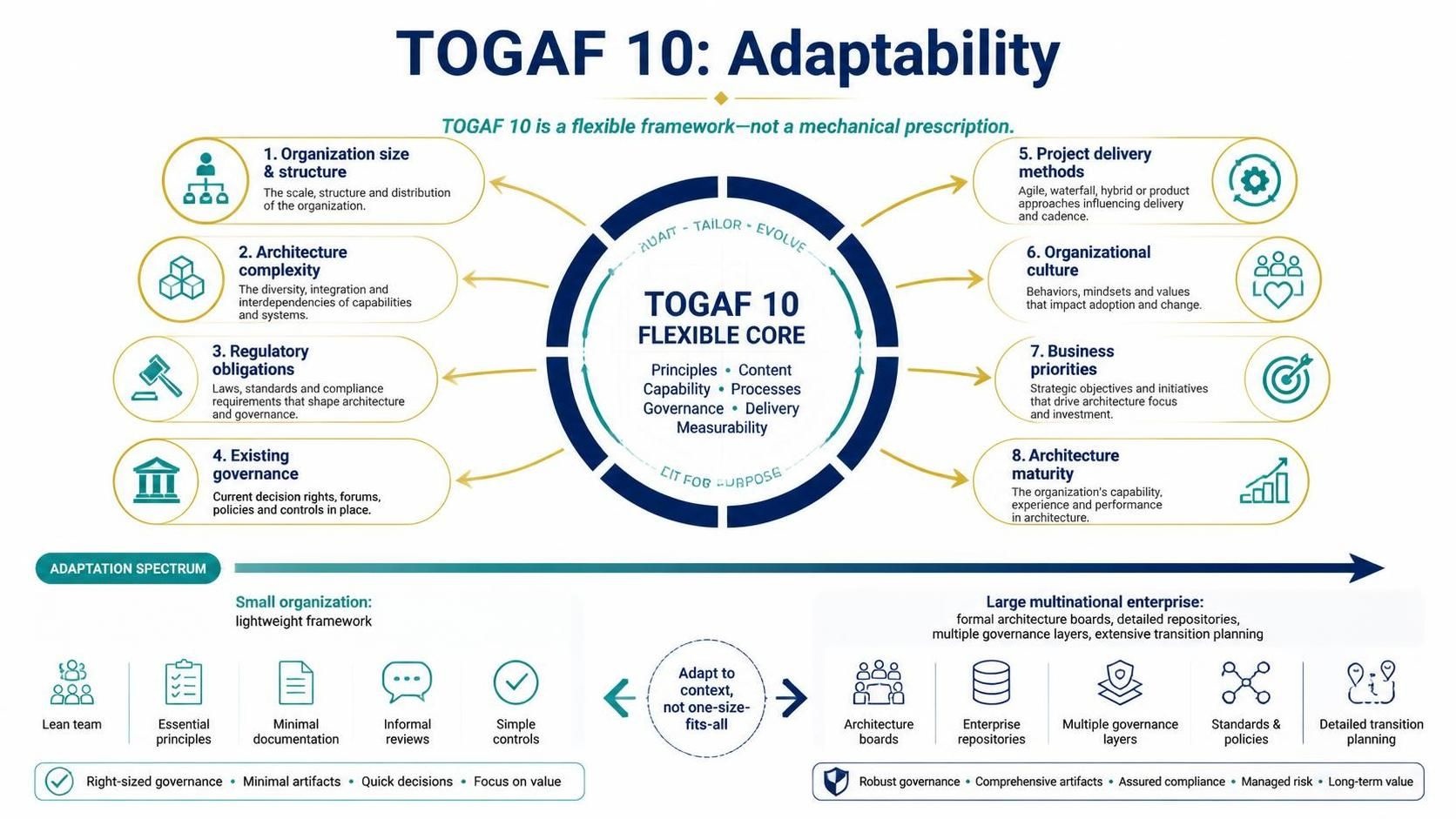 Mastering TOGAF 10 Adaptability: From Concept to Implementation
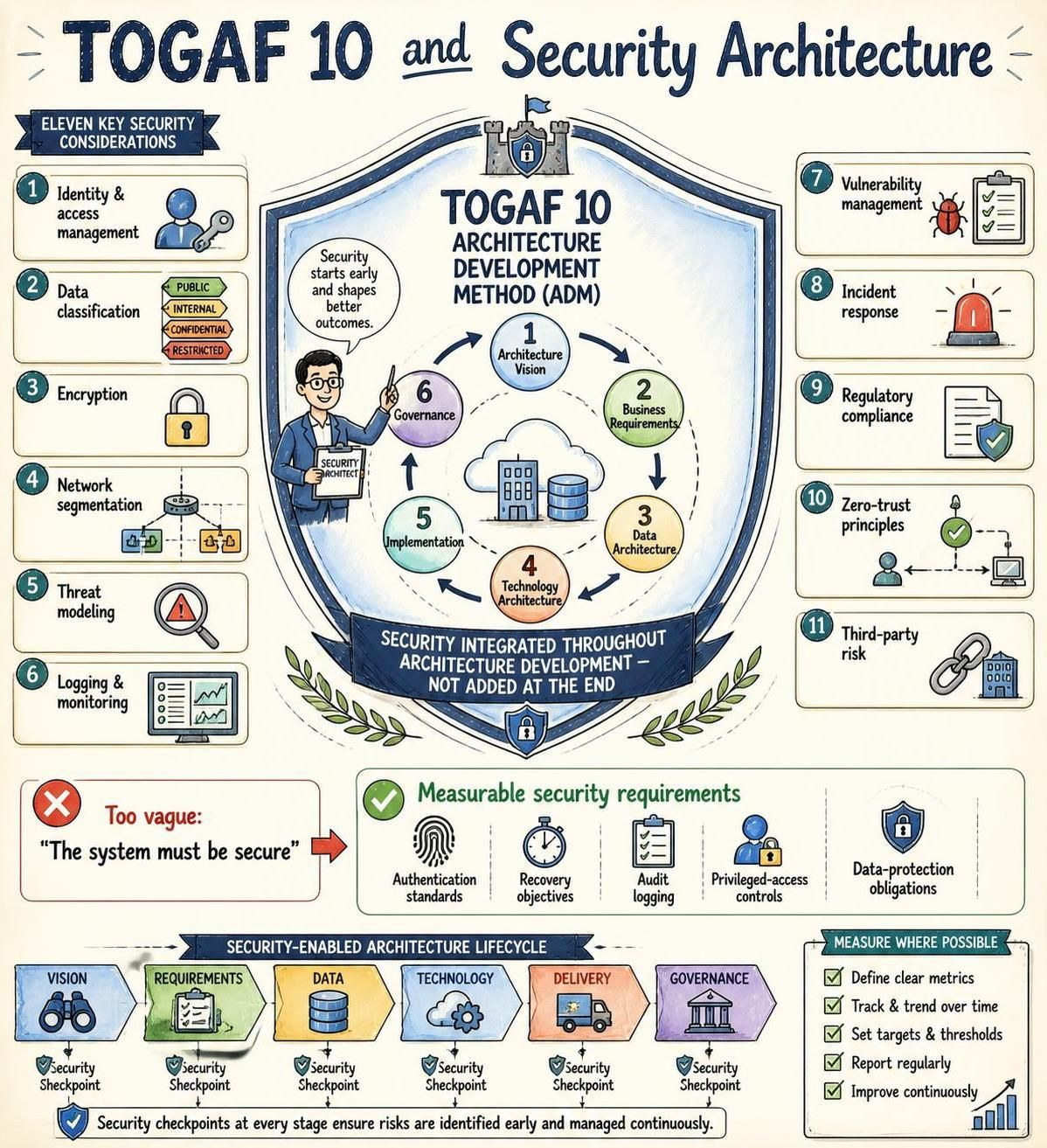 Mastering TOGAF 10 Security Architecture: From Principles to Implementation
 Mastering TOGAF Phase C: A Comprehensive Guide to Information Systems Architecture