In the fast-paced world of e-commerce, the margin between a satisfied customer and a lost sale is often defined by the efficiency of the backend fulfillment process. This tutorial breaks down a critical Business Process Model and Notation (BPMN) case study that transforms a struggling retailer’s operations from a bottleneck-prone legacy system into a high-speed, automated workflow.
We will analyze the shift from an As-Is process plagued by inventory mismatches to a To-Be architecture leveraging real-time integration. By understanding the specific BPMN elements used in this transition, you can learn how to apply similar logic to your own system architectures.
The Problem: The “As-Is” Bottleneck
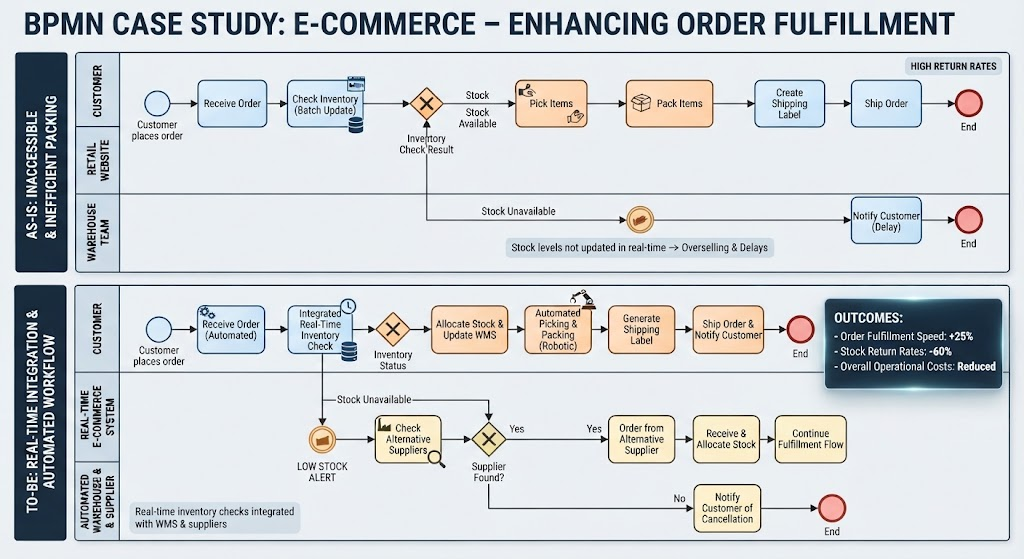
The case study begins with a common challenge: high return rates and shipping delays. Let’s dissect the As-Is architecture shown in the top section of the diagram.
1. The “Black Box” Inventory Check
Notice the task labeled Check Inventory (Batch Update). In BPMN, this represents a critical inefficiency. “Batch Update” implies that the system does not know the true stock level until a scheduled update occurs. This creates a window of time where the system believes items are available when they are not.
2. The Gateway Failure
The process flows through a Exclusive Gateway (the diamond shape). However, because the data is stale:
- The system often routes the order to Pick Items assuming stock is available.
- Only later does the warehouse discover the Stock Unavailable condition.
- This triggers a “Delay” loop, where the Notify Customer task happens too late, resulting in the red “End” event (cancellation).
The diagram explicitly notes this root cause: “Stock levels not updated in real-time → Overselling & Delays.”
The Solution: Real-Time Integration & Automation
The To-Be design (bottom section) re-engineers the system to eliminate latency. This is not just a process change; it is an architectural shift towards an event-driven system.
1. Automated Triggers and Events
Instead of a manual or batched check, the new process starts with an Integrated Real-Time Inventory Check. This is depicted with a clock icon, signifying that the trigger is immediate upon order placement.
2. The “Low Stock” Alert Mechanism
A key feature of this architecture is the Intermediate Catching Event (the orange circle with the envelope icon) labeled LOW STOCK ALERT. In BPMN, this is used to detect a specific condition (low stock) without stopping the entire process immediately. It allows the system to react proactively rather than reactively.
3. The Supplier Decision Logic
When stock is low, the flow moves to the Check Alternative Suppliers task. This is followed by a Exclusive Gateway (the diamond) with a decision point: Supplier Found?
- If Yes: The system automatically initiates an Order from Alternative Supplier, ensuring the fulfillment chain remains unbroken.
- If No: The system triggers a Notify Customer of Cancellation immediately, saving the warehouse team from wasting time on a dead-end order.
Technical Takeaways for System Architects
This case study offers three vital lessons for building robust e-commerce systems:
- Eliminate Batch Latency: Always prioritize real-time API calls over batch updates for inventory management. The cost of a delay is far higher than the cost of a database query.
- Fail Gracefully: Notice how the “To-Be” process handles the “No Supplier Found” scenario. It has a defined path to notify the customer, rather than leaving the order in a limbo state.
- Automate the “Human” Step: The Automated Picking & Packing (Robotic) task shows how workflow automation can integrate with physical hardware to increase speed. The system doesn’t just generate data; it triggers physical actions.
Conclusion
By adopting this BPMN-driven architecture, the retailer achieved a 25% increase in fulfillment speed and reduced stock-related returns by 60%. The diagram serves as a blueprint for how logical modeling translates directly into operational efficiency.