In the modern landscape of software development and business process management, agility is not just a buzzword; it is a necessity. Teams must move fast, but they also need precision. This tutorial explores how Visual Paradigm bridges the gap between rapid development and rigorous modeling standards. By integrating traditional BPMN (Business Process Model and Notation) with advanced AI capabilities, the tool transforms the way Agile teams conceptualize, design, and refine their workflows.
1. The Paradigm Shift: From Manual Drawing to Natural Language Generation
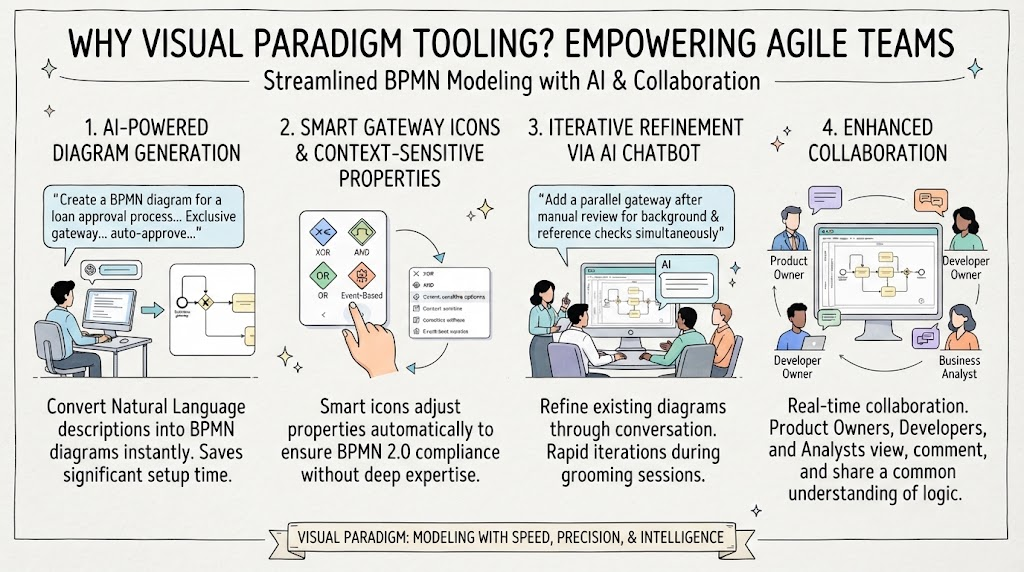
The journey of a complex workflow often begins with a vague idea. Historically, turning that idea into a formal diagram required manual effort, knowledge of specific syntax, and time-consuming setup. Visual Paradigm addresses this through AI-Powered Diagram Generation.
Instead of starting with a blank canvas and dragging icons from a palette, the process now begins with conversation. The system is designed to interpret natural language descriptions provided by users. Consider the following scenario:
- The Input: A user types, “Create a BPMN diagram for a loan approval process… Exclusive gateway… auto-approve…”
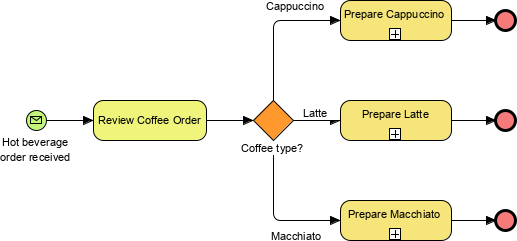
- The Process: The AI engine parses the intent, identifying key process elements (Start Event, Exclusive Gateway, End Event) and logical flow.
- The Output: A structured BPMN diagram is generated instantly.
This capability significantly reduces setup time, allowing teams to focus on the logic of the process rather than the mechanics of drawing it.
2. Understanding Smart Gateway Icons & Context Sensitivity
Once the initial diagram is generated, the next challenge is ensuring accuracy and compliance with industry standards. This is where Smart Gateway Icons and context-sensitive properties come into play.
The Anatomy of a BPMN Gateway
In BPMN, gateways are used to control the flow of a process. Visual Paradigm simplifies this complexity by offering intelligent defaults that adjust properties automatically.
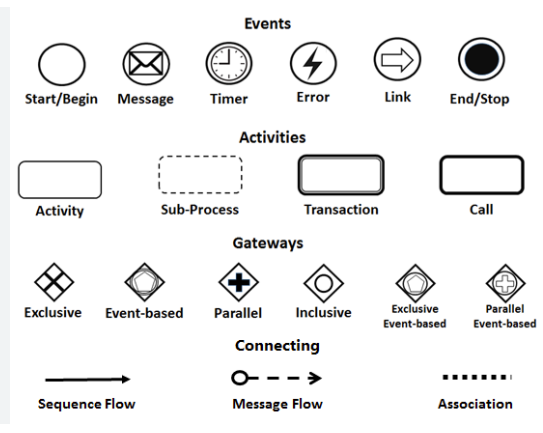
- XOR Gateway (Exclusive): Used when a process must choose only one path (e.g., “Loan Approved” OR “Loan Rejected”).
- AND Gateway (Parallel): Used to split the flow into multiple concurrent paths (e.g., sending an email AND updating the database).
- OR Gateway (Inclusive): Allows for multiple paths to be taken simultaneously if conditions are met.
- Event-Based Gateway: Used to wait for specific events before proceeding.
Visual Paradigm’s interface allows users to select these icons and automatically adjust their underlying properties to ensure BPMN 2.0 compliance. This means that even users without deep expertise in BPMN syntax can create professional, standard-compliant diagrams without worrying about invalid configurations.
3. The Iterative Refinement Loop: Collaboration via AI Chatbot
Software development is iterative. Requirements change, and processes must evolve. Visual Paradigm facilitates this evolution through Iterative Refinement via AI Chatbot. This feature allows teams to refine existing diagrams through a conversational interface.
Imagine a scenario where a team realizes a bottleneck in their process. Instead of manually editing the diagram, a team member can instruct the AI:
“Add a parallel gateway after manual review for background & reference checks simultaneously.”
The AI interprets this instruction and modifies the diagram structure instantly. This rapid iteration capability is crucial during grooming sessions or sprint planning, where logic needs to be tested and validated quickly.
4. Enhanced Collaboration: A Shared Understanding
The final pillar of this tooling ecosystem is Enhanced Collaboration. In an Agile environment, silos between Product Owners, Developers, and Business Analysts can lead to miscommunication. Visual Paradigm breaks down these silos by providing a unified workspace.
- Real-time Interaction: Multiple stakeholders can view the diagram simultaneously.
- Commenting & Discussion: Users can attach context to specific parts of the process, ensuring everyone understands the “why” behind the logic.
- Common Ground: By visualizing the logic, teams create a single source of truth. This shared understanding ensures that the final implementation matches the initial business intent.
Conclusion: Speed, Precision, and Intelligence
Visual Paradigm represents a significant leap forward in process modeling. By combining the speed of AI generation with the precision of BPMN standards, it empowers Agile teams to deliver high-quality documentation and processes without slowing down their development velocity. Whether you are generating a diagram from a simple text prompt or refining a complex workflow with a chatbot, the tool ensures that your modeling is as fast and flexible as your development lifecycle.