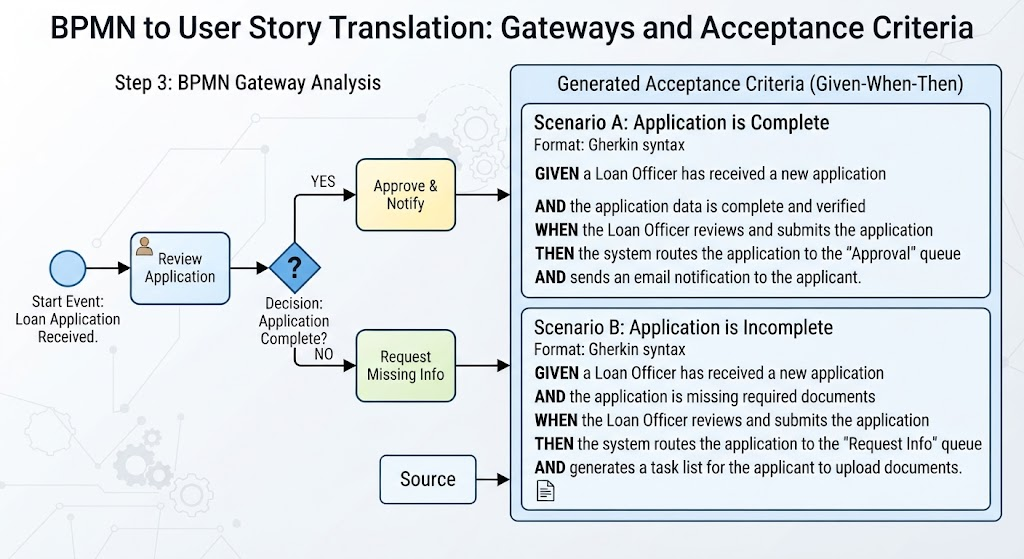
In the world of software development and business process modeling, a bridge often needs to be built between high-level business requirements and technical implementation. This tutorial focuses on a critical phase of that bridge: Translating BPMN Gateway Logic into User Story Acceptance Criteria.
By analyzing the provided diagram, we will walk through how to take a visual decision point (an Exclusive Gateway) and convert it into structured, testable “Given-When-Then” scenarios using Gherkin syntax. This approach is fundamental for Behavior-Driven Development (BDD).
Understanding the BPMN Decision Point
Let’s break down the visual flow on the left side of the diagram, specifically focusing on Step 3: BPMN Gateway Analysis.
1. The Process Flow
- Start Event: The process begins with a “Start Event,” represented by a blue circle. The trigger here is “Loan Application Received.”
- Task Execution: The process moves to a specific activity, “Review Application,” which is performed by a Loan Officer (indicated by the person icon).
2. The Exclusive Gateway (The Diamond)
The core of this architecture is the Exclusive Gateway, depicted as a diamond with a question mark. This is a decision point where the process flow must diverge into exactly one path based on a condition.
- The Question: The gateway asks: “Application Complete?”
- The Branches:
- Path YES: If the application is valid, the flow moves to the “Approve & Notify” task.
- Path NO: If the application is invalid, the flow moves to the “Request Missing Info” task.
Translating Logic to User Stories
The right side of the diagram demonstrates how these visual paths become concrete Acceptance Criteria for a User Story. In Agile development, we don’t just want the system to “work”; we want to define exactly how it behaves in specific scenarios.
Scenario A: The “Happy Path” (YES Branch)
This scenario represents the successful completion of the review process. The acceptance criteria must verify that the system correctly identifies a complete application and triggers the approval workflow.
Format: Gherkin Syntax
Given: A Loan Officer has received a new application
AND: The application data is complete and verified
When: The Loan Officer reviews and submits the application
Then: The system routes the application to the “Approval” queue
AND: The system sends an email notification to the applicant.
Scenario B: The “Exception Path” (NO Branch)
This scenario handles the edge case where data is missing. It is crucial for defining system constraints and error handling.
Format: Gherkin Syntax
Given: A Loan Officer has received a new application
AND: The application is missing required documents
When: The Loan Officer reviews and submits the application
Then: The system routes the application to the “Request Info” queue
AND: The system generates a task list for the applicant to upload documents.
Key Takeaways for Developers
- Visual to Text: Never leave a BPMN diagram uninterpreted. Every diamond (Gateway) represents a conditional statement (If/Else) in your code.
- BDD Alignment: Use the
Given,When, andThenstructure to ensure your developers and QA testers are all reading from the same script. - Completeness: A complete User Story must cover both the “YES” path and the “NO” path to ensure the system handles exceptions gracefully.
By following this methodology, you transform a static diagram into a dynamic set of requirements that drive automated testing and robust software architecture.