


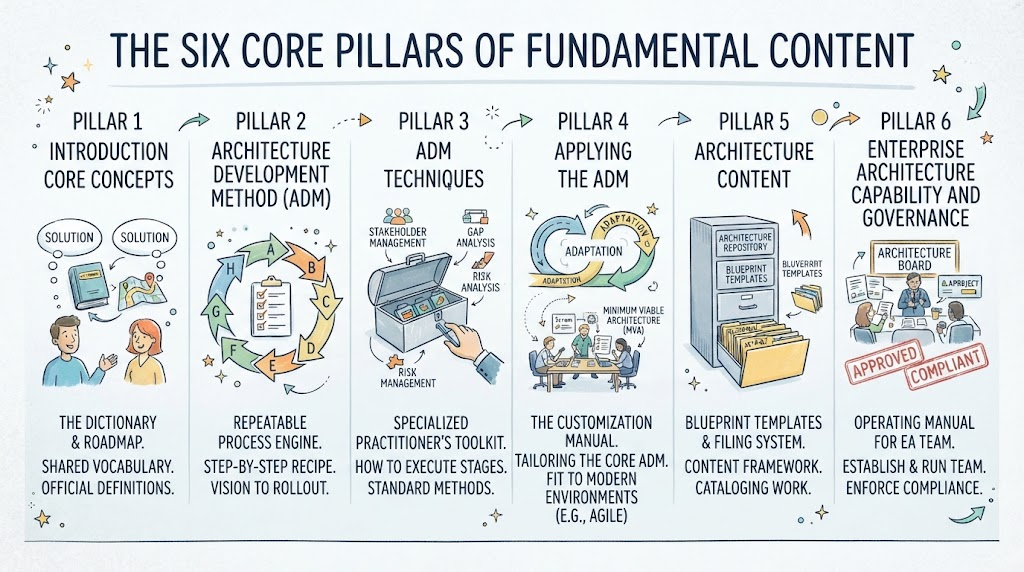
Enterprise Architecture (EA) can often feel like navigating a vast ocean without a compass. With so many acronyms, methodologies, and abstract concepts, it is easy for teams to drift apart. However, frameworks like TOGAF (The Open Group Architecture Framework) provide the structure necessary to navigate this complexity. Central to this framework are the Six Core Pillars of Fundamental Content. These pillars act as the foundational documents that ensure an architecture is not just a theoretical exercise, but a practical, repeatable, and compliant reality.
In this tutorial, we will break down these six pillars, translating the high-level standards into actionable steps for your next enterprise architecture project.
Pillar 1: Introduction and Core Concepts
The Dictionary and the High-Level Roadmap.
Before building a skyscraper, you must agree on what the building materials are called. In EA, this is the role of the Introduction and Core Concepts document. It serves as the “dictionary” for your organization, establishing a shared vocabulary.
Why It Matters
Imagine a scenario where you have a team in London, a team in Tokyo, and a team in New York. Without a shared definition, the term “Solution” might mean “a piece of software” to one team, “a business process” to another, and “a complete infrastructure setup” to the third. This document resolves that ambiguity.
- Key Terms Defined: It provides official definitions for terms like Capability, Stakeholder, Deliverable, and Building Block.
- The Goal: To ensure that when a stakeholder says “Capability,” everyone in the room visualizes the exact same business outcome.
Pillar 2: Architecture Development Method (ADM)
The Repeatable Process Engine.
If Pillar 1 is the dictionary, the Architecture Development Method (ADM) is the recipe. It is the heart of TOGAF, providing a step-by-step, cyclical process to guide you from a vague vision to a fully realized architectural solution.
The ADM Cycle Explained
The ADM is not a linear checklist; it is a continuous loop that ensures your architecture remains relevant. It guides you through the following phases:
- Phase A (Vision): Establishing the scope and goals.
- Phases B, C, D (Business, Data, App, Tech): Designing the specific layers of the architecture.
- Phase E (Opportunities): Evaluating vendors and implementation options.
- Phase F (Migration): Planning the rollout strategy.
- Phase G (Implementation): Oversight during execution.
- Phase H (Change): Governance to manage changes.
Practical Scenario
Suppose your company wants to shift from physical checkout registers to a unified mobile checkout app. Instead of panicking and buying random software, you follow the ADM cycle: align on the vision (Phase A), design the mobile business processes (Phase B), structure the customer data (Phase C), select the cloud technology (Phase D), and plan the migration (Phase F).
Pillar 3: ADM Techniques
The Specialized Practitioner’s Toolkit.
While the ADM tells you what stages to go through, the ADM Techniques document tells you how to execute them. This is the toolkit for the architect, containing the specific methodologies needed to solve problems within the ADM phases.
Key Techniques
This pillar includes standard methods such as:
- Stakeholder Management: How to map influence and interest.
- Gap Analysis: Comparing the Baseline (current state) against the Target (future state).
- Risk Management: Identifying potential failures before they happen.
Practical Scenario
During Phase B (Business Architecture), you need to identify exactly what changes are required for the mobile checkout. You use the Gap Analysis technique to create a matrix, systematically identifying which processes are “new,” “eliminated,” or “retained.” This ensures nothing is forgotten during the transition.
Pillar 4: Applying the ADM
The Customization Manual.
One size does not fit all. The Applying the ADM document acknowledges that a rigid process can stifle innovation. This pillar teaches you how to tailor the core ADM loop to fit specific modern environments, such as Agile Sprints or DevOps pipelines.
Adapting to Agile
In a fast-paced software environment, you cannot wait for a 6-month “Phase D” to finish before coding starts. This document guides you to apply Minimum Viable Architecture (MVA). This means creating “just enough” architectural guardrails to ensure the software team can sprint safely without hitting an accidental dead end.
Pillar 5: Architecture Content
The Blueprint Templates and Filing System.
Great ideas need to be documented. The Architecture Content pillar defines the Content Framework (what your blueprints should contain) and the Architecture Repository (how you store them).
Understanding the Hierarchy
This document clarifies the distinction between three critical terms:
- Deliverable: A formal, signed-off contract or report.
- Artifact: A single item like a catalog, matrix, or diagram.
- Building Block (ABB): A reusable piece of capability (e.g., a specific data structure) that can be used across multiple projects.
Practical Scenario
A Vice President asks for a diagram of how customer data flows across systems. Instead of drawing a messy diagram on a napkin, you refer to the Content Framework to use standardized data diagrams. You then catalog the customer data structure as a reusable Architecture Building Block (ABB) in your repository so future projects don’t have to design it from scratch.
Pillar 6: Enterprise Architecture Capability and Governance
The Operating Manual for the EA Team.
The final pillar addresses the human and organizational side of architecture. Even the best design is useless if projects ignore it. This document teaches you how to establish, staff, and run a sustainable architecture team.
The Architecture Board
This section details how to set up an Architecture Board and enforce compliance using Architecture Contracts. It ensures that IT purchases legally comply with your blueprints.
Practical Scenario
You have spent six months architecting the perfect mobile checkout platform. Suddenly, a rogue development team goes out and purchases an incompatible system. This document provides the governance framework to monitor and review project designs, preventing incompatible purchases and ensuring your strategic vision is actually implemented.
Conclusion
By mastering these six pillars—from the vocabulary of Pillar 1 to the governance of Pillar 6—you transform Enterprise Architecture from a theoretical exercise into a practical, repeatable engine for business success. These documents are not just bureaucratic red tape; they are the tools that allow you to build complex systems with confidence, clarity, and control.
Related posts:
 Demystifying the TOGAF Standard: A Practical Toolkit for Modern Enterprise Architecture
 Mastering TOGAF: A Step-by-Step Guide to the ADM Cycle and Enterprise Architecture
 Mastering Enterprise Architecture: A Step-by-Step Guide to the Four Core Purposes
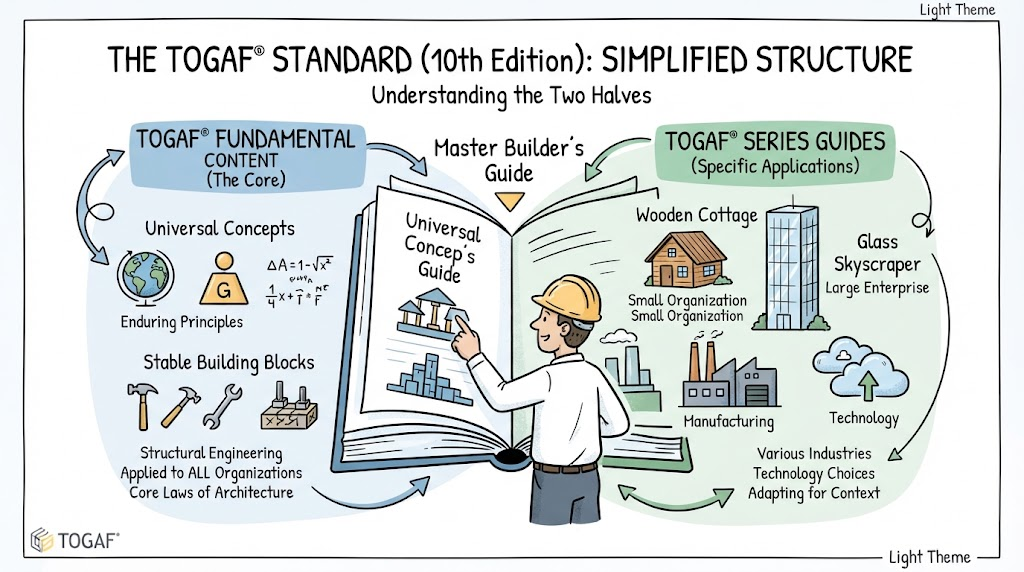 Mastering the TOGAF Standard: The Core vs. The Guides