In the world of Business Process Model and Notation (BPMN), complexity is the enemy of clarity. When a business process involves dozens of steps and intricate decision-making, a single flat diagram becomes a “spaghetti diagram” that confuses rather than clarifies. The solution lies in the power of Sub-Processes.
Sub-processes act as modular building blocks, allowing you to abstract complexity. This tutorial explores how to effectively use Sub-Processes to manage views, hide details, and create reusable assets using the example of an Order Fulfillment workflow.
1. The Hierarchy: Collapsed vs. Expanded Views
The first and most critical skill in BPMN modeling is understanding how to control the “zoom level” of your diagram. A single logical process should often be represented in two distinct ways depending on the audience.
The Collapsed View (The Executive Summary)
Imagine you are presenting to a Branch Manager or a C-Level Executive. They do not need to know the specific logic of every step; they need to know the flow. The Collapsed Sub-Process is your tool for this.
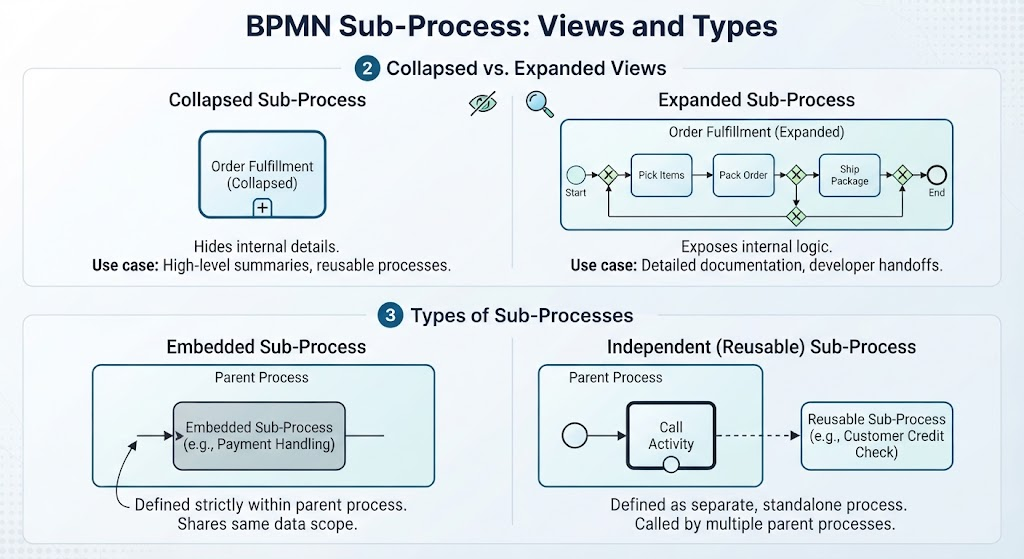
- Visual Representation: It appears as a single activity box (often rounded) with a distinctive plus (+) marker at the bottom.
- Function: It “hides” internal details. For example, a high-level “Order Fulfillment” box might actually contain ten internal tasks, but to the viewer, it is just one step in a larger chain.
- Use Case: High-level summaries, reusable process definitions, and maintaining a clean top-level map.
The Expanded View (The Developer Handoff)
When it comes time to train a Loan Officer, configure a software bot, or hand off the process to a developer, you must “drill down.” The Expanded Sub-Process reveals the internal architecture.
- Visual Representation: The box opens up to reveal a miniature process map inside it.
- Function: It exposes internal logic, including standard tasks (e.g., “Pick Items”), gateways (e.g., “Pack Order?”), and start/end events.
- Use Case: Detailed documentation, technical implementation, and training.
2. Managing Scope: Embedded vs. Reusable Sub-Processes
Not all sub-processes are created equal. Depending on how you define the scope of your process, you may choose between two distinct types of sub-processes.
Embedded Sub-Processes
An Embedded Sub-Process is defined strictly within the boundaries of its parent process. It is the internal engine of that specific workflow.
- Data Scope: It shares the same data scope as the parent process. It can access variables directly without passing them explicitly.
- Analogy: Think of this like a function inside a specific class in programming. It exists only to serve that specific class.
- Best For: Logic that is unique to a specific scenario and unlikely to be needed elsewhere.
Independent (Reusable) Sub-Processes
An Independent Sub-Process (often visualized as a “Call Activity”) is defined as a separate, standalone process model. It is a global asset.
- Global Asset: It is defined once and can be called by multiple parent processes. For example, a “Customer Credit Check” might be needed for a Mortgage Application, a Car Loan, and a Credit Card Application.
- Interface: It has a clear interface (inputs and outputs) that it expects from the parent process.
- Best For: Standardized business logic that needs to be consistent across the entire enterprise.
3. Practical Implementation in Visual Paradigm
To implement these concepts effectively, tools like Visual Paradigm (VP) are essential. VP allows you to toggle between these views without redrawing diagrams manually.
Step 1: Creating the Hierarchy
Start by dragging a Sub-Process shape from the BPMN Palette onto your canvas. By default, VP might create an Expanded view. To make it Collapsed:
- Right-click the Sub-Process shape.
- Select Presentation Options > Collapse Sub-process.
- Verify the appearance of the (+) marker at the bottom of the shape.
Step 2: Defining Internal Logic (Drilling Down)
You do not need to manually draw the inside of a collapsed box on the same canvas. Instead, you “drill down” to a new tab.
- Double-click the Collapsed Sub-Process (or right-click and select Open Specification).
- VP will open a new tab representing the internal view.
- Here, you can drag and drop Tasks, Gateways, and Events just like a normal diagram.
- Note: Any changes made here are automatically reflected if you later choose to “Expand” the shape on the parent diagram.
Step 3: Switching Types (Embedded vs. Reusable)
If you decide that your “Credit Check” logic should be used in a different process (e.g., a Mortgage Application), you can convert it.
- In the Sub-Process specification window, look for the Type setting.
- Change it from Embedded to Reusable.
- VP will treat this as a global asset. You can now drag this specific Sub-Process from the Model Explorer into any other diagram in your project.
Conclusion
Sub-processes are the building blocks of scalable business process modeling. They bridge the gap between high-level strategy and low-level execution. By mastering the distinction between Collapsed (for summary) and Expanded (for detail) views, you ensure your diagrams remain readable regardless of their complexity.
Using tools like Visual Paradigm streamlines this hierarchy, allowing you to manage Embedded and Independent processes efficiently. Remember: a good BPMN diagram doesn’t just show what happens; it organizes information so the viewer understands when and why it matters. Start collapsing your complex workflows today to reveal the clear structure underneath.