


Welcome to this comprehensive tutorial on TOGAF 10 Phase D: Technology Architecture. As a technical architect or enterprise architect, you know that the gap between business strategy and actual implementation is often bridged by the technology landscape. This phase is critical because it defines the technical environment—hardware, software, networks, and services—needed to support your business and data architecture.
In this guide, we will walk through the core components of the Technology Foundation, the strategic reasons for adopting cloud architectures, and the rigorous decision criteria required to build a secure and scalable environment.
Understanding the Technology Foundation
The Technology Architecture is not just a list of servers; it is the “plumbing” of your enterprise. According to the TOGAF standard, this phase defines the hardware and software capabilities required to support the deployment of business, data, and application services.
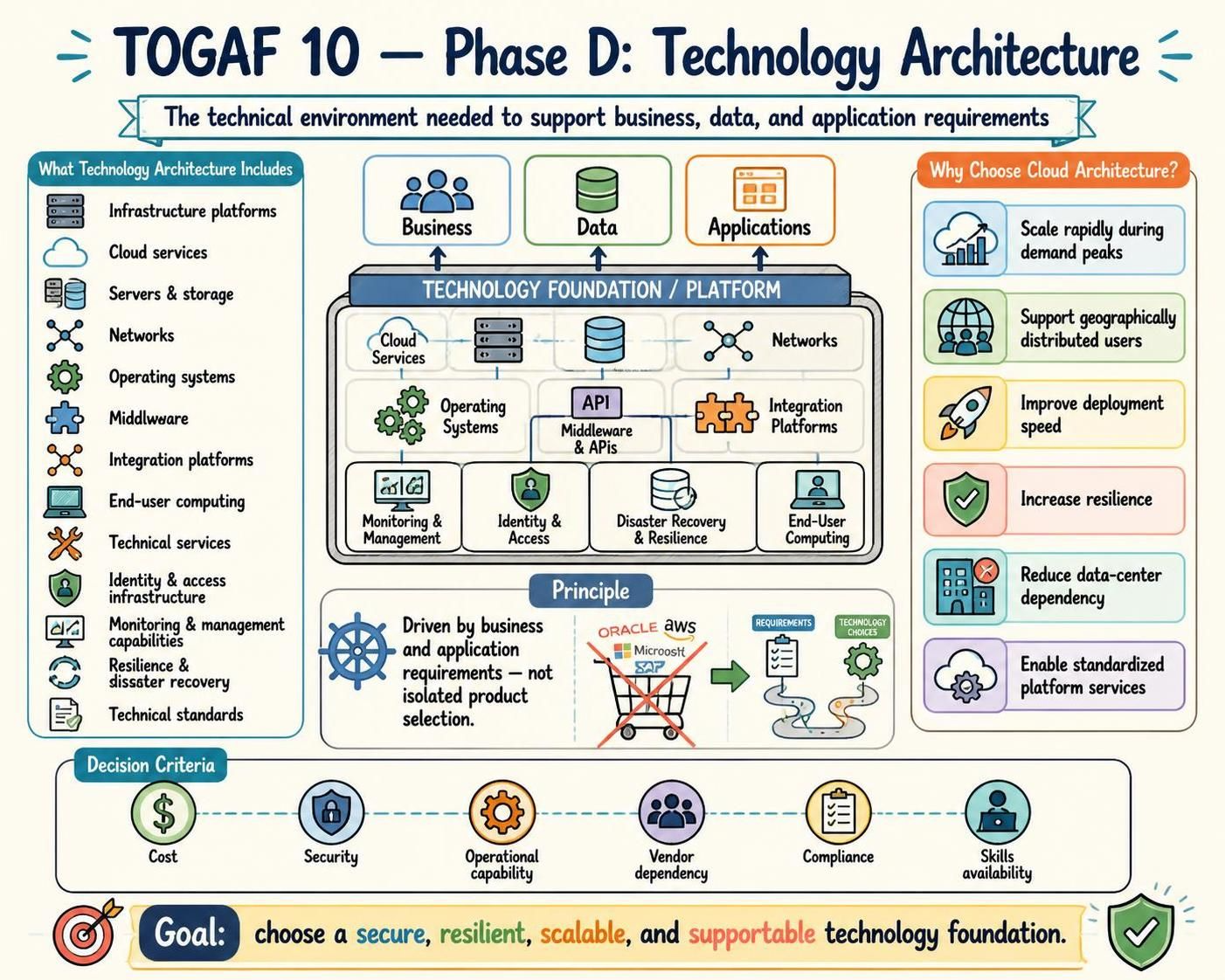
The core Technology Foundation / Platform is typically visualized as a layered structure that supports the business, data, and application layers above it. This foundation includes:
- Infrastructure Platforms: The physical and virtual hardware, including servers, storage, and cloud services.
- Networks: The connectivity that allows data to flow between components.
- Operating Systems & Middleware: The software layers that manage hardware resources and facilitate communication between applications (including APIs).
- Integration Platforms: Tools and services that allow disparate systems to talk to one another.
- End-User Computing: The devices and interfaces users interact with daily.
Furthermore, a robust architecture must include essential technical services such as Identity and Access Management (IAM), Monitoring & Management, and Disaster Recovery capabilities. These ensure that the technology is not only functional but also secure and resilient.
Strategic Drivers: Why Choose Cloud Architecture?
One of the most common decisions in Phase D is determining the deployment model. While an organization might choose a cloud architecture simply because it is popular, a true TOGAF-driven approach selects it based on specific business needs. The Technology Architecture should answer the question: “How does the technology enable the business?”
Consider the following strategic drivers that often justify a move to a cloud or distributed architecture:
- Scalability: The ability to scale rapidly during demand peaks without over-provisioning hardware.
- Geographic Reach: Supporting geographically distributed users with low latency.
- Speed to Market: Improving deployment speed to get features to users faster.
- Resilience: Increasing the system’s ability to recover from failures automatically.
- Cost Efficiency: Reducing data-center dependency to lower capital expenditure (CapEx).
- Standardization: Enabling standardized platform services across the enterprise.
The Golden Rule: Requirements-Driven Decision Making
A critical principle of Technology Architecture is that it must be driven by business and application requirements, not by vendor marketing.
Do not start with a shopping list. You should not select a product simply because it is a “best of breed” or because it is popular. Instead, start with the requirements. For example, if your application requires high availability, your technology selection must prioritize redundancy and disaster recovery solutions.
To avoid the common pitfall of “product selection in isolation,” architects often use a structured approach to filter options. This involves crossing your specific requirements (functional and non-functional) against available technology choices to ensure a perfect fit.
Tooling the Process with Visual Paradigm TOGAF ADM Tool
Implementing the TOGAF Architecture Development Method (ADM) effectively requires more than just documentation; it requires visualization and traceability. To streamline Phase D, we highly recommend the Recommended tooling of Visual Paradigm TOGAF ADM Tool.
Visual Paradigm offers a robust environment for modeling the Technology Architecture. It allows you to:
- Visualize Relationships: Create clear diagrams showing how infrastructure supports applications.
- Manage Requirements: Link business requirements directly to technology capabilities.
- Collaborate: Work with stakeholders to review and validate the architecture.
Using this tooling ensures that your architecture is not just a static document but a dynamic model that evolves with your enterprise.
Decision Criteria: The “Six Pillars” of Selection
Once you have identified your requirements, you must evaluate potential technology solutions against specific decision criteria. The infographic outlines six critical pillars that must be considered before finalizing a technology stack:
- Cost: Total Cost of Ownership (TCO), including licensing, maintenance, and operational costs.
- Security: The ability to protect data and comply with security policies.
- Operational Capability: How easy is it to manage, monitor, and maintain the system?
- Vendor Dependency: Assessing the risk of locking in a single vendor versus using open standards.
- Compliance: Ensuring the technology meets regulatory requirements (e.g., GDPR, HIPAA).
- Skills Availability: Does your team have the necessary skills to operate this technology, or will training be required?
Conclusion: The Ultimate Goal
The objective of Phase D is to choose a technology foundation that is secure, resilient, scalable, and supportable. By adhering to the principles of requirements-driven design and utilizing powerful modeling tools like Visual Paradigm, you ensure that your technology architecture is a strategic asset rather than a bottleneck.
Remember, the goal is not to select the “fanciest” technology, but to select the technology that best enables your business to succeed.
Related posts:
 Mastering TOGAF 10: A Step-by-Step Guide to the Six Fundamental Content Pillars
 Mastering the TOGAF Preliminary Phase with Visual Paradigm and ArchiMate
 Mastering TOGAF 10: A Modern Guide to Flexible Enterprise Architecture
 Mastering TOGAF 10: Separating the Essential Architecture Method from Specialized Guidance