


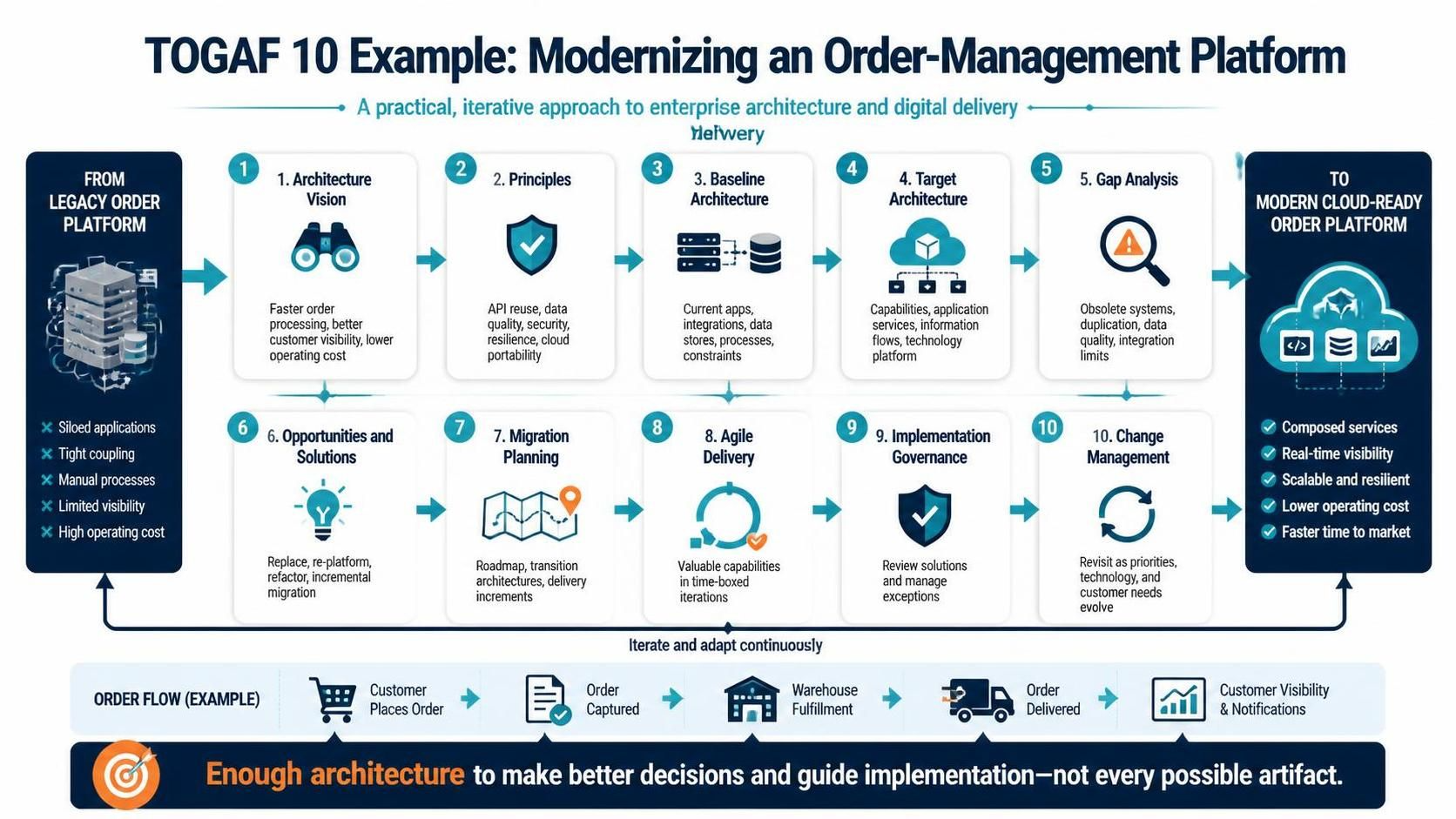
Enterprise architecture is often perceived as a rigid, bureaucratic exercise in document creation. However, in the context of modern digital transformation, it serves as the critical roadmap that guides organizations from legacy constraints to future-ready agility. The image provided illustrates the TOGAF 10 Architecture Development Method (ADM), specifically tailored for modernizing an order-management platform. This tutorial breaks down the 10 phases of the cycle, explaining how a practical, iterative approach replaces heavy documentation with actionable strategy.
1. From Legacy to Cloud: The Transformation Context
The process begins by establishing the “As-Is” and “To-Be” states. On the far left of the diagram, we see the Legacy Order Platform. This system is characterized by:
- Siloed Applications: Data is trapped in isolated systems.
- Tight Coupling: Changes in one module break others.
- Manual Processes: High reliance on human intervention.
- High Operating Cost: Maintenance of old infrastructure.
The goal, shown on the far right, is a Modern Cloud-Ready Order Platform. This target state offers composed services, real-time visibility, scalability, and lower costs. The TOGAF ADM cycle acts as the bridge between these two states.
2. The Strategic Foundation: Phases A, B, and C
Before diving into technical details, the architecture team must define the vision and the rules of the road.
Phase A: Architecture Vision
The journey starts with Architecture Vision. Using the “binoculars” icon in the diagram, this phase represents looking ahead to define business goals. In this specific example, the goals are:
- Faster order processing: Reducing latency in the supply chain.
- Better customer visibility: Providing real-time tracking.
- Lower operating costs: Optimizing resource usage.
Phase B: Principles
Next comes Principles, represented by the shield icon. These are the guiding rules that ensure the architecture remains consistent and secure. The diagram highlights essential modern principles:
- API Reuse: Building once, using many times.
- Data Quality: Ensuring accuracy across the platform.
- Security & Resilience: Protecting data and ensuring uptime.
- Cloud Portability: Avoiding vendor lock-in.
Phase C: Baseline Architecture
The Baseline Architecture (Phase C) involves a realistic audit of the current state. This is the “inventory” phase where architects document existing applications, integrations, data stores, and major constraints. You cannot modernize effectively without understanding exactly what you currently have.
3. The Target State and Gap Analysis: Phases D and E
Once the baseline is understood, the team defines the future and identifies the distance between the two.
Phase D: Target Architecture
In this phase, we define the desired Target Architecture. The cloud icon signifies a shift towards a modern, likely cloud-native, platform. This includes defining new business capabilities, application services, and information flows. The goal is to design a system that supports the principles established in Phase B.
Phase E: Gap Analysis
The Gap Analysis is the critical comparison step. By contrasting the Baseline (Phase C) with the Target (Phase D), the team identifies:
- Obsolete systems that must be retired.
- Duplicated capabilities that need consolidation.
- Integration limitations that prevent real-time data flow.
4. Planning the Journey: Phases F, G, and H
With the gaps identified, the organization must decide how to cross them.
Phase F: Opportunities and Solutions
This phase focuses on evaluating modernization options. The diagram suggests a strategic decision matrix involving:
- Replacement: Buying a new SaaS solution.
- Re-platforming: Moving to a new infrastructure.
- Refactoring: Rewriting code to be cloud-native.
- Incremental Migration: Moving piece by piece.
Phase G: Migration Planning
Once solutions are selected, Migration Planning creates the roadmap. This includes defining “Transition Architectures”—intermediate states that deliver value incrementally rather than waiting for a “Big Bang” launch.
Phase H: Agile Delivery
Modern architecture demands speed. Agile Delivery ensures that the most valuable capabilities are delivered in time-boxed iterations. This keeps the business engaged and allows for quick feedback loops.
5. Governance and Evolution: Phases I and J
The final phases ensure the project stays on track and remains relevant over time.
Phase I: Implementation Governance
This phase acts as the quality gate. It involves reviewing solutions to ensure they align with the Target Architecture and managing exceptions. If a development team deviates from the design, this phase ensures the deviation is justified and documented.
Phase J: Change Management
Enterprise architecture is not a one-time project. Change Management ensures the architecture evolves as business priorities, technology, and customer needs shift. It closes the loop, feeding new requirements back into the Vision phase.
6. The Operational Reality: Order Flow
At the bottom of the diagram, we see the Order Flow example. This illustrates the functional reality of the platform:
- Customer Places Order: The trigger event.
- Order Captured: Data ingestion.
- Warehouse Fulfillment: Operational execution.
- Order Delivered: Physical completion.
- Customer Visibility & Notifications: Feedback loop.
The modern architecture aims to make this flow seamless, automated, and transparent.
Conclusion: Practical Architecture with Visual Paradigm
The overarching message of this TOGAF 10 example is clear: “Enough architecture to make better decisions.” The organization does not need to produce every possible artifact; it needs enough clarity to guide implementation.
To execute this cycle efficiently, organizations are increasingly turning to Visual Paradigm TOGAF ADM Tool. This recommended tooling supports the entire architecture lifecycle, allowing teams to model the Baseline and Target architectures, perform automated Gap Analysis, and visualize the migration roadmap. By integrating Visual Paradigm, architects can move from static documentation to a dynamic, living model of the enterprise, ensuring that the journey from Legacy to Cloud is both manageable and successful.
Related posts:
 Mastering TOGAF: A Step-by-Step Guide to the ADM Cycle and Enterprise Architecture
 Overcoming the EA Blank Canvas: Leveraging the TOGAF Library & Tooling
 Mastering Phase E: Opportunities & Solutions in Enterprise Architecture
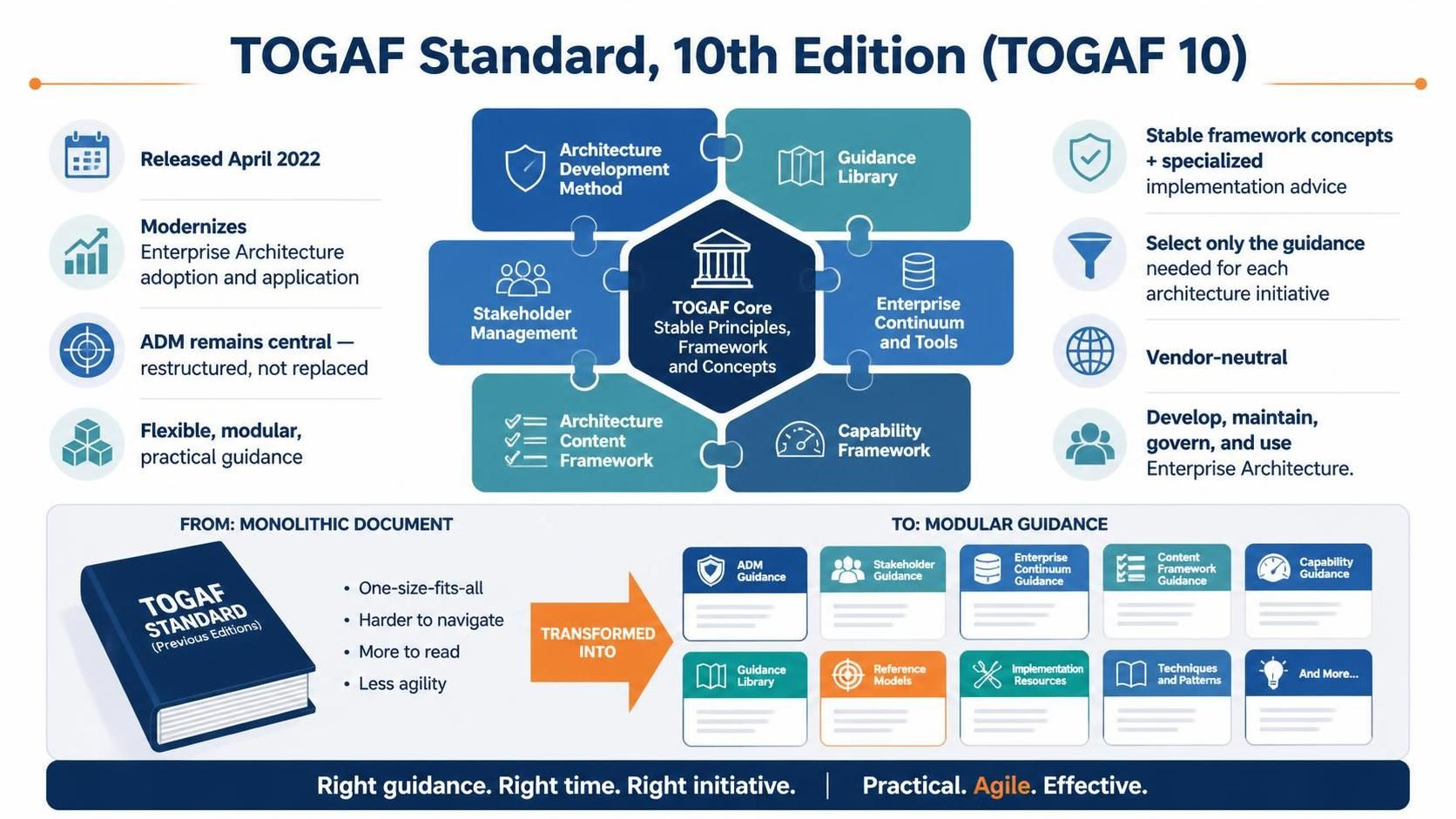 Mastering the TOGAF Standard 10th Edition: A Modular Approach to Enterprise Architecture