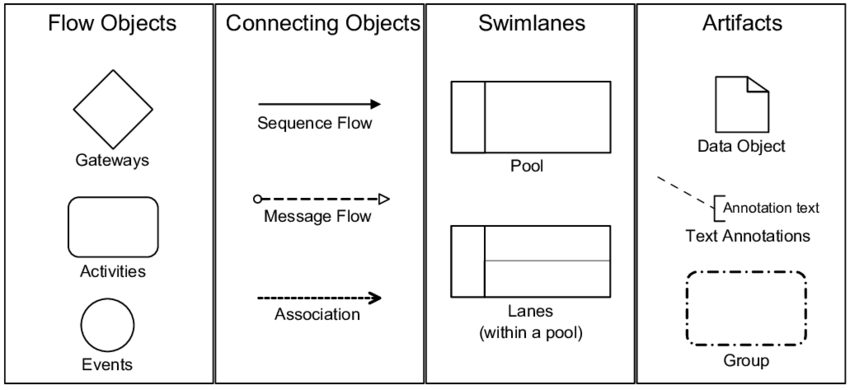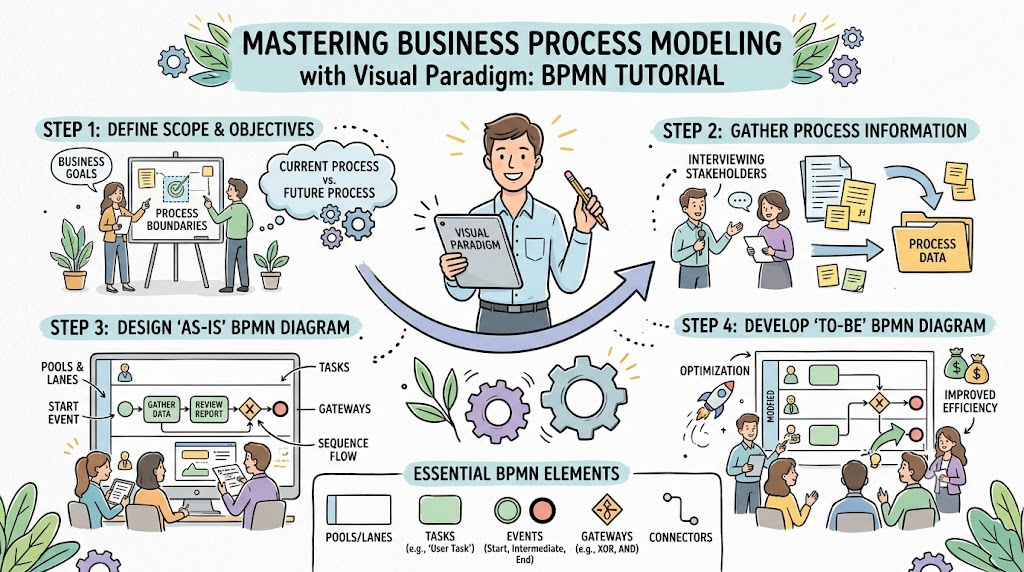
Welcome to this comprehensive tutorial on Business Process Model and Notation (BPMN). In the world of enterprise architecture, few concepts are as critical as exception handling. Real-world business processes rarely follow a perfect, linear path. Instead, they are filled with variables, delays, and missing data.
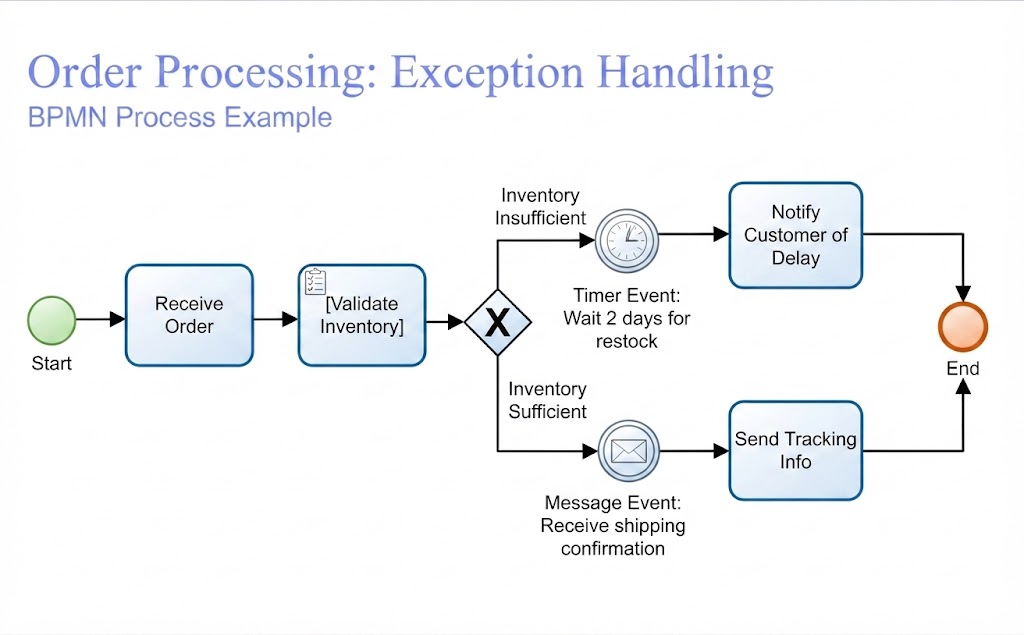
In this article, we will deconstruct a specific BPMN process diagram focused on Order Processing. We will analyze how the system manages scenarios where inventory is insufficient, utilizing the powerful Exclusive Gateway and two distinct types of Intermediate Events: the Timer Event and the Message Event.
1. The Standard Flow: Receiving and Validating
Every robust process begins with a trigger. In our diagram, this is represented by the Start Event (the green circle). The process initiates when an order is placed. Let’s trace the initial steps:
- Receive Order: The system captures the incoming request. This is a standard Task, represented by the blue rounded rectangle.
- Validate Inventory: The next step involves a check. Notice the document icon in the corner of this task. This indicates a specific type of task where the output or action involves a document or a detailed review of records.
At this stage, the system has gathered the necessary data to make a decision. This leads us to the pivotal junction in our process.
2. The Decision Point: The Exclusive Gateway
The diamond shape with the “X” inside is known as an Exclusive Gateway. In BPMN, this symbol represents a branching point where the process must choose exactly one path based on a specific condition.
In our Order Fulfillment scenario, the condition is binary:
- Is the inventory sufficient?
- Is the inventory insufficient?
The gateway forces the process to evaluate the status of the stock. Depending on the answer, the flow diverges into two completely different branches of logic. This is the essence of structured decision-making in process modeling.
3. Branch A: The “Insufficient” Path (Timer Event)
Let’s explore the scenario where the system determines that Inventory Insufficient. This path highlights how to handle delays and wait times.
- The Timer Event: Notice the clock icon. In BPMN, this is a Timer Intermediate Event. Unlike a task that is performed immediately, a timer event represents a “wait” state. The system pauses the process flow here.
- Logic: The diagram specifies: “Wait 2 days for restock.” This implies that the business logic dictates a specific time window to resolve the issue before notifying the customer of a permanent delay.
- Notify Customer of Delay: Once the timer expires (after 2 days), the process resumes to this task, where the customer is informed of the delay.
4. Branch B: The “Sufficient” Path (Message Event)
Now, let’s look at the alternative path: Inventory Sufficient. Here, the process handles the successful completion of the order.
- The Message Event: Notice the envelope icon. This represents a Message Intermediate Event. This is crucial for modeling asynchronous processes—actions that rely on external communication rather than internal logic.
- Logic: The text below reads: “Receive shipping confirmation.” This indicates that the system cannot proceed to send tracking info until an external signal (the shipping confirmation) is received from a logistics partner.
- Send Tracking Info: Once the message is received, the process moves to the final task of sending the tracking details to the customer.
5. The Convergence: End Event
Regardless of which path the process takes—whether it waits 2 days for stock or receives a shipping confirmation immediately—both branches eventually merge. This is known as convergence.
Both paths lead to the End Event (the orange circle). This signifies that the process has concluded. The system has successfully handled the order, either by fulfilling it or by communicating a delay.
Conclusion
This diagram is a perfect example of how BPMN allows us to visualize complex logic clearly. By using the Exclusive Gateway to split the flow and combining it with specific Intermediate Events (Timer and Message), we create a model that is both resilient and realistic. It anticipates what happens when things go wrong (insufficient inventory) and what happens when things go right (sufficient inventory), ensuring that every possible outcome is accounted for in the system architecture.