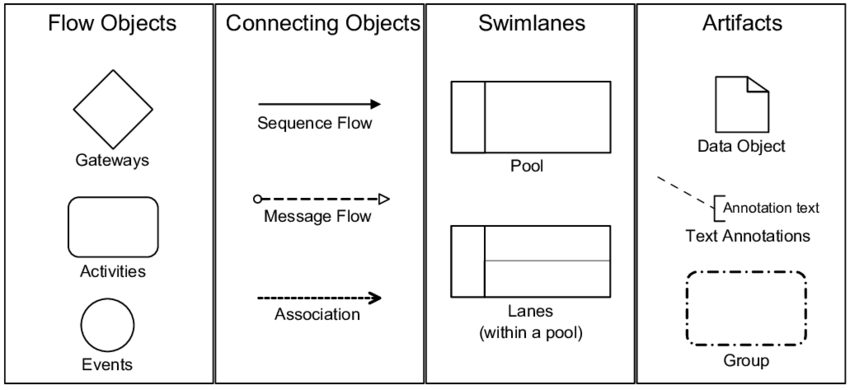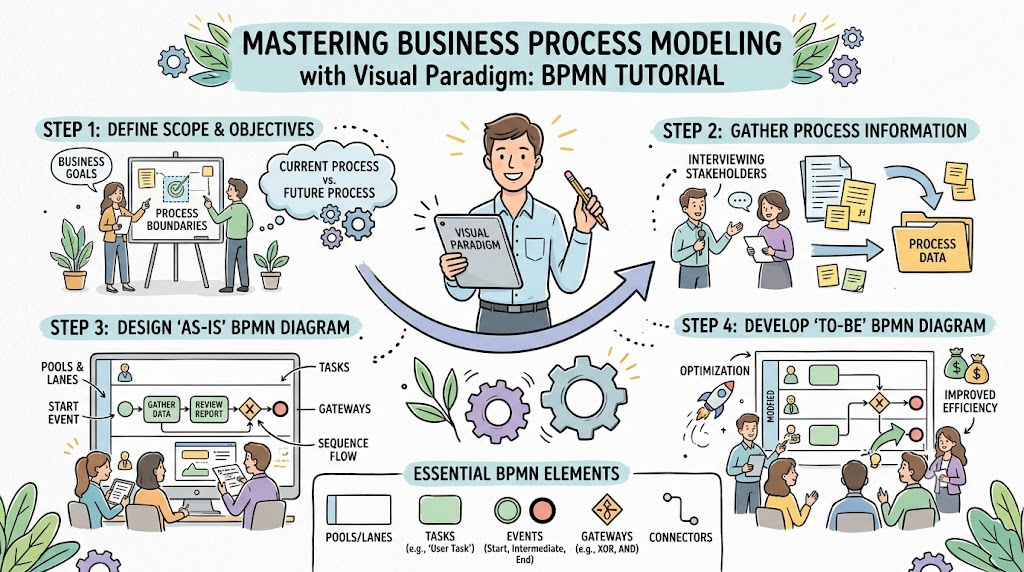
In the world of Business Process Model and Notation (BPMN), clarity is king. However, a frequent stumbling block for practitioners is understanding the different “lenses” through which a process can be viewed. Is your process internal? Does it need to communicate with external partners? Are you defining a contract between multiple organizations?
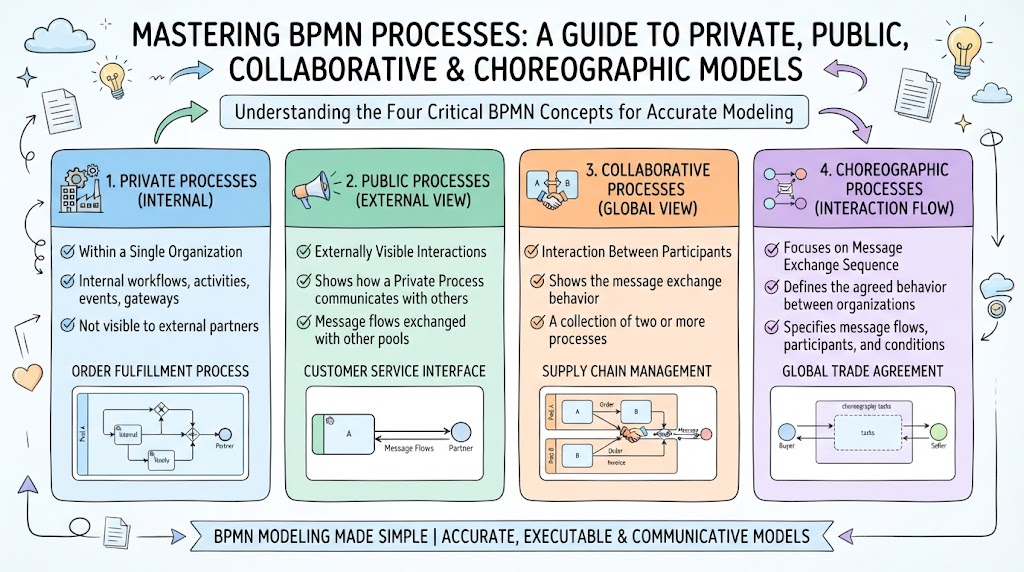
This tutorial breaks down the four critical BPMN concepts—Private, Public, Collaborative, and Choreographic processes—explaining their system architecture, unique roles, and how to model them effectively.
1. Private Processes (Internal)
The “Black Box” Architecture
A Private Process, often referred to as a Process Collaboration or Internal Process, is the most granular view of a business workflow. It represents the specific steps, logic, and decision-making rules inside a single organization.
Key Characteristics
- Scope: Confined to a single organization (represented by one Pool).
- Visibility: The internal details (activities, gateways, and events) are hidden from external partners. To the outside world, this is a “black box.”
- Ownership: The organization has full control over the logic and execution.
Practical Example: Order Fulfillment
Imagine a company, Company A, receiving an order. The private process details exactly how Company A handles this:
- Receive Order.
- Check Inventory (Gateway).
- If Stock Exists $\rightarrow$ Ship.
- If Stock Missing $\rightarrow$ Notify Supplier.
In a diagram, this is a single Pool containing the full lifecycle of the task.
2. Public Processes (External View)
The “Service Contract” Architecture
While Private processes show what happens inside, a Public Process (often modeled as a Conversation Diagram) shows what happens outside. It defines the interface of a private process without revealing its internal logic.
Key Characteristics
- Scope: Represents the boundary of a single organization but focuses on interaction points.
- Visibility: It “hides” the internal complexity of the private process, exposing only the entry and exit points.
- Function: It acts as a contract. It tells external partners, “If you send me this message, I will do that,” without showing how I do it.
Practical Example: Customer Service Interface
Consider a Customer Service Interface for Company A. The Public Process does not show the internal steps of checking inventory. Instead, it simply shows:
- A Message Flow coming in from a Partner (e.g., “Request Shipment”).
- A Message Flow going out to the Partner (e.g., “Shipment Confirmation”).
This abstraction allows partners to interact with Company A without needing to understand Company A’s internal ERP system or workflow rules.
3. Collaborative Processes (Global View)
The “Orchestrated” Architecture
When multiple organizations need to work together on a shared goal, a Collaborative Process (or Interaction Diagram) is used. This view brings multiple Private Processes together.
Key Characteristics
- Scope: Global view involving two or more participants (Pools).
- Interaction: Shows the explicit message exchange between the participants.
- Control: Typically, one participant acts as the “orchestrator,” controlling the flow of the conversation.
Practical Example: Supply Chain Management
In a Supply Chain scenario involving Supplier A and Buyer B, the Collaborative Process visualizes the handshakes:
- Supplier A sends an “Order” message.
- Buyer B receives it and sends an “Invoice” message.
Unlike the Private process, this diagram focuses on the exchange of messages between the pools, showing how the two distinct internal systems interact.
4. Choreographic Processes (Interaction Flow)
The “Decentralized” Architecture
The Choreographic Process is the most abstract level. It defines the global behavior of the system without specifying which individual organization performs which specific task. It is a description of the agreement rather than the execution.
Key Characteristics
- Scope: Defines the agreed behavior between organizations.
- Focus: Message Exchange Sequence. It answers: “If I send X, you must reply with Y.”
- Execution: It does not define a central controller. Each participant acts based on the rules defined in the choreography.
Practical Example: Global Trade Agreement
In a Global Trade scenario, a Choreography defines the rules of engagement:
- If the Buyer sends an “Order,” the Seller must send an “Invoice”.
- If the Seller sends a “Rejection,” the Buyer must cancel the order.
In the diagram, you will often see a central “Choreography Task” or simply arrows connecting participants that represent these mandatory rules, independent of any single party’s internal logic.
Summary: Choosing the Right Model
| Process Type | Primary Focus | Visibility | Analogy |
|---|---|---|---|
| Private | Internal Logic | Hidden | The Recipe (How I cook) |
| Public | Interface/Contract | External View | The Menu (What I serve) |
| Collaborative | Interaction | Shared View | The Dinner Party (Who talks to whom) |
| Choreographic | Agreement | Global Rules | The Etiquette (Rules of conduct) |
By mastering these four concepts, you can create accurate, executable, and communicative models that bridge the gap between technical execution and business strategy.