


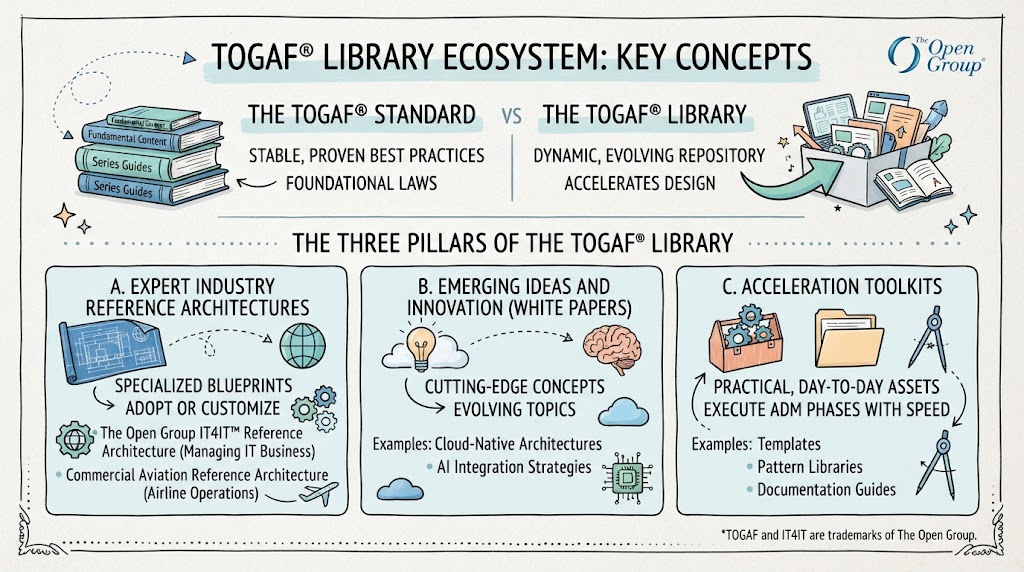
In the complex world of Enterprise Architecture (EA), time is often the most scarce resource. The TOGAF Standard provides a rigorous methodology, but how do you actually apply it efficiently? The answer lies in understanding the ecosystem surrounding the core standard: the TOGAF Library.
This tutorial explores the critical distinctions between the TOGAF Standard and its Library, breaks down the three pillars that support modern architecture, and demonstrates how to leverage Visual Paradigm to accelerate your Architecture Development Method (ADM) phases.
1. The Fundamental Distinction: Standard vs. Library
Before diving into the resources, it is essential to distinguish between the “rules of the road” and the “tools in the toolbox.”
The TOGAF Standard: The Foundation
The TOGAF Standard represents stable, proven best practices. It is the core methodology that has stood the test of time across industries. This includes the Fundamental Content and Series Guides. Think of this as the “Foundational Laws”—it is stable, formal, and provides the structural backbone for your architecture.
The TOGAF Library: The Accelerator
In contrast, the TOGAF Library is a dynamic, evolving repository. It is designed specifically to accelerate architecture design. While the Standard tells you how to build, the Library provides the assets—templates, patterns, and emerging ideas—to build it faster. It contains resources that may not yet be formalized into the standard but are critical for modern innovation.
2. The Three Pillars of the TOGAF Library
The Library is structured around three primary pillars that cater to different needs, from industry-specific blueprints to cutting-edge innovation.
A. Expert Industry Reference Architectures
These are specialized blueprints developed by experts within The Open Group forums. Instead of building a system structure from scratch, these architectures allow you to adopt industry-standard structures “as-is” or customize them to fit your specific context.
- IT4IT™ Reference Architecture: Provides a complete blueprint for managing the business of IT, focusing on the flow of value.
- Commercial Aviation Reference Architecture: Offers pre-defined data flows and business capabilities specifically for airline operations.
B. Emerging Ideas and Innovation (White Papers)
Technology evolves faster than formal standards can be written. The library hosts White Papers that capture cutting-edge concepts and creative thinking on evolving topics. This section is your source for understanding how to integrate modern technologies like:
- Cloud-native architectures
- AI integration strategies
- Microservices patterns
C. Acceleration Toolkits
These are the practical, day-to-day assets that help execute ADM phases with speed and consistency. If you are a junior architect, these are your best friends. They include:
- Templates: Ready-made documents for architecture descriptions.
- Pattern Libraries: Proven solutions to common problems.
- Documentation Guides: Instructions on how to articulate your architectural decisions.
3. Practical Application: Speeding Up Your First Project
To visualize the impact of the Library, consider a scenario where a junior Enterprise Architect joins a commercial airline. The task is to integrate flight coordination systems with baggage handling software.
The “Without the Library” Approach
Without access to the Library, the architect must start from zero. They spend months interviewing staff, asking what the processes look like, and drawing system boxes from scratch. This approach risks design gaps, inefficiencies, and a lack of industry alignment.
The “With the Library” Approach
By accessing the Commercial Aviation Reference Architecture from the Library, the architect has a massive head start. This blueprint already outlines standard business capabilities and data flows for airlines. The architect uses this as a baseline, tweaks it for specific software needs, and completes the initial draft in a fraction of the time.
4. Recommended Tooling: Visual Paradigm + TOGAF ADM + ArchiMate
Understanding the theory is one thing; executing it is another. To effectively utilize the TOGAF Library and its assets, you need robust modeling software. Visual Paradigm stands out as a comprehensive solution for this ecosystem.
Why Visual Paradigm for TOGAF?
Visual Paradigm is not just a drawing tool; it is an integrated Enterprise Architecture platform. It bridges the gap between the theoretical concepts of the TOGAF Library and practical execution.
Integration with TOGAF ADM
Visual Paradigm natively supports the TOGAF Architecture Development Method (ADM). It provides:
- Phase Guides: Built-in checklists and templates for each ADM phase (Preliminary, A, B, C, D, E, F, G, H).
- Architecture Repository: A centralized database to store the assets mentioned in the TOGAF Library (Reference Architectures, Patterns).
- Workflow Management: Tools to track the approval and lifecycle of your architectural artifacts.
ArchiMate Modeling Capabilities
The TOGAF ecosystem relies heavily on ArchiMate for visualization. Visual Paradigm offers a robust ArchiMate modeling environment that allows you to map the “Three Pillars” of the Library into visual models:
- Strategic Layer: Map the “Expert Industry Reference Architectures” to visualize high-level business capabilities.
- Application Layer: Use the “Acceleration Toolkits” to define application components and their interfaces.
- Technology Layer: Model the infrastructure required for “Emerging Ideas” like Cloud-Native architectures.
How It Helps the EA Process
By using Visual Paradigm, your “junior architect” in the airline scenario can import the Commercial Aviation Reference Architecture directly into their workspace. They can then visualize the gaps between the standard blueprint and the specific software requirements, automatically generating the documentation required for the TOGAF Standard. This seamless integration turns the abstract concepts of the TOGAF Library into actionable, visual models.
Related posts:
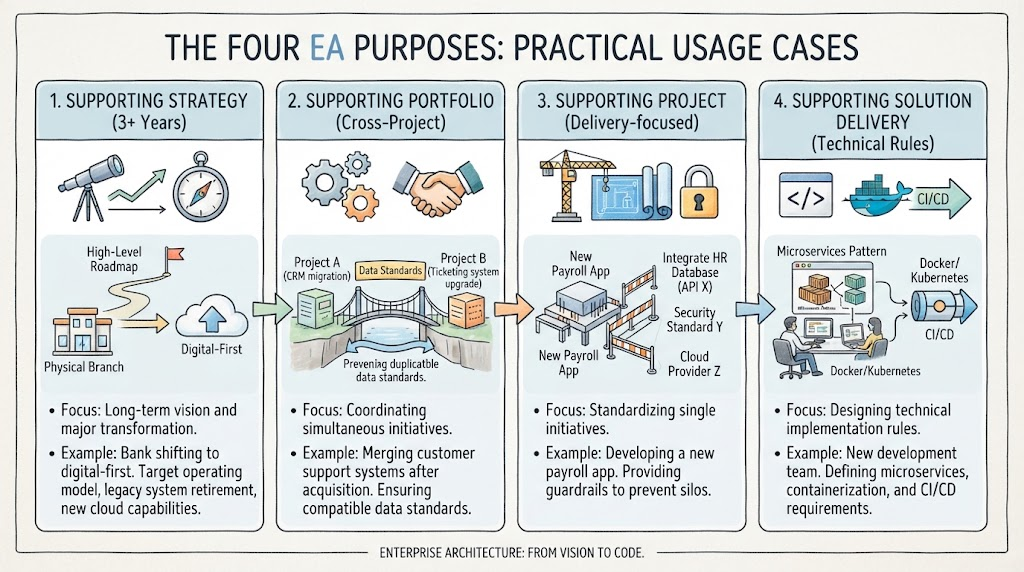 Mastering Enterprise Architecture: A Step-by-Step Guide to the Four Core Purposes
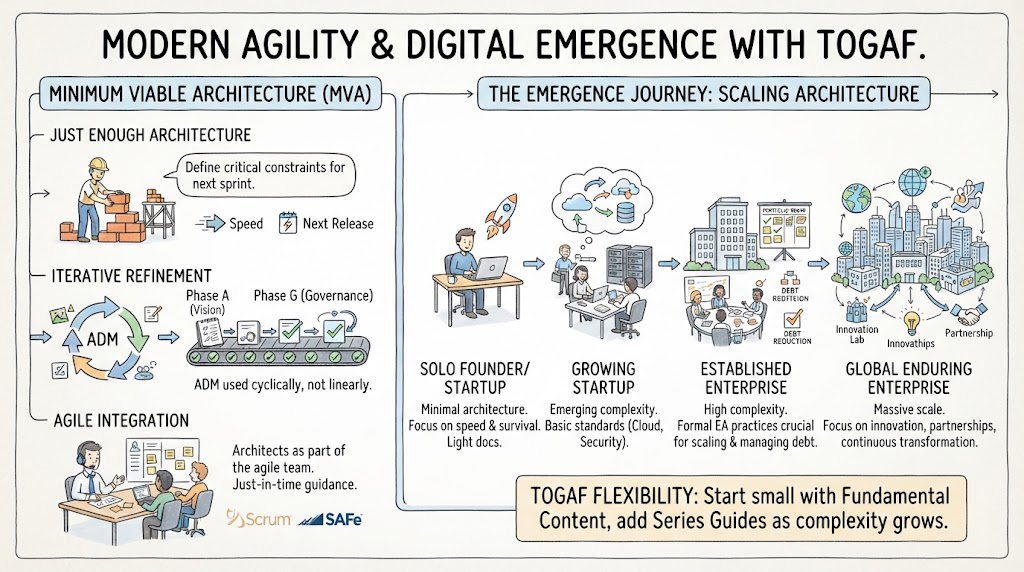 Mastering Modern Agility: A Tutorial on Minimum Viable Architecture and the Digital Emergence Journey
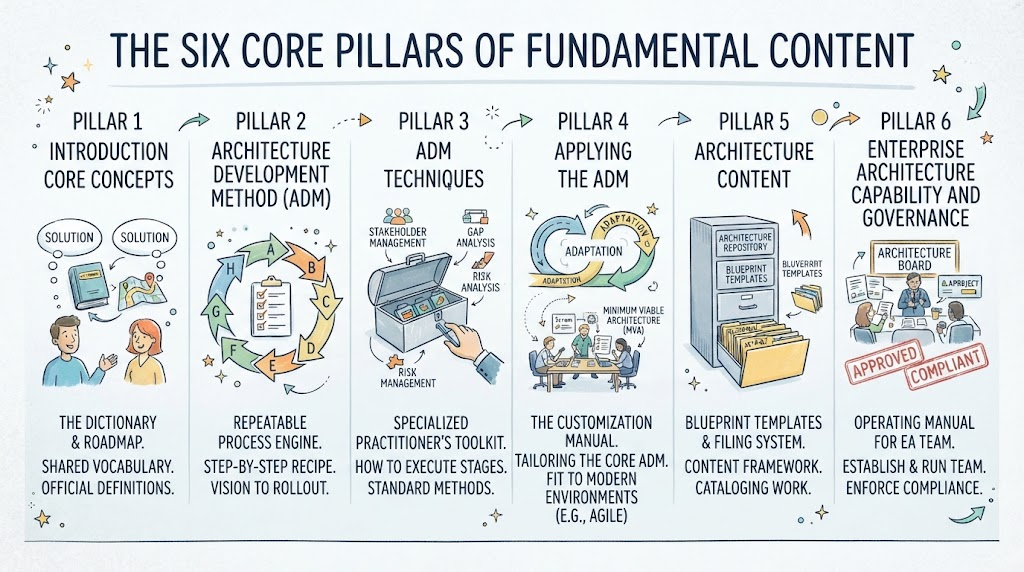 Mastering Enterprise Architecture: A Step-by-Step Guide to the Six Core Pillars of TOGAF
 Mastering Enterprise Architecture: A Strategic Guide to the TOGAF Framework