


Enterprise Architecture (EA) is often criticized for being rigid or too theoretical to be practical in fast-paced business environments. However, the The Open Group Architecture Framework (TOGAF) addresses this by employing a layered approach designed to be both durable and adaptable. This article dissects the structure of the TOGAF Library, explaining how the framework balances stable core concepts with emerging architectural practices.
The Three-Tiered Architecture of TOGAF
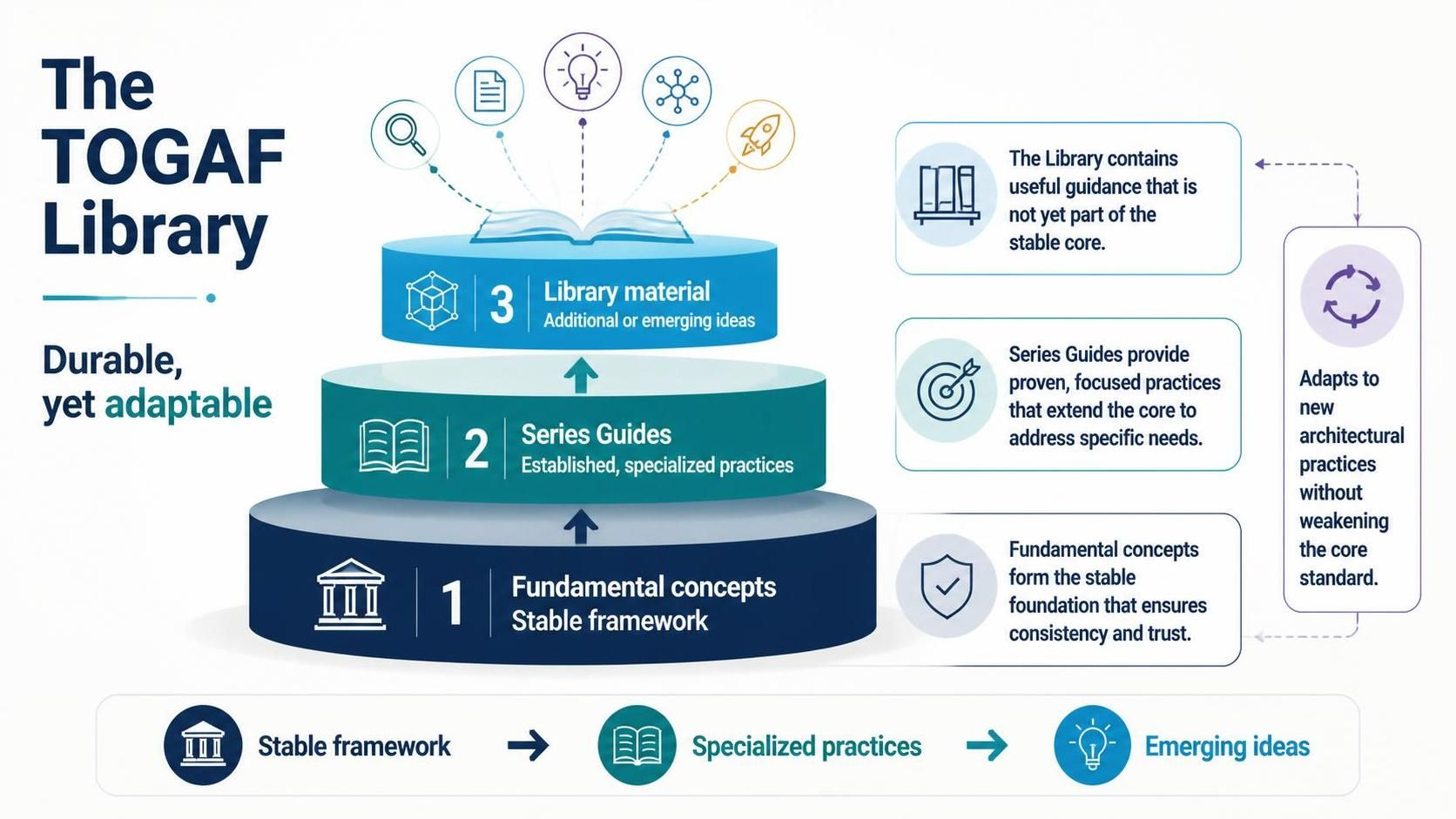
To understand how TOGAF evolves without losing its foundation, we must look at its content as a structured hierarchy. The diagram illustrates a progression from a solid foundation to a flexible repository of ideas. Let’s break down these three layers.
1. Fundamental Concepts: The Stable Framework
At the base of the architecture lies the Fundamental Concepts. These are the bedrock of the standard, forming a stable framework that ensures consistency and trust across all implementations.
- Purpose: To provide the core definitions, principles, and lifecycle models (such as the ADM) that define what TOGAF is.
- Stability: Unlike the layers above, this core is rarely changed. It provides the “grammar” and “syntax” of enterprise architecture.
2. Series Guides: Established, Specialized Practices
Building upon the foundation, the second layer consists of Series Guides. These provide established, specialized practices that extend the core to address specific needs.
- Purpose: If the Fundamental Concepts are the rules of the game, Series Guides are the strategy manuals for specific positions (e.g., Security Architecture, Data Architecture, or Cloud Architecture).
- Focus: They offer proven, focused practices that have moved beyond the “emerging” phase and are ready for widespread adoption.
3. Library Material: Additional or Emerging Ideas
The top layer, the Library, is the most dynamic part of the ecosystem. It contains guidance that is useful but is not yet part of the stable core of the standard.
- Purpose: This acts as a sandbox for new ideas, tools, and methodologies. It allows the architecture community to experiment with emerging technologies without polluting the core standard.
- Adaptability: By keeping these materials in the Library, TOGAF can adapt to new architectural practices without weakening the core standard.
The Cycle of Evolution
The diagram highlights a crucial feedback loop: “Adapts to new architectural practices without weakening the core standard.” This is achieved through a continuous cycle:
- Emergence: New ideas enter the Library as experimental guidance.
- Validation: As these practices prove their worth, they migrate to Series Guides.
- Stabilization: Eventually, if an idea becomes universally accepted, it may eventually inform the Fundamental Concepts.
This layered approach ensures that TOGAF remains durable. It does not force change upon the core framework until that change is proven to be necessary and robust.
Conclusion and Recommended Tooling
Understanding the distinction between the stable core and the emerging library is essential for any architect looking to implement TOGAF effectively. It allows organizations to innovate quickly using library materials while maintaining governance through the fundamental concepts.
To visualize these layers and model the architecture effectively, it is highly recommended to utilize Visual Paradigm TOGAF ADM Tool. This software facilitates the management of architectural artifacts across all three layers, allowing architects to map out the progression from fundamental concepts to specialized series guides and emerging library materials within a single, cohesive environment.
Related posts:
 Mastering TOGAF: A Step-by-Step Guide to the ADM Cycle and Enterprise Architecture
 Overcoming the EA Blank Canvas: Leveraging the TOGAF Library & Tooling
 Mastering Phase E: Opportunities & Solutions in Enterprise Architecture
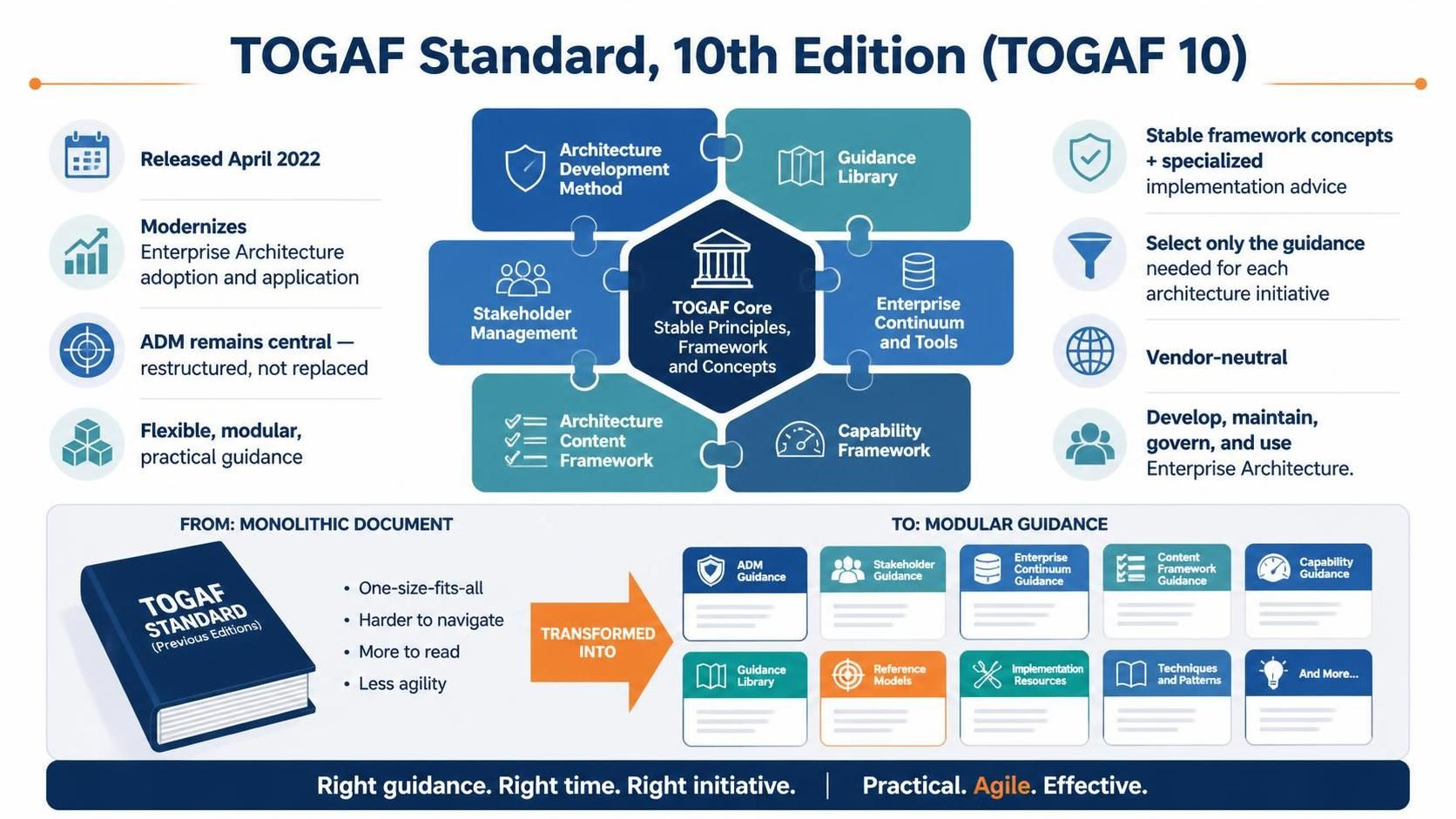 Mastering the TOGAF Standard 10th Edition: A Modular Approach to Enterprise Architecture