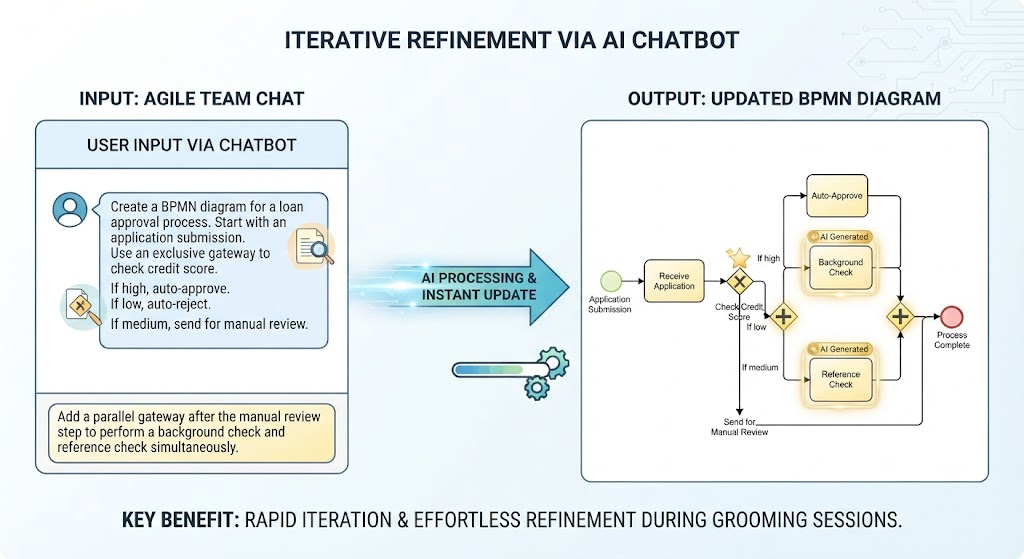
In modern Agile environments, the gap between business requirements and technical process modeling is often bridged by tools that democratize complexity. This tutorial explores how Visual Paradigm leverages AI-driven chatbot technology to transform natural language instructions into precise BPMN (Business Process Model and Notation) diagrams. We will walk through the architecture of an Online Loan Approval Process, demonstrating how a team can iteratively refine a system from a simple text prompt into a complex, multi-path workflow.
The AI-Driven Modeling Workflow
The core of this system is the interaction between a user and the AI Chatbot. Unlike traditional modeling tools that require users to drag and drop specific shapes, this approach allows for natural language processing. The workflow follows a distinct “Input-Process-Output” architecture:
- Input (Chatbot): The user provides high-level business logic in plain English.
- Processing (AI Engine): The AI interprets the intent, selects the appropriate BPMN gateways, and generates the visual model.
- Output (BPMN Diagram): An instantly updated diagram that reflects the new logic.
Step-by-Step: Constructing the Loan Approval Model
To illustrate this capability, let’s build a Loan Approval process. We will move from a basic structure to an enhanced version involving background checks.
Phase 1: The Initial Request (Natural Language Input)
The process begins with the user defining the entry point and the primary decision logic. In the chatbot interface, the user inputs the following command:
"Create a BPMN diagram for a loan approval process. Start with an application submission. Use an exclusive gateway to check credit score. If high, auto-approve. If low, auto-reject. If medium, send for manual review."
Technical Analysis of the Prompt:
- Start Event: “Application Submission” creates the green circle entry point.
- Task: “Check Credit Score” is modeled as a standard process task.
- Decision Logic: The phrase “If high… If low… If medium” dictates the use of an Exclusive Gateway (XOR). This diamond shape ensures that only one path is taken based on the outcome.
Phase 2: The Initial Diagram Structure
Upon receiving the command, the system generates the initial flow. The diagram visualizes the branching logic:
- Receive Application: The process starts.
- Check Credit Score: The system evaluates the applicant.
- Exclusive Gateway: The traffic splits into three distinct paths:
- If High: The path leads to an Auto-Approve task.
- If Low: The path leads to an Auto-Reject task.
- If Medium: The path leads to a Send for Manual Review task.
Phase 3: Iterative Refinement (The “Grooming” Session)
Agile processes are rarely static. During a grooming session, the product owner might realize that manual reviews need more rigor. The power of the AI Chatbot is demonstrated here, as the user does not need to manually manipulate shapes.
New Command:
"Add a parallel gateway after the manual review step to perform a background check and reference check simultaneously."
What Happens Under the Hood?
The AI identifies the “Manual Review” task and appends a new Parallel Gateway (AND) immediately after it. This changes the logic from a linear sequence to a concurrent workflow. It creates two parallel branches: one for the Background Check and one for the Reference Check.
Final Architecture: The Converged Workflow
The final diagram represents a robust business process. After the parallel checks are completed, the process must synchronize. The diagram includes a second Parallel Gateway that converges the two background tasks back into a single flow, ensuring both checks are finished before proceeding to the final state.
Key Modeling Concepts Illustrated
This tutorial highlights three critical BPMN concepts that the AI correctly implements:
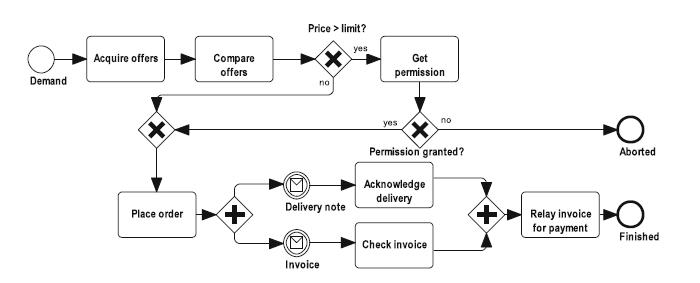
- Exclusive Gateway (XOR): Used for the initial credit check. It represents a choice where only one outcome is possible (High, Medium, or Low). Visually, it looks like a diamond with an ‘X’ inside.
- Parallel Gateway (AND): Used for the background checks. It represents concurrency. The process splits to do two things at once and waits for both to finish before recombining. Visually, it looks like a diamond with a plus sign (+) inside.
- Event-Based Gateways: While not used in this specific iteration, the context notes that these are used for reactive triggers, showing the versatility of the modeling tool.
Conclusion: The Value of AI in BPMN
By leveraging Visual Paradigm’s AI-driven tooling, teams can bypass the steep learning curve of BPMN syntax. The ability to generate and refine diagrams using natural language allows Agile practitioners to focus on what matters most: the business logic and value delivery. Whether you are mapping a simple approval flow or a complex multi-system integration, this technology empowers you to model with speed, precision, and intelligence.