


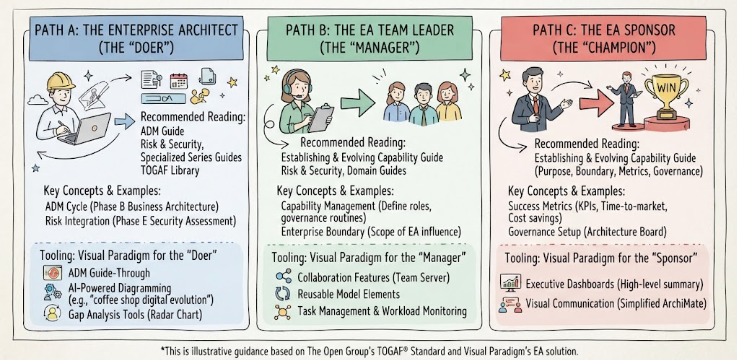
Enterprise Architecture (EA) is not a monolithic discipline; it is a multifaceted practice that requires different tools, mindsets, and strategies depending on who is performing the work. To effectively implement the TOGAF Standard (The Open Group Architecture Framework), organizations must align their architectural activities with the specific responsibilities of their team members. This tutorial explores how to navigate the EA landscape through three distinct personas: the Enterprise Architect (The Doer), the EA Team Leader (The Manager), and the EA Sponsor (The Champion). We will also examine how Visual Paradigm acts as the central nervous system for these roles, integrating the ADM Cycle and ArchiMate modeling language.
Path A: The Enterprise Architect (The “Doer”)
For the practitioner, the EA landscape is defined by the day-to-day grind of development, approval, and application of architectures. The focus here is on the mechanics of the Architecture Development Method (ADM) and the practical application of TOGAF content.
Core Responsibilities and Reading
The Enterprise Architect is the engine room of the organization. To build a solid foundation, the recommended reading sequence focuses on the Practitioner’s Approach to Developing Enterprise Architecture. Key attention should be paid to:
- Chapters 3 and 6: These chapters are critical for understanding the practical application of the ADM cycle and the Fundamental Content.
- Integrating Risk and Security: Essential for reducing uncertainty and ensuring that architectures meet strict accountability standards.
- Specialized Guides: Architects should select guides based on immediate project needs, such as Digital Enterprise, Agile Integration, or Data/Information Architecture.
Key Concepts & Examples
In practice, the “Doer” must translate abstract strategy into concrete models. Two primary areas of focus are the ADM Cycle and Risk Integration.
- ADM Cycle Application (Phase B): When mapping current business capabilities to future goals, the architect utilizes Phase B (Business Architecture). This is where you define the scope and structure of the business.
- Risk Integration (Phase E): During Phase E (Opportunities and Solutions), architects must assess risks associated with new digital platforms. This ensures that security is not an afterthought but an integral part of the solution.
Tooling: Visual Paradigm for the “Doer”
For the architect, efficiency is paramount. Visual Paradigm offers a suite of tools designed to streamline the ADM process:
- ADM Guide-Through Process: The interface guides architects through each phase of the ADM, providing contextual help and deliverable templates so you never miss a step.
- AI-Powered Diagramming: Modernize your workflow by using natural language prompts to generate ArchiMate diagrams. For instance, describing a “coffee shop digital evolution” can automatically generate stakeholder maps and process flows for Business Architecture (Phase B) or Application Architecture (Phase C).
- Gap Analysis Tools: Leverage smart radar charts to visually compare the baseline and target architectures. This highlights specific gaps in capabilities or services that need addressing.
Path B: The EA Team Leader (The “Manager”)
The EA Team Leader operates at the intersection of strategy and execution. Their primary concern is setting up, optimizing, and evolving the EA department while mentoring the practitioners who do the modeling.
Defining the Team and Boundaries
Management requires a shift in focus from “how to build a diagram” to “what are we building and why?” The recommended reading, The TOGAF Leader’s Guide to Establishing and Evolving an EA Capability, provides the framework for:
- Defining Team Purpose: Clearly articulating what the EA team exists to achieve.
- Enterprise Boundary: Determining what is inside and outside the scope of EA influence. This prevents scope creep, a common pitfall where EA attempts to model every system in the organization.
Key Concepts & Examples
Effective management ensures that the team has direction and consistency.
- Capability Management: Define clear roles within the EA team (e.g., Business Architect, Data Architect) and establish governance routines to ensure smooth operations.
- Domain Distribution: As a manager, you act as a filter, distributing specialized guides to practitioners based on the specific projects they are currently assigned to.
Tooling: Visual Paradigm for the “Manager”
Visual Paradigm serves as the collaborative hub for the EA department:
- Collaboration Features: Use the Team Server to manage access controls, review models, and track progress across multiple architecture projects simultaneously.
- Reusable Model Elements: Create a library of standardized ArchiMate components. Practitioners can reuse these to ensure consistency and reduce the time spent on repetitive modeling tasks.
- Task Management: Integrate ADM phases with task tracking to monitor team workload and ensure deliverables are completed on schedule.
Path C: The EA Sponsor (The “Champion”)
The EA Sponsor is the executive champion responsible for ensuring the EA team aligns with business goals and drives value. They are less concerned with the mechanics of the ADM and more focused on the outcomes of the architecture.
Championing Value and Governance
The Sponsor’s role is to champion the EA team to help the business make better change decisions. The reading focus is on the TOGAF Leader’s Guide, specifically looking at:
- Core Purpose: Why does the EA team exist?
- Success Metrics: How do we measure the success of architecture outcomes?
- Governance Structure: Establishing the rules for change decisions.
Key Concepts & Examples
For the Sponsor, the value of EA is measured in business results.
- Success Metrics (KPIs): Define measurable goals such as reduced time-to-market, improved compliance rates, or cost savings derived from reusable services.
- Governance Setup: Establish an Architecture Board that reviews major changes against strategic goals to ensure alignment.
Tooling: Visual Paradigm for the “Sponsor”
Visual Paradigm provides the transparency and communication tools necessary for executive oversight:
- Executive Dashboards: Generate high-level summaries of architecture health, risk exposure, and project status without getting bogged down in technical details.
- Visual Communication: Leverage simplified ArchiMate views to communicate complex architectural changes to non-technical stakeholders during governance meetings.
Recommended Tooling: Visual Paradigm + TOGAF ADM + ArchiMate
The synergy between Visual Paradigm, the TOGAF ADM, and ArchiMate creates a robust ecosystem for Enterprise Architecture. This combination supports the entire lifecycle of architecture development:
- Visual Paradigm as the Enabler: It provides the platform for collaboration, ensuring that the “Doer,” “Manager,” and “Sponsor” all have access to the same source of truth. Its AI features and automated diagramming reduce the administrative burden, allowing architects to focus on value.
- TOGAF ADM as the Process: The ADM provides the structured workflow (Phases A through H) that guides the team from vision to implementation. Visual Paradigm maps its tools directly to these phases, ensuring compliance and completeness.
- ArchiMate as the Language: ArchiMate provides the standardized notation to model the business, application, and technology layers. By using ArchiMate within Visual Paradigm, organizations ensure that their models are industry-standard, portable, and clear to all stakeholders.
By aligning the right tools with the right roles, organizations can transform their EA function from a bureaucratic hurdle into a strategic asset.
Related posts:
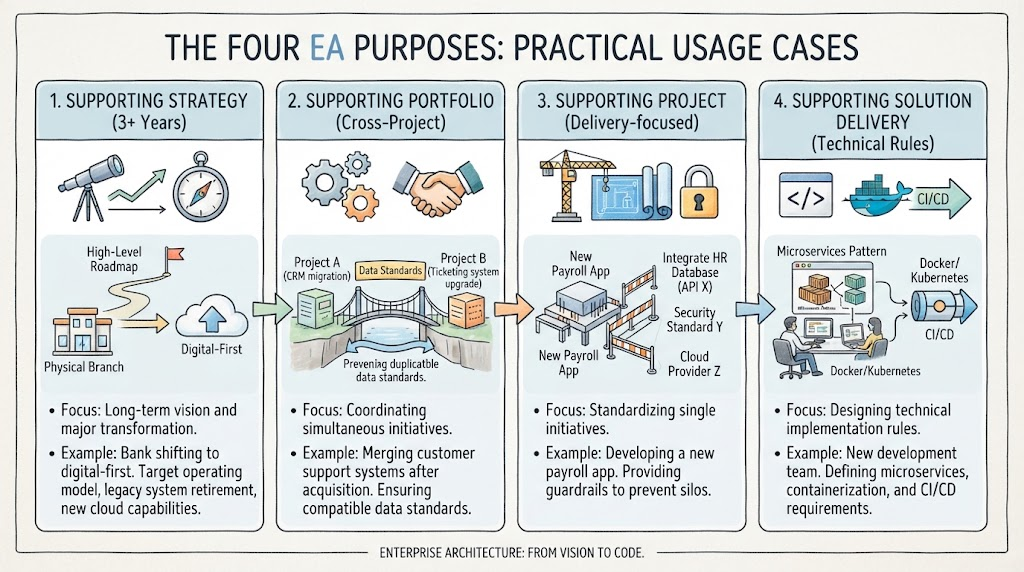 Mastering Enterprise Architecture: A Step-by-Step Guide to the Four Core Purposes
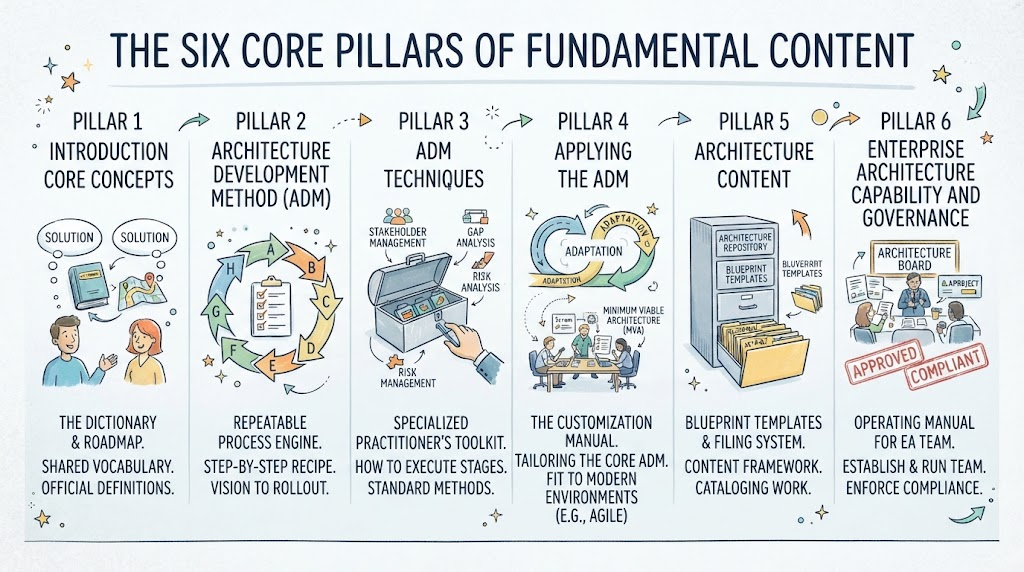 Mastering Enterprise Architecture: A Step-by-Step Guide to the Six Core Pillars of TOGAF
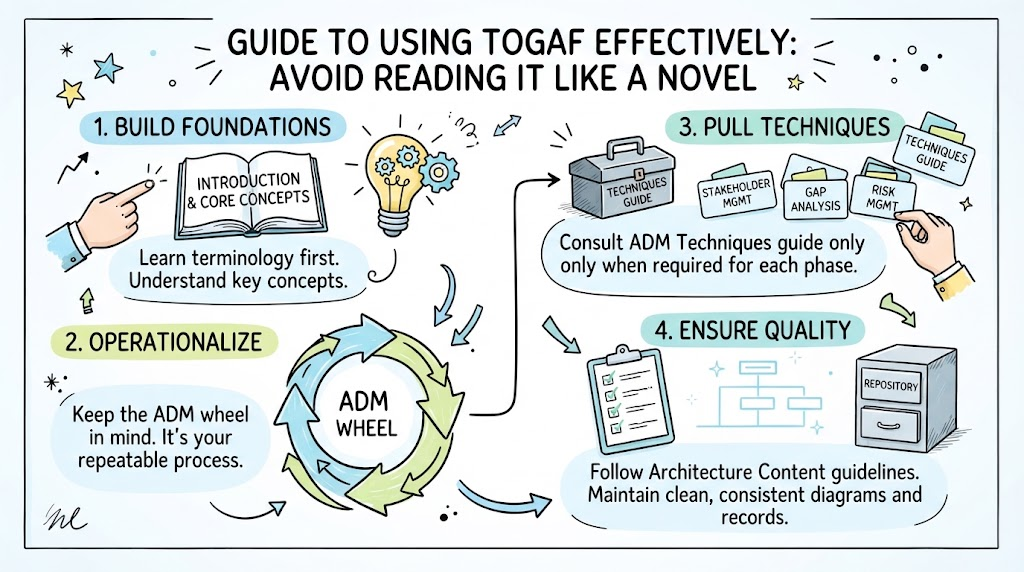 Mastering Enterprise Architecture: A Strategic Guide to the TOGAF Framework
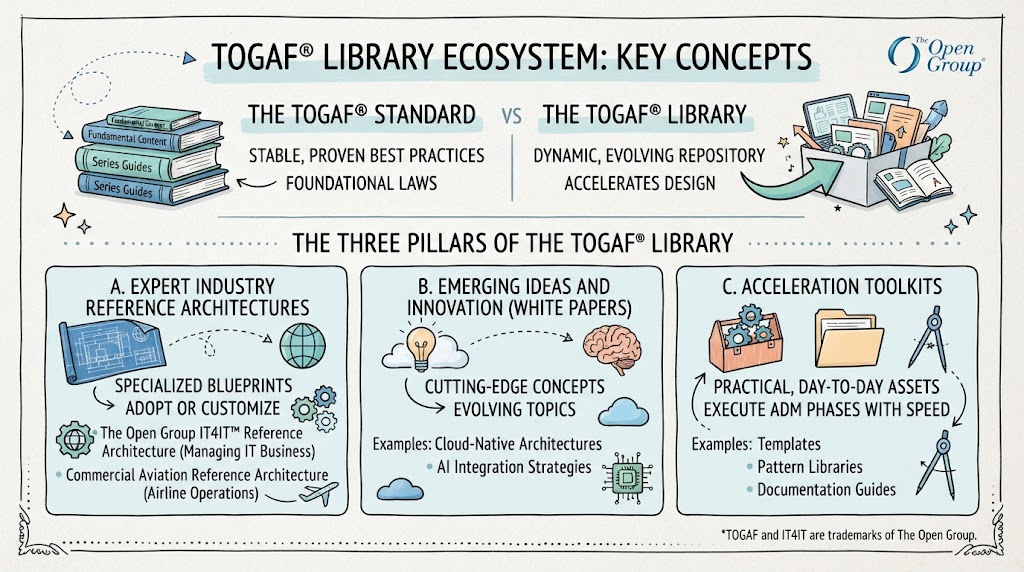 Mastering the TOGAF Library Ecosystem: From Concept to Modeling with Visual Paradigm