


In the rapidly evolving landscape of enterprise architecture, stability is an illusion. Markets shift, technologies advance, and business strategies pivot. This is where TOGAF ADM Phase H: Architecture Change Management becomes critical. This phase is not merely a maintenance task; it is the guardian of the architecture’s integrity, ensuring that the system remains relevant and effective over time.
This tutorial explores the mechanics of Phase H, breaking down the flow of change management, the assessment of impact, and the tools required to visualize and manage these complex workflows effectively.
1. The Core Objective: Keeping Architecture Relevant
The primary goal of Phase H is to manage changes after implementation. Unlike earlier phases (like A, B, C, and D) which focus on creating a new architecture, Phase H focuses on the lifecycle management of that architecture. It operates on a continuous loop of monitoring, assessing, and updating.
At the heart of this phase is the concept of a “change loop.” The process begins when a trigger event occurs in the environment. This trigger forces the organization to evaluate the current state of the architecture against the new reality.
Key Sources of Change
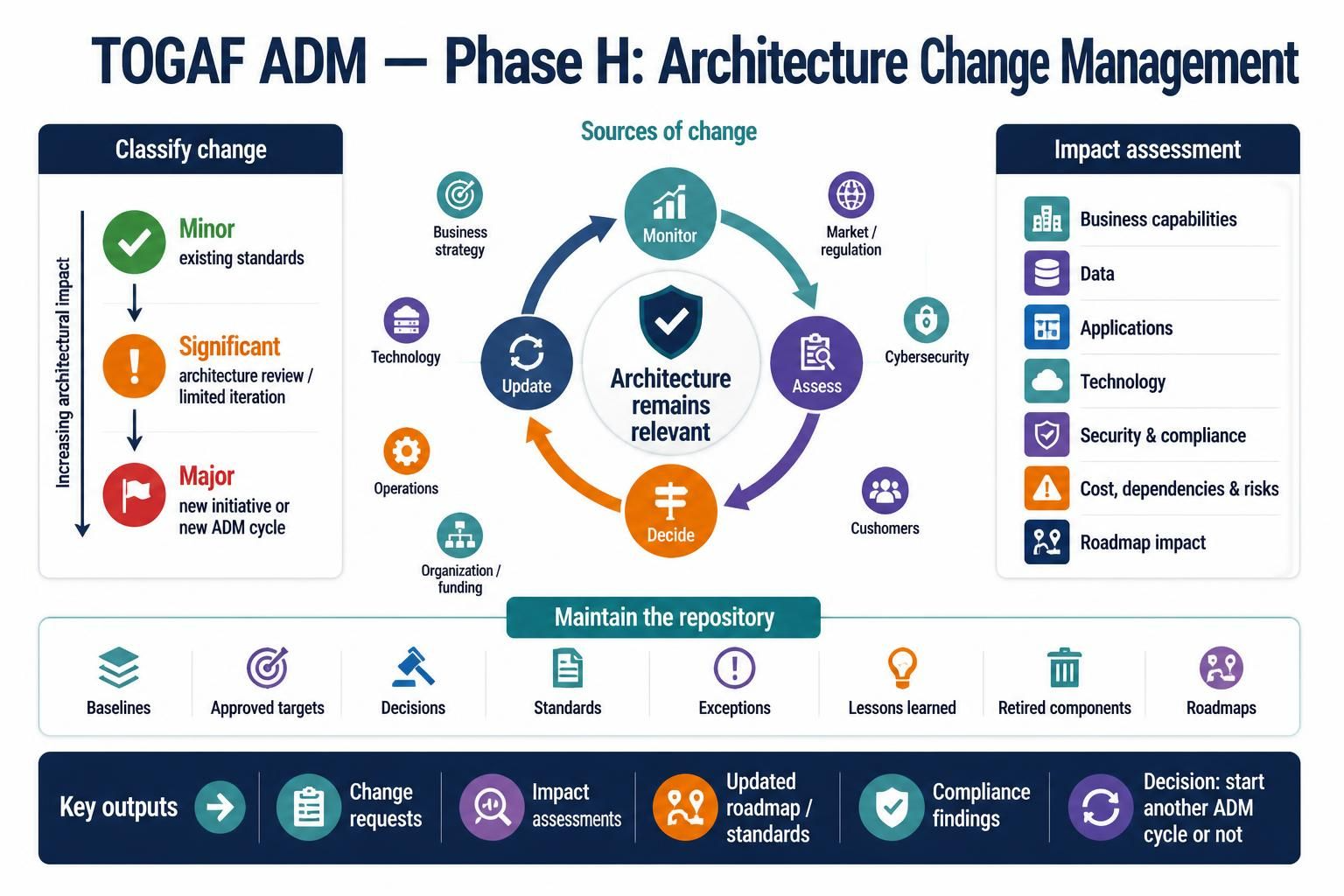
Change does not happen in a vacuum. As illustrated in the architecture diagram, changes typically stem from specific external or internal pressures:
- New Business Strategy: The organization pivots its goals.
- Market Disruption: Competitors or market trends shift.
- Regulatory Changes: New laws require compliance adjustments.
- Technology Shifts: New tech emerges that renders current stacks obsolete.
- Cybersecurity Threats: New vulnerabilities demand immediate architectural hardening.
- Operational Incidents: Performance failures highlight architectural flaws.
2. Classifying Change Requests
Not all changes are created equal. A small tweak to a user interface requirement should not consume the same resources as a restructuring of the entire data layer. Phase H introduces a critical classification mechanism to handle these requests efficiently based on their Architectural Impact.
The Three Levels of Impact
When a change is requested, it is categorized into one of three tiers:
- Minor Change:
These are adjustments that can be handled within existing standards and architecture. They do not disrupt the core framework. For example, changing a color scheme or adding a minor data field.
- Significant Change:
These changes require an architectural review or a limited iteration. They impact the architecture but do not require a full rebuild. This often involves updating specific components or modifying interfaces.
- Major Change:
These are the most critical. A Major Change implies that the current architecture can no longer support the business requirements. It necessitates a new architecture initiative or the initiation of a new ADM cycle.
3. The Architecture Impact Assessment
Once a change is classified as “Significant” or “Major,” a rigorous Impact Assessment must be conducted. This is the analytical engine of Phase H. It answers the question: “If we make this change, what breaks?”
The assessment is holistic and covers the entire architecture stack:
- Business Capabilities: How does this change affect what the business can do?
- Data: Does this require new data types, storage solutions, or migration strategies?
- Applications: Which software systems need to be updated or replaced?
- Technology: Does this require new infrastructure or hardware?
- Security & Compliance: Are there new risks or regulatory implications?
- Cost, Dependencies & Risks: What is the financial impact, and what are the potential failure points?
- Roadmap Impact: How does this shift the timeline for future releases?
4. Maintaining the Architecture Repository
After the assessment is complete and decisions are made, the architecture must be updated. This is not a passive record-keeping task; it is an active maintenance of the organization’s “source of truth.” The Architecture Repository serves as the central store of all architectural assets.
Key elements to update include:
- Baselines and Target Changes: Recording what the system was and what it is becoming.
- Decisions and Standards: Documenting the “why” behind the change and the rules that now apply.
- Exceptions: Recording instances where standards were bypassed.
- Lessons Learned: Capturing operational insights to improve future cycles.
- Retired Components: Identifying what is no longer in use to prevent technical debt.
- Roadmaps: Updating the visual plan for the organization’s evolution.
5. The Decision Point
Ultimately, the phase culminates in a strategic decision. Based on the impact assessment, the Architecture Board must decide whether to:
- Approve the change and update the repository.
- Reject the change.
- Initiate another ADM Cycle: If the change is too significant to be managed as an update, a new ADM cycle must be started to design a new architecture from the ground up.
6. Recommended Tooling: Visual Paradigm
To effectively manage the complexity of TOGAF ADM Phase H, manual spreadsheets and static documents are often insufficient. Organizations need robust modeling tools that can visualize these relationships and automate the assessment process.
Visual Paradigm stands out as the premier tool for this task. Specifically, the Visual Paradigm TOGAF ADM Tool is highly recommended for the following reasons:
- Integrated Modeling: It allows architects to create comprehensive diagrams (such as the Impact Assessment and Change Management flows shown above) directly within the TOGAF framework.
- Traceability: It links change requests directly to business capabilities and technical components, ensuring the impact assessment is accurate.
- Repository Management: It provides a centralized environment to store baselines, standards, and decisions, making the “Maintain the Repository” step seamless.
- Visualization: It enables the creation of dynamic roadmaps and compliance dashboards, which are essential outputs of Phase H.
Conclusion
TOGAF Phase H is the safety net and the steering mechanism for enterprise architecture. By classifying changes, assessing impacts rigorously, and maintaining a living repository, organizations ensure their IT infrastructure remains aligned with business goals. Whether you are handling a minor update or a major strategic pivot, having a structured process is vital. For architects looking to implement this process efficiently, leveraging the Visual Paradigm TOGAF ADM Tool provides the necessary structure, visualization, and traceability to manage architecture change management with precision.
Related posts:
 Mastering TOGAF 10: Navigating the Modular Library and Architecture Content
 Mastering Continuous Evolution: A Deep Dive into TOGAF Phase H Architecture Change Management
 Mastering TOGAF Phase D: Building a Strategic Technology Architecture
 Mastering TOGAF 10: Implementing Scalable Architecture Governance for Business Alignment