In the world of complex enterprise systems, particularly within travel and hospitality, reliability is paramount. A simple booking process often involves multiple interdependent resources: a flight, a hotel room, and a rental car. What happens when the final piece of the puzzle fails, or a customer decides to cancel after the first two items have been successfully booked? This is where compensation handling becomes a critical architectural pattern.
This tutorial delves into the “Travel Booking Process: Compensation Handling” example, a classic Business Process Model and Notation (BPMN) scenario. We will analyze the system architecture, explaining how modern workflow engines manage transactions that span multiple systems and how they gracefully handle failures through rollback mechanisms.
The Challenge of Distributed Transactions
Before understanding the diagram, we must understand the problem it solves. In a traditional monolithic database, a transaction is all-or-nothing. However, in a distributed environment:
- Flight Systems: Often reside on a legacy mainframe or a specialized API.
- Hotel Systems: Might be connected to a Global Distribution System (GDS).
- Car Rental Systems: Could be a separate third-party vendor.
It is technically difficult to guarantee an atomic transaction (2-phase commit) across these disparate systems. If you book a flight and a hotel, but the car rental service is down, you are left with a “partial” booking. The system needs a way to undo the successful steps to return the customer to a clean state. This is the role of the Compensation Handler.
Decoding the BPMN Diagram
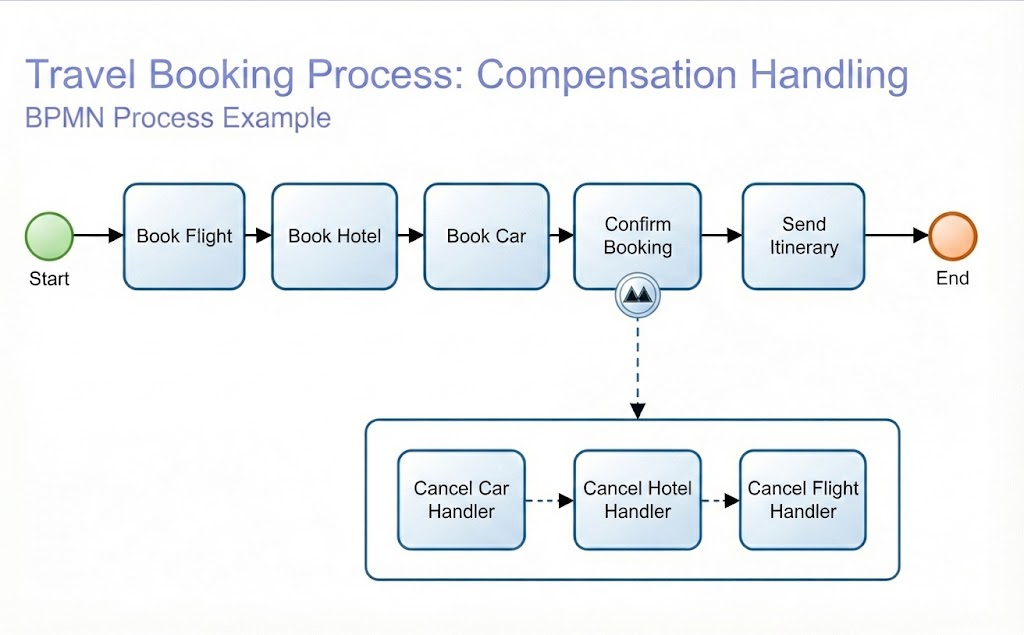
The visual model presented above illustrates a robust solution using a specific BPMN pattern. Let’s break down the flow into two distinct parts: the Success Path and the Compensation Path.
1. The Success Path (Top Row)
The upper sequence represents the happy path where everything goes according to plan. This is a linear workflow:
- Start Event: The process initiates when a customer requests a travel package.
- Book Flight: The system attempts to reserve a flight. This is an “Invoking Service” task.
- Book Hotel: Following the flight, the system reserves accommodation.
- Book Car: The final resource, the rental vehicle, is secured.
- Confirm Booking: At this stage, the system acknowledges that all resources are reserved.
- Send Itinerary: The customer receives their confirmation.
- End Event: The process concludes successfully.
2. The Compensation Boundary (The “Circle with Mountains”)
The critical element in this architecture is the icon located beneath the Confirm Booking task. In BPMN terminology, this is known as a Boundary Compensation Event.
This event acts as a safety net. It is attached to the main process flow. It signals to the workflow engine: “If an error occurs during any of the tasks in this sequence, or if the user explicitly cancels, execute the logic defined inside this boundary.”
The Compensation Logic (Bottom Row)
When a failure occurs (e.g., the user clicks “Cancel” or a system timeout happens), the engine does not simply crash. Instead, it triggers the logic contained within the compensation boundary. Notice the order of operations in the bottom row:
- Cancel Car Handler: The system first cancels the last resource booked (the car).
- Cancel Hotel Handler: Next, it cancels the hotel reservation.
- Cancel Flight Handler: Finally, it cancels the flight.
This is known as a Reverse Sequence or a Stack-Based Rollback. This logic is crucial because it respects dependencies. If you booked a flight, a hotel, and a car, you generally want to cancel the most recent additions first. Furthermore, this logic is often implemented using a callback mechanism or a compensating transaction, where the engine invokes a specific API call to undo the work done by the original “Book” tasks.
Why This Architecture Matters
This pattern transforms a fragile system into a resilient one. By explicitly defining compensation handlers:
- Data Integrity: The system ensures that resources are not left “half-booked.”
- User Experience: The customer is refunded or notified immediately, rather than being stuck in a “pending” state.
- Decoupling: The main flow (booking) remains separate from the failure logic (cancellation), making the code easier to maintain and test.
Whether you are designing a microservices architecture or a legacy mainframe interface, understanding how to model these “undo” operations is a fundamental skill for any technical architect.