


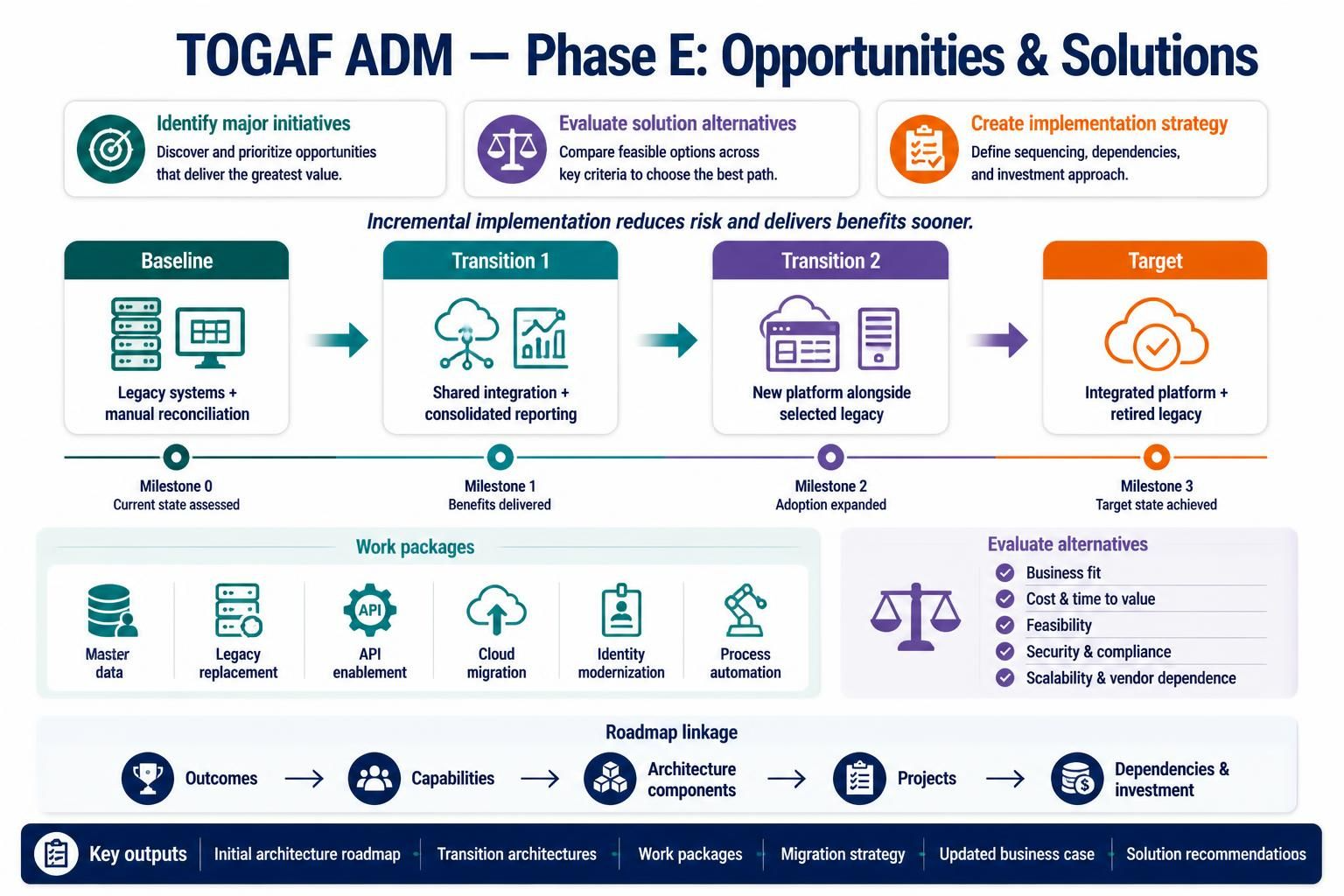
In the realm of Enterprise Architecture, few phases are as critical for translating vision into reality as Phase E: Opportunities and Solutions. This phase acts as the vital bridge between the strategic design of a future state (created in Phase D) and the actual execution of IT projects.
This tutorial breaks down the complex mechanics of Phase E, explaining how architects define work packages, manage risk through transition architectures, and build a roadmap that links business outcomes to technical execution.
Core Objectives of Phase E
The primary mission of this phase is to turn abstract target architectures into concrete candidate implementation approaches. As the reference material highlights, the process focuses on several key objectives:
- Identify Major Implementation Projects: Discovering the specific opportunities that deliver the greatest value.
- Group Related Changes: Organizing disparate changes into logical Work Packages.
- Evaluate Solution Alternatives: Comparing options against criteria like cost, time to value, and feasibility.
- Define Transition Architectures: Creating intermediate states to reduce risk.
- Create an Implementation Strategy: Defining the sequencing and investment approach.
Defining Work Packages
A Work Package is a fundamental concept in this phase. It is defined as a coherent set of changes that can be planned and delivered as a single unit. Instead of viewing an IT overhaul as a massive, unmanageable list of tasks, architects group them into work packages.
Common examples of work packages include:
- Master Data Implementation: Consolidating customer or product data.
- Legacy Application Replacement: Phasing out old systems.
- API Enablement: Exposing data via modern interfaces.
- Cloud Migration: Moving infrastructure to the cloud.
- Process Automation: Implementing robotic process automation (RPA).
Strategic Transition Architectures
One of the most significant insights in Phase E is the concept of Transition Architectures. Most organizations cannot move directly from their current Baseline state to the Target state without risking catastrophic failure. Instead, they must take intermediate steps.
The Transition Journey
Consider a scenario where an organization moves from a fragmented legacy environment to an integrated cloud platform:
- Baseline: The organization operates with separate legacy systems and manually reconciled data. (Milestone 0: Current state assessed).
- Transition 1: A shared integration layer is established, and reporting is consolidated. (Milestone 1: Benefits delivered).
- Transition 2: A new customer platform operates alongside selected legacy systems, reducing the footprint of old tech. (Milestone 2: Adoption expanded).
- Target: The fully integrated platform is live, and legacy components are retired. (Milestone 3: Target state achieved).
This incremental approach reduces risk and ensures that benefits are delivered sooner rather than waiting for a massive “big-bang” release.
Evaluating Solution Alternatives
Before committing to a specific path, architects must evaluate alternative solutions. The infographic identifies several critical criteria for this assessment:
- Business Fit: Does the solution solve the actual business problem?
- Cost & Time to Value: Can we afford it, and will we see a return on investment quickly?
- Feasibility: Do we have the technical skills to build this?
- Security & Compliance: Does it meet regulatory requirements?
- Scalability & Vendor Dependence: Can it grow, and are we locked into a single vendor?
Building the Architecture Roadmap
The final output of Phase E is the Architecture Roadmap. This is not merely a project schedule; it is a strategic linkage that connects high-level business goals to low-level technical details.
The roadmap links the following elements in a logical flow:
- Business Outcomes: The goals we want to achieve.
- Capabilities: The skills or functions required.
- Architecture Components: The specific software or infrastructure needed.
- Projects: The initiatives that build the components.
- Dependencies & Investment: The resources and constraints.
Conclusion
Phase E: Opportunities and Solutions is the turning point where strategy meets execution. By carefully defining work packages, mapping out transition architectures, and rigorously evaluating alternatives, architects ensure that IT investments deliver tangible business value.
For practitioners looking to model these complex relationships effectively, it is recommended to utilize specialized tooling. Specifically, the Visual Paradigm TOGAF ADM Tool is an excellent choice for visualizing these transition architectures and generating the initial architecture roadmap.
Related posts:
 Mastering TOGAF 10: Navigating the Modular Library and Architecture Content
 Mastering Continuous Evolution: A Deep Dive into TOGAF Phase H Architecture Change Management
 Mastering TOGAF Phase D: Building a Strategic Technology Architecture
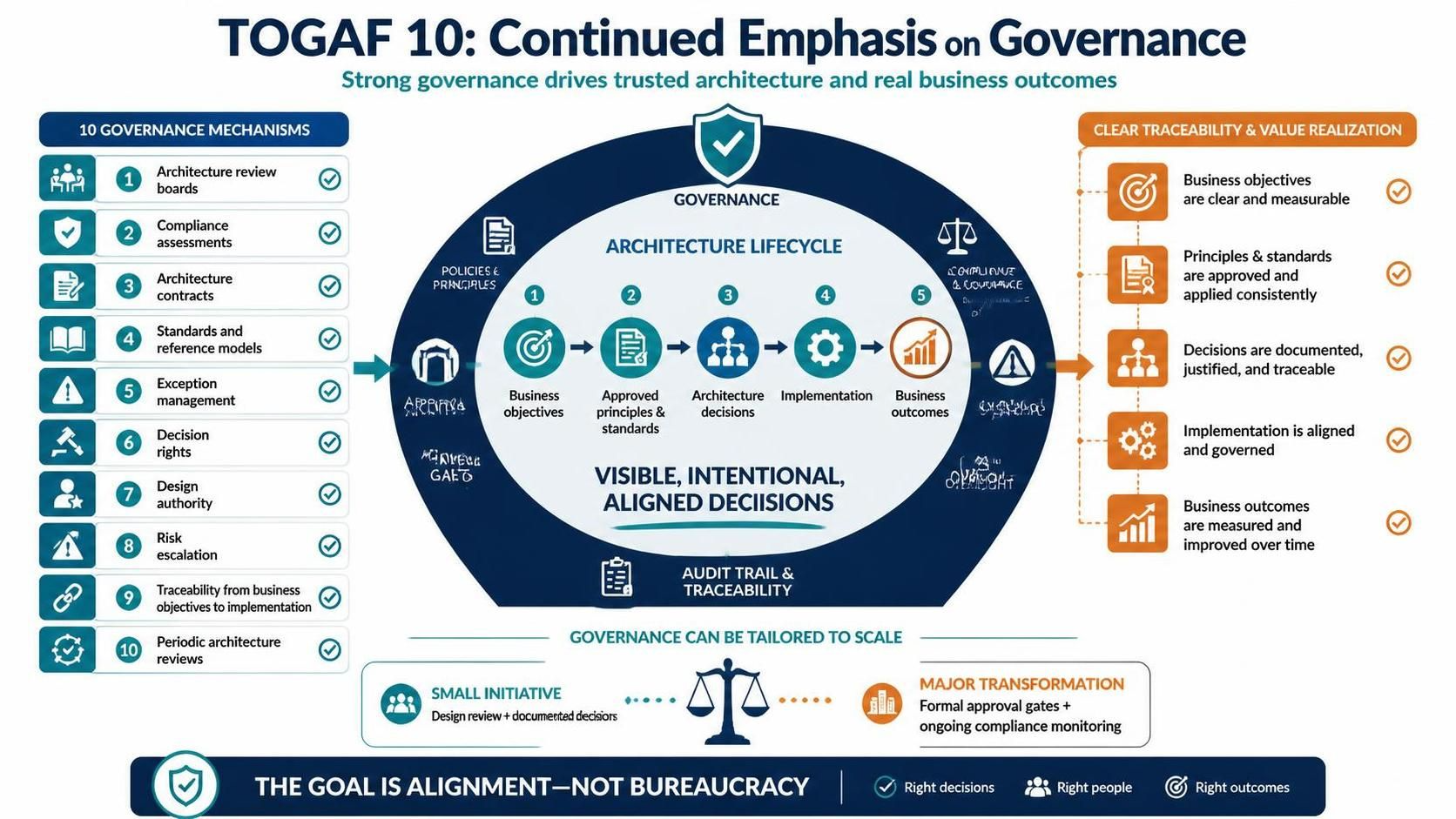 Mastering TOGAF 10: Implementing Scalable Architecture Governance for Business Alignment